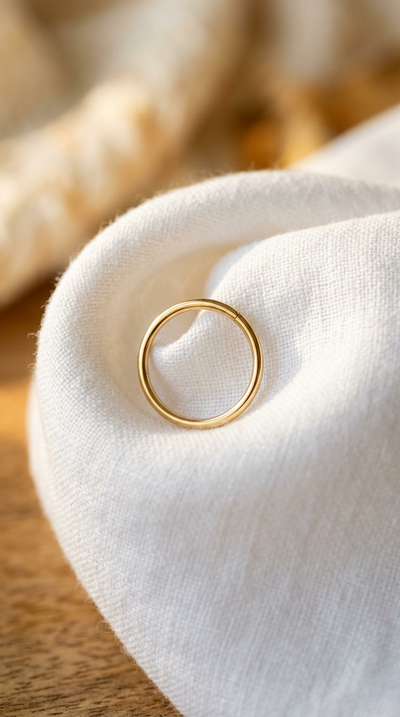
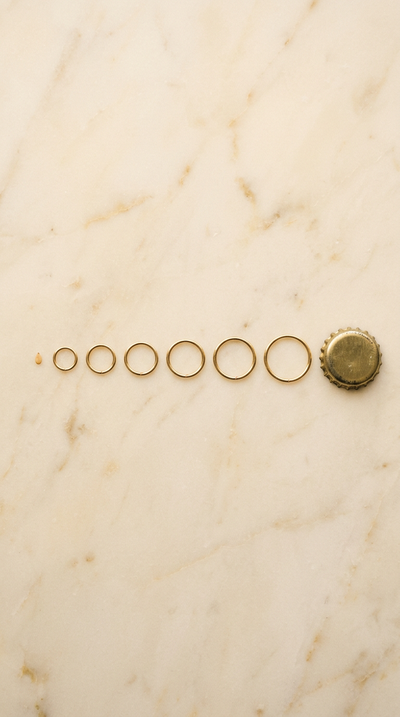
New 14ct Solid Gold Piercing Hoop


Cross 14ct Solid Gold Conch Ring
Cross 14ct Solid Gold Conch Ring


14K Gold vs Titanium vs Surgical Steel: Best Metal for Piercings
- Surgical steel (316L) contains 10–14% nickel and is the leading cause of metal-related piercing reactions in the UK
- Implant-grade titanium (ASTM F136) is completely nickel-free and the most chemically inert option — ideal for people with known metal sensitivities
- 14K solid gold (nickel-free alloy) combines biocompatibility with durability, tarnish resistance and an aesthetic no other piercing metal matches
- Gold-plated, gold-filled and vermeil are not the same as solid gold — the base metal is eventually exposed and causes the same reactions as surgical steel
- For the vast majority of healed piercings, 14K solid gold is the most complete long-term material choice
- Titanium remains the best choice for people healing a fresh piercing or with confirmed severe metal sensitivity
Why material matters so much
A piercing is not a wound that heals and closes. It is a permanent channel through living tissue, maintained open by a piece of metal that sits in direct contact with that tissue 24 hours a day. The material the jewellery is made from has ongoing biological consequences — it is not a one-time event. This is why the material standards for piercing jewellery are different from those for fashion accessories worn on the outside of the skin.
For a ring worn on a finger, a reactive metal causes redness and a green mark. For a ring sitting inside a cartilage channel, the same reactive metal continuously irritates the lining of the piercing, causes chronic low-grade inflammation, and significantly increases the risk of irritation bumps, scarring and slow healing. The stakes are different when the metal is inside the body.
Surgical steel — the most common, not the best
Surgical steel (316L stainless steel) is the most widely used piercing metal in the UK, largely because it is inexpensive. The name "surgical" implies medical safety, and this implication is used heavily in marketing. The reality is more nuanced.
What it is
316L stainless steel is an iron alloy containing chromium (16–18%), nickel (10–14%) and small amounts of molybdenum, manganese and carbon. The chromium forms a passive oxide layer on the surface that resists corrosion — this is why it is called "stainless." The nickel is present throughout the alloy as a structural component.
The nickel problem
Nickel is the most common contact allergen in Europe. An estimated 10–17% of women in the UK are sensitised to nickel, and continued exposure increases sensitisation rates. In EU medical device regulations, nickel release from items that penetrate the skin is limited to 0.5 μg/cm²/week (EN 1811). Surgical steel releases nickel at rates that, depending on the surface finish, can approach or occasionally exceed this threshold in moist environments like the inside of a piercing channel.
In practice, many people wear surgical steel without noticeable reactions. Many others experience chronic mild irritation, unexplained bumps or itching that resolves immediately when they switch metals — without ever knowing nickel was the cause. The dose-response relationship is individual: some people tolerate surgical steel indefinitely, others react within days.
When surgical steel is acceptable
If you have worn surgical steel jewellery for years with no reaction whatsoever, and you are not healing a fresh piercing, the clinical risk is low for you specifically. Surgical steel is also significantly less expensive than gold or titanium, which is a legitimate consideration. Its limitations become most relevant during healing (when the channel lining is most permeable to metal ions) and for people who have already developed nickel sensitivity.
Implant-grade titanium — the most inert option
Implant-grade titanium (ASTM F136, Ti-6Al-4V ELI) is the most chemically inert material used in body piercing. It is the metal used in surgical implants, bone screws, hip replacements and dental implants — applications where the metal must remain in the body indefinitely without adverse biological response.
What makes titanium inert
Titanium forms a stable, passive titanium dioxide (TiO₂) oxide layer on its surface the moment it contacts air. This layer is electrochemically stable — it does not dissolve in body fluids, does not leach ions, and does not interact with skin chemistry. Even if the surface is scratched, the oxide layer reforms immediately. No other common piercing metal has this self-repairing inertness.
Titanium contains no nickel in its implant-grade alloy. The alloy elements (aluminium and vanadium in trace amounts) are stabilised within the titanium structure and are not released at biologically significant levels.
Titanium’s limitations
Titanium is a grey metal. Anodised titanium can produce blue, purple, gold-toned and rainbow colours through an electrochemical process that changes the surface oxide layer thickness — but these are surface treatments, not the same as 14K yellow gold. The warm, rich colour of solid gold is something titanium cannot replicate. For people who want the gold look specifically, titanium is not a visual substitute.
Titanium is also somewhat lighter than gold, which changes how it hangs on the ear. For very fine seamless rings, the lighter weight means less tension at the gap — which is why some piercers prefer heavier gold rings for piercings where ring tension helps keep the gap closed.
When titanium is the best choice
Titanium is the recommended material for initial jewellery during the healing period of any piercing. Its complete inertness minimises the immune response in the healing channel. It is also the clear choice for anyone who has confirmed severe metal sensitivity, even to gold alloys. For healed piercings where the aesthetic of gold is not a priority, titanium performs as well as gold at a lower price point.
14K solid gold — biocompatibility meets longevity
14K gold occupies a specific position in the material hierarchy: it is less inert than titanium but more aesthetically permanent than any other option, and its biocompatibility — when properly alloyed without nickel — makes it safe for lifelong wear inside a healed piercing in a way that surgical steel is not.
What 14K means
14 karat means 14 parts gold out of 24 — 58.3% pure gold by mass. The remaining 41.7% is alloy metals that add hardness, change the colour and adjust the melting point for workability. In yellow gold, the alloy is typically silver and copper. In white gold, palladium (or sometimes nickel — see below). In rose gold, a higher copper ratio creates the characteristic warm pink tone.
The gold itself — the 58.3% pure gold content — is entirely inert. Pure gold does not oxidise, does not tarnish, does not dissolve in body fluids, and does not trigger immune responses. The 24K gold used in leaf gilding and electronics is the same noble metal, just at full purity. At 14K, the gold portion retains all these properties while the alloy metals provide necessary structural strength.
Why the alloy matters
The alloy composition determines whether 14K gold is safe for piercings. Yellow 14K gold alloyed with silver and copper is nickel-free and biocompatible — both alloy metals are well-tolerated by skin. White 14K gold presents a complication: the bright white colour of popular white gold is achieved either with palladium (safe, nickel-free) or with nickel (cheaper but problematic). White gold intended for piercing jewellery must be specifically labelled nickel-free or palladium-alloyed. If the product listing does not confirm nickel-free composition, ask before purchasing.
Why 14K rather than 18K or 24K
Higher karat gold is purer but softer. 24K (pure) gold is too soft for any wearable jewellery — it bends, scratches and deforms under normal use. 18K (75% gold) is acceptable for earrings but noticeably softer than 14K and more prone to bending on thin-wire seamless rings. 14K hits the equilibrium point: hard enough to hold its circular shape under daily stress, pure enough to be biocompatible, and gold-rich enough to maintain its colour and tarnish resistance indefinitely. This is why 14K is the standard in piercing jewellery globally, and why it is the rating used by the Association of Professional Piercers for recommended initial jewellery.
What solid gold does that other metals cannot
It does not change colour. 14K gold looks the same on day one and year twenty. Titanium’s anodised colours can shift over time with exposure to cleaning products and friction. Surgical steel develops a different surface texture with long-term wear. Gold remains gold.
It can be repaired and re-polished. A gold ring that has been scratched can be polished back to a mirror finish by a jeweller. Titanium’s anodised surface cannot be restored once scratched without re-anodising. Surgical steel can be polished but retains a different optical quality from gold.
It has intrinsic value. Gold jewellery retains material value regardless of fashion. A 14K solid gold hoop is worth its gold weight in any market. This is not a piercing consideration per se, but it changes the frame around buying a £50 gold hoop versus a £10 steel one — one is a consumable, the other is an asset.
The look is irreplaceable. The warm, light-catching character of 14K yellow gold is a specific optical property of the metal. It is not achieved by any surface treatment, plating or anodising. For ear piercings — small hoops that catch light at different angles throughout the day — the material the ring is made from determines this visual entirely.
Full comparison table
| Surgical steel (316L) | Implant-grade titanium | 14K solid gold (nickel-free) | |
|---|---|---|---|
| Nickel content | 10–14% | None | None (yellow/rose); check for white gold |
| Biocompatibility | Moderate — nickel release is a risk | Excellent — most inert option | Excellent — when nickel-free alloy |
| Tarnish | Does not tarnish (stainless) | Does not tarnish | Does not tarnish |
| Colour permanence | Stays silver — surface texture changes | Anodised colours can fade over time | Permanent — same colour lifelong |
| Durability | Very hard — scratch resistant | Hard — very scratch resistant | Good — some scratching over years |
| Weight | Medium | Very light | Medium-heavy (adds nice hang) |
| Aesthetic | Cold silver tone | Grey or anodised colour | Warm yellow, white or rose gold |
| Repairable | Limited | Surface treatments are not restorable | Yes — polish, resize, re-work |
| Intrinsic value | None | None | Yes — gold spot value |
| EU compliance | Borderline — nickel release can approach limits | Fully compliant | Fully compliant (nickel-free alloy) |
| UK price per hoop | £5–£20 | £15–£50 | £30–£120 |
| Best for | Budget; tolerated by most non-sensitive ears | Fresh piercings; confirmed nickel allergy; budget-conscious | Healed piercings; long-term daily wear; aesthetics OUR CHOICE |
The right material for each situation
Healing a new piercing
During healing, the channel lining is an open wound. Metal ion permeability is highest during this period. For this reason, implant-grade titanium is the safest initial jewellery — its complete inertness means zero chemical contribution to the healing response. 14K gold is also acceptable for initial jewellery in experienced piercers who use it routinely. Surgical steel, while commonly used for initial jewellery, carries the nickel risk at the worst possible time.
Fully healed piercings, everyday wear
Once a piercing is fully healed, the channel lining is mature skin that is less permeable to metal ions than a healing wound. For the day-to-day daily earring in a healed piercing, 14K solid gold performs best across all the criteria that matter for long-term wear: biocompatibility, colour permanence, durability and aesthetics. The cost difference over years of daily wear becomes negligible compared to the accumulated cost and inconvenience of replacing reacting or deteriorating cheaper jewellery.
People with confirmed metal sensitivity
If you have a confirmed nickel allergy (patch-tested by a dermatologist), titanium is the safest option because it eliminates all metal ion leaching. Yellow 14K gold alloyed without nickel is also appropriate — the gold and copper/silver alloy does not trigger nickel contact dermatitis. White gold requires specific confirmation of nickel-free alloy before use.
Cartilage piercings specifically
Cartilage is slower to heal and more reactive to metal than lobe tissue. The avascular nature of cartilage means metal ion accumulation is less efficiently cleared. For this reason, cartilage piercings benefit more than lobes from the best possible material. The difference between surgical steel and 14K gold matters more in a helix, rook or tragus than it does in a well-healed lobe with thick, robust soft tissue. See our cartilage bump guide for the role reactive metal plays in cartilage complications.
What about gold-plated, filled and vermeil?
These are frequently marketed as alternatives to solid gold. They are not equivalent, and for piercing jewellery specifically, they carry the same risks as the base metal they are made from:
Gold-plated: A base metal (usually brass or copper) with a 0.5–2 micron gold surface coating. The plating wears through with daily wear, showering and body fluid contact — typically within 3–12 months. Once through, the brass or copper base is in direct contact with the piercing channel.
Gold-filled: A thicker gold layer (minimum 5% by weight) bonded to a brass core. Lasts 2–5 years of daily wear before the base metal begins to show through at points of stress and contact. Better than plated but still a finite life before base metal exposure.
Gold vermeil: Sterling silver (92.5% silver, 7.5% copper) base with a minimum 2.5 micron gold plating. When the plating wears through, the silver tarnishes inside the piercing channel. Silver sulphide deposits in the channel act as a persistent irritant.
For piercing jewellery intended for extended wear inside the body, the distinction between solid gold and surface-treated alternatives is clinically meaningful. The base metal that is eventually exposed behaves exactly like bare base-metal jewellery. See our sensitive ears guide for the full explanation of why this matters.