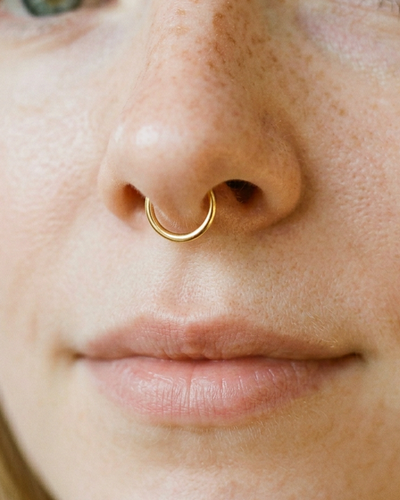
What Size Nose Hoop Should I Buy? A UK Guide to Choosing the Right Size

- 8mm is the most popular nose hoop size in the UK — it fits standard nostril placements and suits most nose shapes
- Your piercing placement determines your size, not the size of your nose. Measure from piercing hole to nostril edge
- 20G (0.8mm) is the most common gauge for nostril piercings in the UK. 22G is also available for a finer, more delicate look
- Inner diameter is the measurement that matters. UK jewellery listings should state inner diameter, not outer
- 14K solid gold and implant-grade titanium are among the materials listed by the APP as suitable for body piercings
Which diameter fits your nostril?
The right diameter depends on one thing: how far your piercing hole is from the bottom edge of your nostril. That distance is your minimum inner diameter. A lower piercing needs a smaller hoop; a higher piercing needs a larger one. The size of your nose does not determine your hoop size — placement does.
Best size by placement
| Your placement | Distance to edge | Best diameter | Look |
|---|---|---|---|
| Low — near nostril edge | ~5–6mm | 6–7mm | Very snug hugger, minimal gap |
| Standard — below crease Most common | ~7mm | 8mm | Classic nose ring — visible but not oversized |
| Higher — closer to bridge | ~8–9mm | 9–10mm | Relaxed loop, more gap, statement look |
Full diameter comparison
| Diameter | Look | Best for | Choose this if… |
|---|---|---|---|
| 6mm | Very tight hugger | Very low placement, small nostril | Your piercing is right at the nostril edge and you want barely any gap |
| 7mm | Snug, close fit | Low placement, subtle look | You want a fitted hoop that hugs the nostril closely without pressing into the skin |
| 8mm Most popular | Classic nose ring | Standard placement, most nose shapes | You want the most reliable starting point — visible but not oversized |
| 9mm | Relaxed, visible loop | Higher placement, wider nostrils | Your piercing is higher or you prefer more breathing room |
| 10mm | Bold statement hoop | High placement, wider nostrils, aesthetic choice | You want a dramatic look or your piercing is positioned high |
Which gauge should you choose?
Gauge is the thickness of the wire, not the size of the hoop. It is a separate measurement from diameter. In the UK, many nostril piercings are done at 20G (0.8mm). If you do not know your gauge, check your current jewellery or ask your piercer.
| Gauge | Thickness | Notes |
|---|---|---|
| 20G Most common in UK | 0.8mm | A popular gauge among UK piercers. A good balance of delicacy and durability for everyday wear |
| 22G | 0.6mm | Finest option. Beautiful, barely-there wire. Pair with a comfortable (not too tight) diameter to avoid the cheese wire effect |
How to measure your nose hoop size
You can measure at home in under a minute. All you need is a small piece of paper or card and a ruler with millimetre markings.
Position the paper
Hold a small strip of paper against the bottom edge of your nostril, on the outside of your nose.
Thread it through
Gently push the paper up and through your piercing hole from the outside. Let it poke out through the hole.
Mark the exit point
Mark the paper where it exits the piercing hole. This is the distance the hoop needs to travel around your nostril.
Measure and add 1mm
Flatten the paper and measure the marked distance in millimetres. Add 1mm for comfortable clearance. That number is your ideal inner diameter.
Why 14K solid gold for your nose hoop?
Material matters as much as size. The inside of your nostril is a moist environment where low-quality metals corrode, tarnish, and cause reactions. The Association of Professional Piercers (APP) lists several material categories as suitable for body piercings, including solid gold (14K minimum) and implant-grade titanium (ASTM F136).
| Material | Gold content | Nickel risk | Durability | Verdict |
|---|---|---|---|---|
| 14K solid gold Recommended | 58.3% pure gold | Very low (nickel-free alloy available) | Lifetime — solid all the way through | Suitable for everyday wear, sensitive skin, long-term use |
| Implant-grade titanium | N/A | None | Excellent — medical-grade | Great alternative if you prefer a lighter weight |
| 9K gold | 37.5% pure gold | Low, but higher alloy ratio | Good | Common in UK traditional jewellery, but 14K preferred for body piercings |
| Gold-filled | 5% gold layer over brass | Possible if layer wears through | Moderate — layer can erode | Better than plated, but not solid. May degrade in the nose |
| Gold-plated Avoid | Thin coating (<1%) | High — base metal exposed within weeks | Poor — flakes and peels | Not safe for body piercings. Plating exposes reactive base metals |
| Surgical steel Avoid | N/A | High — typically contains 10–14% nickel | Good | May cause irritation in nickel-sensitive wearers (estimated 8–19% of population). Not listed by the APP |
Shop by size
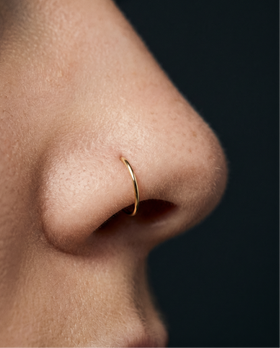
Know your size? Go straight to the right hoop. Available in 6mm to 10mm, in 20G and 22G, in solid 14K yellow gold.
Frequently asked questions
- Association of Professional Piercers (APP) — Jewelry for Initial Piercings — material and quality standards for body jewellery, including 14K solid gold minimum and implant-grade titanium (ASTM F136)
- Thyssen JP et al., “The epidemiology of contact allergy in the general population — prevalence and main findings,” Contact Dermatitis, 2007 — nickel allergy prevalence in European populations (8–19%)
- UK Nickel Regulations (SI 2005/2831) — UK legal limits on nickel release in jewellery intended for prolonged skin contact
- Stepoy internal fitting guidance — based on customer enquiries and common sizing patterns for healed nostril piercings in the UK, with 8mm 20G as the most frequently chosen combination