Nostril Piercing: Your Complete Guide to Pain, Healing, Jewellery & Gold Nose Rings

- A nostril is not “just cartilage” — it is a complex layered structure of cartilage, fatty tissue, connective membranes, and small muscles. This complexity is why nostril piercings can be trickier to heal than ear cartilage piercings
- Placement determines your future hoop size. If you want a snug hoop later, discuss this with your piercer before they mark the spot. A higher placement = a larger hoop diameter needed
- Start with a flat-back labret stud and wait at least 3–6 months before switching to a hoop. Switching too early is the number-one cause of nostril piercing bumps
- 20G is the UK standard. 18G is slightly thicker and more stable. 22G is the finest option — beautiful for a delicate look, but requires correct diameter to avoid excess pressure on the tissue
- 14K solid gold or implant-grade titanium — the only materials recommended by the APP for nostril piercings. Surgical steel contains 10–14% nickel
What is a nostril piercing?
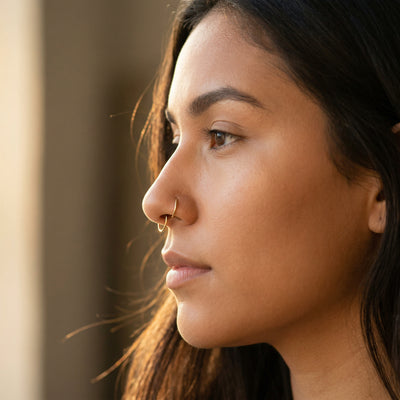
A nostril piercing passes through the wing (ala) of the nose, entering from the outside and exiting into the nasal passage. It has been part of human adornment for over 4,000 years, with origins in Middle Eastern and South Asian cultures. Today it is one of the most common piercings in the UK — subtle enough for most workplaces, expressive enough to make a statement with the right jewellery.
What most guides get wrong is calling the nostril “just cartilage, like your ear.” It is not. The nostril is a far more complex anatomical structure than ear cartilage. It is composed of multiple layers: cartilage, fatty tissue, connective membranes, and small muscles that allow independent movement. Your nostrils move every time you smile, laugh, speak, flare, sneeze, or blow your nose. This constant micro-movement is why nostril piercings can be more challenging to heal than ear cartilage — and why the jewellery style, material, and fit matter enormously.
Nose shapes and nostril anatomy vary dramatically between people — narrow, wide, upturned, downturned, deviated, thick-walled, thin-walled. Almost everyone can support a nostril piercing, but the ideal placement, angle, and initial jewellery will differ based on your unique anatomy.
Placement — the decision that affects everything
Placement is the single most consequential decision in a nostril piercing, yet most guides barely mention it. Where the needle goes determines how your jewellery sits, what hoop size you can wear, and how the piercing looks on your face for years to come.

The nostril crease
Flare your nostrils in a mirror — the line that forms is your nostril crease. This crease marks the thinnest part of the cartilage and is the traditional location for a nostril piercing. Most piercers place the piercing just below the crease rather than directly in it, because jewellery sits more comfortably and heals better when it is not in the fold itself (the crease collects oils and moves the most during facial expressions).
Placement height determines hoop size
This is the point most people miss. The distance from your piercing hole to the bottom edge of your nostril is the minimum diameter of hoop you can wear. A higher placement = a longer distance = a larger hoop. If you know you want a snug, small hoop (6–7mm), your piercing needs to be low, near the nostril edge. If your piercing is placed higher (closer to the bridge), you will need a 9–10mm hoop to reach the nostril edge.
Tell your piercer your jewellery goals before they mark the spot. If you say “I want a small, snug gold hoop eventually,” they can place the piercing to accommodate that. If you do not mention it, they will place for what looks best with a stud — which may not work well with a hoop later.
Jewellery types for nostril piercings
Understanding the different jewellery styles is essential because each serves a different purpose at different stages of your piercing. Here is every common nostril jewellery type, with honest pros and cons:
| Style | Best for | Pros | Cons |
|---|---|---|---|
| Flat-back labret stud Best for healing | Initial piercing & healing period | Flat disc sits flush inside nostril — no booger buildup on the back. Does not move or rotate. Most stable for healing. Easiest to sleep with. | Requires piercer tools to change. Cannot insert yourself without practice. |
| L-shape stud | Healed piercings, daily wear | Easy to insert and remove yourself. Sits relatively flat. Good for jewellery changes. | Can slide out during sleep. The bend can poke inside the nostril. Collects more buildup than flat-back. |
| Nostril screw / corkscrew | Healed piercings, secure daily wear | More secure than L-shape — the spiral holds it in place. Traditional style in many cultures. | Harder to insert and remove — must be custom-bent to fit your nostril. The spiral can feel like a “booger” sensation inside the nose. |
| Bone stud | Healed piercings only | Simplest design — straight post with a small ball on the end. Low profile. | The ball must be pushed through the piercing hole to insert/remove, causing friction. Falls out easily during sleep. Not recommended for fresh piercings. |
| Seamless hoop Most popular upgrade | Fully healed piercings (3–6+ months) | Clean, minimal circle of gold. No hardware visible. Comfortable once in place — smooth interior, nothing catches. | Must wait for full healing. Requires correct diameter matched to your placement. More movement in the piercing than a stud. |
How much does a nostril piercing hurt?
3–4 out of 10 — on the lower end of the pain scale for piercings. The nostril cartilage is relatively thin, and the piercing itself takes 1–2 seconds. Most people describe it as a sharp pinch, then immediately… your eyes water.
Why your eyes water: This is not a pain response — it is a reflex. The trigeminal nerve runs through your nasal area and connects to your tear ducts. When the needle passes through, the nerve fires, and your eyes water automatically. Some people also sneeze. Both are completely normal and stop within a minute.
What to expect afterwards: A dull, throbbing ache for 1–3 hours. Tenderness when the piercing is touched or bumped for 1–2 weeks. A “stuffy nose” feeling on the pierced side for the first few days. After the first week, most people report only noticing the piercing when they accidentally bump it.
| Piercing | Pain |
|---|---|
| Earlobe | 2–3/10 |
| Nostril This piercing | 3–4/10 |
| Septum (sweet spot) | 3–4/10 |
| Helix | 4–5/10 |
| Tragus / Conch / Daith | 5–6/10 |
| Rook | 6–7/10 |
Healing timeline
Nostril piercings take 3–6 months to heal, sometimes longer. Like all piercings, they heal from the outside in — the surface closes long before the internal channel matures. Never judge healing by how the outside looks.
| Phase | Timeline | What to expect | What to do |
|---|---|---|---|
| Inflammatory | Day 1–3 | Tender, swollen, may bleed slightly. Eyes watering and sneezing on day 1 (trigeminal reflex). Nose may feel congested on the pierced side. | Saline spray 2x daily (outside and inside nostril). Do not touch. Be extremely careful with towels after showering — pat, do not rub. |
| Early healing | Week 1–4 | Swelling subsides. Crusty buildup around jewellery (dried lymph fluid — normal, not infection). Nose may still feel stuffy. | Continue saline. Do not pick crusties — let warm water in the shower soften them. Downsize appointment at week 4–6 if your piercer recommends it. |
| Intermediate | Month 1–3 | Looks much better externally. Internal channel forming but fragile. Irritation bumps may appear if jewellery is bumped, slept on, or caught by towels/masks/glasses. | Do not change jewellery yet. Reduce saline to 1x daily. Avoid sleeping on pierced side. Blow nose very gently on the unpierced side only. |
| Full healing | Month 3–6 | Most piercings healed enough for jewellery change at 3–4 months. Some need 6 months. Channel feels solid and settled. | Visit your piercer to confirm healing before switching to a hoop. First jewellery change should ideally be done by your piercer. |
Nostril piercing bumps — causes and solutions
Approximately 25% of nostril piercings develop a bump at some point during healing. The vast majority are harmless irritation bumps that resolve within weeks once the cause is addressed. Understanding the three types of bumps helps you respond correctly:

| Type | Appearance | Cause | Solution |
|---|---|---|---|
| Irritation bump | Small, soft, red or skin-coloured. Appears within weeks. Stays at the piercing site. | Friction (towels, masks, glasses, sleeping on it), touching, low-quality metal (nickel in surgical steel), jewellery that is too long/short/tight. | Remove the irritant: upgrade to 14K gold or titanium, stop touching, stop sleeping on it, downsize post if too long. Resolves in 2–4 weeks. |
| Hypertrophic scar | Firm, raised, red. Larger than an irritation bump but stays within the wound boundary. | Repeated trauma, slow healing. More common with nostril piercings than ear piercings due to the constant movement of the nose. | Same approach as irritation bump. May take weeks to months to flatten. Silicone scar sheets can help. |
| Keloid Rare | Firm, shiny, grows beyond the original wound. Continues growing. Itchy or painful. | Genetic predisposition. Not caused by aftercare mistakes. | Requires medical treatment (corticosteroid injections, cryotherapy). Changing jewellery will not help. See a dermatologist. |
The quick test: Fix the likely cause (switch to 14K gold or titanium, stop sleeping on it, stop touching, downsize if post is too long). If the bump shrinks within 2–4 weeks, it was an irritation bump. If it continues growing despite perfect care, see your piercer, then a dermatologist.
Size guide: gauge & diameter for gold nose rings
Gauge (wire thickness)
| Gauge | Thickness | Best for | Notes |
|---|---|---|---|
| 18G | 1.0mm | Initial piercing (US standard); sturdy hoops | Most stable option. Professional piercers often use 18G to prevent cheese wire effect long-term |
| 20G UK Standard | 0.8mm | Most nostril piercings in the UK | The standard gauge used by UK piercers. Excellent balance of delicacy and stability |
| 22G | 0.6mm | Delicate, dainty look | Beautiful fine wire. Choose a diameter that fits comfortably without being too tight — a snug-but-not-compressing fit is ideal |

Diameter (ring size)
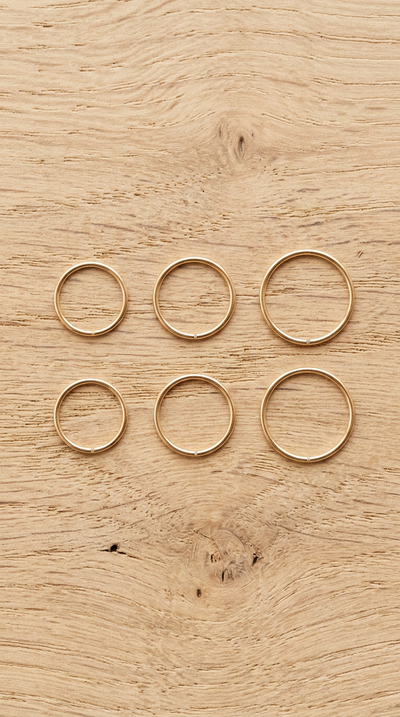
Your ideal diameter depends on where your piercing sits on your nostril — not on the size of your nose:

| Diameter | Look | Best for |
|---|---|---|
| 6–7mm | Snug hugger, sits very close to nostril | Low placement near nostril edge. Subtle, minimal look. |
| 8mm Most Popular | Classic nose ring — visible but not oversized | Standard placement below the crease. The most universally flattering size. |
| 9–10mm | Relaxed loop, more visible gap | Higher placement or larger nostrils. Bohemian, statement look. |
| 11–12mm | Bold, dramatic hoop | High placement, thick nostrils, or intentional oversized aesthetic. |
How to measure: Hold a small piece of paper at the bottom edge of your nostril. Thread it up and through your piercing hole. Mark where it exits. Flatten and measure — that distance is your minimum inner diameter. Add 1mm for comfortable clearance.
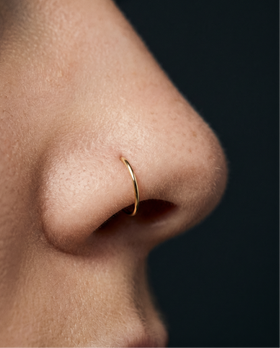
Gold colour options
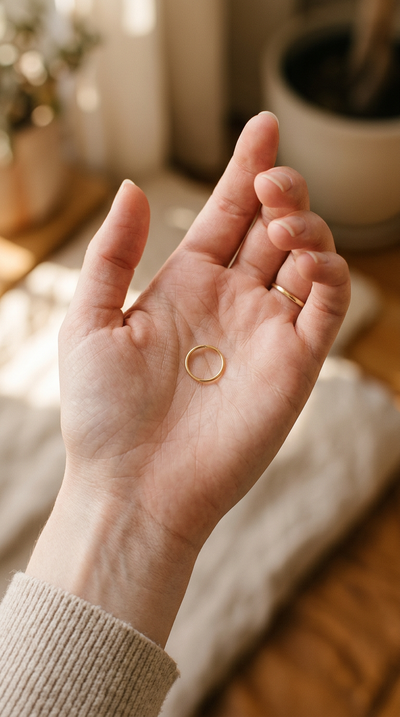
14K solid gold nose rings are available in yellow gold and rose gold. Both contain the same 58.3% pure gold — the difference is in the alloy metals:

Yellow Gold
- Traditional warm gold tone
- Alloyed with silver and copper
- Complements warm, olive, and medium skin tones
- The most popular choice for nose rings
Rose Gold
- Warm pinkish-gold hue
- Higher copper ratio in the alloy
- Flatters fair, cool, and neutral skin tones
- Trendy, feminine, soft aesthetic
Switching from stud to hoop
This is the question every nostril piercing owner eventually asks: “When can I finally switch to a hoop?” Here is the full answer:
When is it safe?
Minimum 3 months, ideally 4–6 months. Your piercer must confirm healing before you switch. The outside of the piercing will look healed long before the internal channel is ready. Switching to a hoop too early introduces movement into a fragile channel, causing irritation bumps and healing setbacks that can take months to resolve.
Your first hoop change: let your piercer do it
A seamless hoop must be twisted open and threaded through the piercing at the correct angle. Your piercer has insertion tapers and ring-opening pliers that make this quick and painless. They can also confirm your gauge and measure your exact inner diameter while they are at it — ensuring you order the right size in the future.
What to expect after the switch
Some minor tenderness for 1–2 days is normal after any jewellery change, even in a healed piercing. The tissue needs to adjust to the new shape (straight post to curved hoop). If you develop a bump within the first week after switching, it is almost always because the piercing was not quite ready. See your piercer — you may need to go back to a stud for another month or two.
Aftercare
Correct aftercare
- Spray with sterile saline (0.9% NaCl) 2x daily — tilt head to spray inside the nostril too
- Let warm shower water run over it to loosen crusties
- Pat face dry with clean tissue — never rub a towel across your nose
- Sleep on the opposite side
- Blow nose very gently, on the unpierced side only, for the first 2–3 weeks
- Keep hair tied back and away from the jewellery
- Remove glasses carefully — lift up and over, do not slide down the nose
Common mistakes
- Touch, twist, rotate, or pick at the jewellery or crusties
- Use TCP, Dettol, hydrogen peroxide, alcohol, or tea tree oil
- Apply makeup, foundation, or skincare over the piercing area
- Rub face with a towel (the number-one day-one accident)
- Sleep on the pierced side
- Submerge in pools, baths, or natural water for at least 3 months
- Change jewellery before your piercer confirms healing
- Use face-cleaning sponges or cloths near the piercing
Glasses wearers: special considerations
Glasses slide down the nose during the day and frequently catch on nostril jewellery. This is one of the most common sources of irritation bumps that people do not recognise. Solutions: Tell your piercer you wear glasses so they can optimise placement. Choose frames with adjustable nose pads (they stay higher and are less likely to slide onto the piercing). Lift glasses up and over when removing — never pull down the nose. Get your piercing downsized promptly so the post does not protrude.
Cold, flu, and allergy season
A runny nose and a healing piercing are an uncomfortable combination. Blow gently — light pressure, unpierced side first. Keep the inside of the nostril clean with saline spray, which also helps with congestion. Use soft tissues rather than rough paper towels. If you are sneezing frequently (allergies), the repeated nasal movement can irritate the piercing — take antihistamines to reduce sneezing if possible, and spray saline more frequently to keep the area clean.
Nostril vs septum: comparison
| Nostril | Septum | |
|---|---|---|
| Location | Through the nostril wing (outside) | Through the membrane between nostrils (columella/sweet spot) |
| Pain | 3–4/10 | 3–4/10 (if pierced through the sweet spot) |
| Healing | 3–6 months | 6–8 weeks (one of the fastest) |
| Visibility | Always visible | Can be flipped up inside the nose to hide |
| Jewellery | Hoop, L-stud, corkscrew, bone stud | Seamless hoop, clicker, horseshoe |
| Work-friendly | Very — small stud is discreet | Yes — can flip up to hide completely |
| Closing speed | Starts closing within hours if healing | Can stay open longer due to membrane tissue |