Tragus Piercing: Complete Guide to Pain, Healing, Earbuds & Gold Rings

- The tragus is thick cartilage directly in front of your ear canal. Pain is 5–6/10 — you will hear a “crunch” sound as the needle passes through. Intense but over in seconds
- No earbuds for at least 3–6 months. Earbuds press directly on the healing piercing and introduce bacteria from the ear canal. Over-ear headphones or bone conduction headphones are safe alternatives
- Not everyone’s tragus can support a piercing. The flap must be thick enough, prominent enough, and angled correctly. A good piercer will assess and tell you honestly
- Once healed, a 6mm hoop is the most earbud-compatible size — it sits close to the tragus without protruding into the ear canal space where earbuds rest
- Earwax is a unique tragus concern. The piercing sits at the ear canal entrance where earwax accumulates — keep both the piercing and the ear canal clean
What is a tragus piercing?
The tragus is the small, pointed flap of cartilage that partially covers the opening of your ear canal. When you push it inward with your finger to block sound, that is your tragus. A tragus piercing passes horizontally through this flap, entering from the outside and exiting on the inner side facing the ear canal.
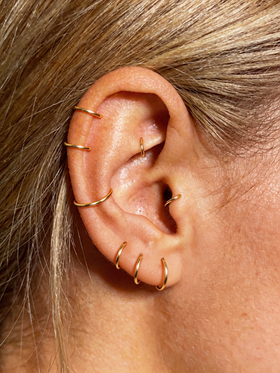
The tragus is one of the most visible ear piercings because of its front-facing position — directly in the line of sight when someone looks at you from the side. Despite its small size, it makes a significant style impact. A tiny gold hoop or a discreet flat-back stud on the tragus adds a refined, intentional detail to any ear stack.
But the tragus is also one of the most lifestyle-dependent piercings. It sits exactly where earbuds rest, where your phone presses during calls, and at the entrance to your ear canal where earwax accumulates. These three factors — earbuds, phone pressure, and earwax proximity — create a unique set of challenges that no other ear piercing shares. If you use earbuds daily for work, commuting, or exercise, you need to plan for a 3–6 month break from them on the pierced side.

Anatomy: can your tragus support a piercing?
Tragus anatomy varies enormously between people. Not everyone can get this piercing. Your piercer will assess three things:
Size: The tragus flap must be large enough to accommodate jewellery with stable tissue on both sides of the piercing. Very small or narrow tragi may not have enough surface area.
Thickness: The cartilage must be thick enough to hold jewellery securely. A very thin, paper-like tragus can tear or reject the jewellery during healing.
Angle: Some tragi angle forward toward the face or inward toward the ear canal, which can cause jewellery to sit awkwardly or put uneven pressure on the channel. Your piercer will assess whether the angle allows for a clean, comfortable placement.
Tragus piercing types & variations
| Type | Description | Pain | Rejection risk |
|---|---|---|---|
| Standard tragus This guide | Horizontal piercing through the tragus cartilage flap. The classic, most common type. | 5–6/10 | Low |
| Anti-tragus | Through the small cartilage ridge opposite the tragus, just above the earlobe. Similar aesthetic, different anatomy. | 6–7/10 | Moderate |
| Vertical tragus | Enters the top of the tragus and exits the bottom — a vertical orientation rather than horizontal. Creates a different visual with two visible ends. | 5–6/10 | Moderate to high |
| Surface tragus High rejection | A surface piercing near (but not through) the tragus cartilage. Sits on the skin beside the tragus rather than passing through it. | 3–4/10 | High — surface piercings are prone to migration and rejection |
How much does a tragus piercing hurt?
5–6 out of 10. The tragus is moderately painful — the cartilage is surprisingly thick for such a small area. But the unique aspect of tragus pain is not the sensation itself; it is the sound.
The crunch: Because the tragus sits directly in front of your ear canal, you hear the needle passing through the cartilage as a crunching or popping sound, amplified by the proximity to your eardrum. Most people find the sound more alarming than the actual pain. It is the sound of cartilage fibres separating — completely normal, but psychologically unsettling if you are not expecting it.
What helps: A good piercer will talk to you throughout the process specifically to distract you from the sound. Some people find it helpful to listen to music through the other ear. The actual needle pass takes 1–2 seconds. After that: a dull ache for a few hours, tenderness for 1–2 weeks, then nothing unless bumped.
| Piercing | Pain |
|---|---|
| Earlobe | 2–3/10 |
| Nostril / Septum | 3–4/10 |
| Helix | 4–5/10 |
| Tragus This piercing | 5–6/10 |
| Conch / Daith | 5–6/10 |
| Rook | 6–7/10 |
Healing timeline
3–6 months for initial healing. The tragus heals moderately fast for a cartilage piercing because the cartilage flap is relatively thin compared to locations like the rook or conch. Full maturation of the internal channel takes 6–12 months.
| Phase | Timeline | What to expect | What to do |
|---|---|---|---|
| Inflammatory | Week 1–2 | Swelling, redness, throbbing. The tragus may feel warm and puffy. Hearing may feel slightly muffled on that side (swelling near ear canal). | Saline spray 2x daily. No earbuds. No phone on that ear. Do not touch. |
| Swelling subsides | Week 3–6 | Swelling reduces. Crusty discharge around jewellery (dried lymph — normal). Still tender if bumped. | Continue saline. Downsize appointment at week 4–6: swap long initial post (8mm) for shorter one (6mm). Still no earbuds. |
| Intermediate | Month 2–4 | Looks healed externally. Internal channel forming but fragile. Irritation bumps if bumped, slept on, or if earbuds used too early. | Do not change jewellery. Reduce saline to 1x daily. Continue avoiding earbuds on that side. |
| Healed | Month 3–6 | Most tragus piercings healed enough for jewellery change at 3–4 months. Channel feels solid. | Visit piercer to confirm healing. First jewellery change by your piercer, not yourself. Carefully reintroduce earbuds. |
Earbuds, headphones & phone calls — the tragus lifestyle guide
This is the section that matters most for daily life. The tragus sits exactly where modern technology wants to be — earbuds, AirPods, phone screens. Managing these three pressure sources is the difference between a smooth healing experience and months of irritation bumps.

Earbuds (AirPods, in-ear)
During healing (0–6 months): absolutely not on the pierced side. Earbuds press directly against the tragus and introduce bacteria from the ear canal and your hands into a healing wound. Even if it “feels fine for 10 minutes,” the repeated friction keeps the piercing swollen and prevents the channel from forming properly.
After healing (6+ months): Most people can reintroduce earbuds once fully healed. Compatibility depends on your jewellery choice:
6mm hoop: Sits very close to the tragus surface — most compatible with earbuds. Minimal protrusion into the ear canal space.
7mm hoop: The classic tragus look. May require a slight angle adjustment when inserting earbuds, but most people manage fine.
8mm hoop: May physically interfere with earbuds depending on your ear anatomy. Test before committing.
Flat-back labret stud: The most earbud-compatible option long-term — the flat disc sits flush and does not protrude. If earbuds are non-negotiable in your daily life, consider keeping a flat-back stud rather than switching to a hoop.
Over-ear headphones
Generally safe at all stages, as long as the ear cup does not press inward onto the tragus. Large, well-padded over-ear headphones that cup around the ear (rather than pressing the ear flat) are ideal. On-ear headphones that sit directly on the ear are not safe during healing.
Bone conduction headphones
The perfect tragus-friendly alternative. Bone conduction headphones sit on your cheekbones and transmit sound through vibration — they never touch the ear at all. If you need audio for work, exercise, or commuting during the healing period, bone conduction headphones are the solution.
Phone calls
Do not press your phone against a healing tragus. The phone screen applies direct pressure to the jewellery and transfers bacteria from the screen surface into the piercing. Solutions: use the other ear for calls, use speakerphone, or use wireless earbuds in the non-pierced ear. If you take many phone calls throughout the day (e.g. for work), consider which ear you naturally hold your phone to before choosing which side to pierce.
Jewellery types for tragus piercings
| Style | Best for | Earbud-friendly? | Notes |
|---|---|---|---|
| Flat-back labret stud Best for healing | Initial piercing & healing. Also the best long-term option if earbuds are essential. | Yes — most compatible | Flat disc sits flush behind tragus. No protrusion. Threadless tops can be swapped for different looks without removing the post. |
| Seamless hoop (6mm) | Healed piercings. Discreet, close-fitting. | Yes — minimal protrusion | Sits very close to tragus surface. Smallest, most subtle hoop look. |
| Seamless hoop (7mm) Most popular | Healed piercings. Classic tragus hoop. | Usually — slight angle adjustment | The most popular tragus hoop size. Visible but not oversized. |
| Seamless hoop (8mm) | Healed piercings. Larger tragus flaps. | Sometimes — may interfere | More visible, slightly more dramatic. May catch on earbuds depending on anatomy. |
Size guide: gauge & diameter
Gauge
Tragus piercings are typically done at 18G (1.0mm) or 20G (0.8mm). 18G is the more common choice at professional studios because the slightly thicker wire provides more stability in the dense tragus cartilage. 20G gives a finer, more delicate look. Both are comfortable for daily wear.
Diameter (hoop size)

| Diameter | Look | Best for | Earbud impact |
|---|---|---|---|
| 6mm | Snug, sits very close to tragus | Discreet, earbud-users | Minimal — most compatible |
| 7mm Most Popular | Classic tragus hoop — visible but not oversized | Most face shapes and ear anatomies | Usually fine with slight angle adjustment |
| 8mm | Slightly larger, more visible | Bigger tragus flaps, statement look | May interfere — test with your earbuds |
Gold colour options

Yellow Gold
- Traditional warm gold tone — the most popular tragus choice
- Complements warm, olive, and medium skin tones
- A tiny circle of warm gold on the tragus is one of the most refined ear details
Rose Gold
- Warm pinkish-gold hue — softer, more feminine
- Flatters fair, cool, and neutral skin tones
- Pairs beautifully with rose gold hoops elsewhere in the ear stack
Aftercare
Tragus aftercare follows standard cartilage piercing guidelines with two unique additions: earwax management and audio device discipline.
Correct aftercare
- Spray sterile saline 2x daily — front and back of the tragus flap
- Keep your ear canal clean — earwax near the piercing is a bacteria source
- Sleep on the opposite side — use a donut pillow if needed
- Use speakerphone or the other ear for calls
- Return for downsize at week 4–6 (8mm post → 6mm)
- Wash pillowcases frequently
Common mistakes
- Use earbuds on the pierced side during healing (3–6 months)
- Press your phone against the pierced ear
- Touch, twist, or rotate the jewellery
- Use TCP, alcohol, hydrogen peroxide, or tea tree oil
- Clean with cotton balls or Q-tips — fibres get trapped in the piercing and cause irritation. Use saline spray or non-woven gauze only
- Sleep on the pierced side
- Change jewellery before your piercer confirms healing
The earwax factor
The tragus sits at the entrance to your ear canal, where earwax naturally accumulates. Earwax exists to trap bacteria — which means earwax itself is full of bacteria. During healing, this proximity creates an additional infection risk that other cartilage piercings do not have. Keep your ear canal clean during the healing period: gently clean the outer ear canal area (not deep inside) when you clean the piercing. Do not use cotton buds/Q-tips inside the ear canal — they push wax deeper and leave fibres. A warm shower rinse is usually sufficient.

Tragus vs helix: comparison
| Tragus | Helix | |
|---|---|---|
| Location | Front cartilage flap, covering ear canal | Upper outer rim of the ear |
| Pain | 5–6/10 (thick, with “crunch” sound) | 4–5/10 (thinner cartilage) |
| Healing | 3–6 months | 3–9 months |
| Gauge | 18G or 20G | 16G or 18G |
| Hoop size range | 6–8mm (small) | 6–12mm (wide range) |
| Earbuds impact | Major — no earbuds during healing | None — earbuds do not contact helix |
| Phone impact | Major — phone presses on tragus | None |
| Earwax concern | Yes — sits at ear canal entrance | No |
| Visibility | Front-facing, always visible from side profile | Top/side of ear, visible from various angles |
| UK cost | £25–£45 | £25–£45 |