


Helix Piercing: Complete Guide to Pain, Healing, Sizing & 14K Gold Helix Rings

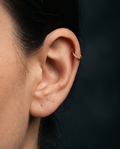
- Cartilage heals slowly. Expect 6–12 months for a helix piercing to fully heal. Cartilage has almost no blood supply — patience and consistent aftercare are non-negotiable
- Pain is moderate. Most people rate helix pain around 4–5/10 — sharper than an earlobe but milder than inner-ear cartilage piercings like daith or rook
- 18G is the most common gauge for helix. 16G is a secondary option for a slightly bolder look. Both work well with seamless gold hoops
- Diameter determines the look. 6–7mm sits tight against the ear; 8mm is the classic helix hoop; 9–10mm gives a relaxed, stackable feel
- 14K solid gold outperforms steel and plated metals in cartilage piercings — non-porous, nickel-free, will not tarnish in years of continuous wear
What is a helix piercing?
A helix piercing passes through the upper cartilage of the outer ear — the curved rim that runs from above the tragus up and around the top of the ear. It is the most popular cartilage piercing in the UK, and the entry point for most people building a curated ear. Unlike an earlobe piercing (which goes through soft, fleshy tissue), a helix piercing goes through cartilage: a firm, avascular tissue that heals fundamentally differently.
The helix position is versatile. A single gold hoop on the upper rim is quietly striking. Two or three hoops stacked along the curve create a layered, editorial look. And because the helix sits on the outer edge of the ear, it is visible from almost every angle — front, side, and behind — making it one of the most impactful piercings for minimal effort.
Helix vs forward helix — what is the difference?
Standard helix: the outer upper rim of the ear (the most exposed curve). This is what most people mean when they say “helix piercing.”
Forward helix: the small fold of cartilage where the upper ear meets the head, just above the tragus. Forward helix piercings are more tucked in, closer to the face, and typically use smaller jewellery (5–7mm studs or tiny hoops).
Both are cartilage piercings with similar healing times, but they occupy very different visual positions on the ear. This guide focuses on the standard helix.
Is a helix piercing right for you?
A helix suits you if…
- You want to start building a curated, layered ear look
- You already have lobe piercings and want your first cartilage piercing
- You want something visible but understated — a single thin gold hoop
- You can commit to 6–12 months of aftercare and sleeping adjustments
- You work in an environment where small ear jewellery is acceptable
A helix may not suit you if…
- You cannot avoid sleeping on the pierced ear (or are unwilling to use a travel pillow)
- You wear over-ear headphones daily and cannot switch to earbuds during healing
- You tend to abandon aftercare routines after a few weeks
- You expect the piercing to heal as quickly as an earlobe (it will not)
How much does a helix piercing hurt?
4–5 out of 10 for most people — a firm, sharp pressure that lasts about one second. The helix is thinner cartilage compared to the conch or rook, so the needle passes through relatively quickly. Most people describe it as “a strong pinch with a crunch” — the crunch being the sensation (and sometimes the sound) of the needle passing through cartilage.
After the piercing: Expect a hot, throbbing ache for 2–4 hours. The ear may feel warm and look slightly red for 1–3 days. Sleeping on the pierced side will be uncomfortable for several weeks — plan accordingly. By week two, the helix should only hurt if directly bumped or slept on.
| Piercing | Pain |
|---|---|
| Earlobe | 2–3/10 |
| Helix This piercing | 4–5/10 |
| Tragus | 4–5/10 |
| Conch | 5–6/10 |
| Daith | 5–6/10 |
| Rook | 6–7/10 |
| Industrial | 6–8/10 |
Healing timeline
6–12 months for full healing. Cartilage has almost no direct blood supply — it receives nutrients by diffusion from surrounding tissue, which is why it heals so much more slowly than skin or membrane piercings.
| Phase | Timeline | What to expect | What to do |
|---|---|---|---|
| Inflammatory | Week 1–4 | Redness, swelling, warmth, throbbing. Clear/pale yellow lymph discharge (crusties) on jewellery. | Saline spray 2x daily. Do not touch. Do not sleep on it. Avoid headphones on that side. |
| Proliferative | Month 2–4 | Swelling reduces. Crusties lessen. Can look “healed” externally but is not. | Continue saline. Still avoid sleeping on it. Do not change jewellery. |
| Maturation | Month 4–8 | Much more comfortable. Minimal discharge. Temptation to change jewellery is strong. | Continue gentle cleaning. Visit piercer at month 6 to assess. |
| Fully healed | Month 8–12 | No tenderness, no discharge, no redness. Jewellery moves freely. | Safe to change to your chosen 14K gold seamless hoop. |
Why choose 14K solid gold for helix?
Cartilage piercings are more demanding on jewellery than earlobe piercings. The tissue is slower to heal, more reactive to irritants, and the piercing stays in place for months or years without removal.
14K solid gold vs other metals
| Material | Nickel | Tarnish | Porous? | Long-term wear |
|---|---|---|---|---|
| 14K solid gold Recommended | Nickel-free alloy | Will not tarnish | Non-porous | Lifetime — years of continuous wear |
| Implant-grade titanium | Nickel-free | Will not tarnish | Non-porous | Excellent — best for initial healing |
| Surgical steel (316L) | Contains 10–14% nickel | Resistant | Low | Adequate, but nickel risks irritation |
| Gold-plated / gold-filled | Base metal may contain nickel | Plating wears off | Once plating wears: yes | Months — plating degrades |
| Sterling silver | May contain nickel | Tarnishes readily | Slightly | Not recommended — oxidises |
The non-porous advantage: 14K solid gold has a smooth, dense molecular structure that does not harbour bacteria. In a cartilage piercing — where the channel is warm, slightly moist, and enclosed — this reduces the risk of buildup.
The nickel question: Nickel is the most common contact allergen in the UK. Surgical steel contains 10–14% nickel. 14K solid gold with a nickel-free alloy eliminates this risk entirely.
Size guide: gauge & diameter
Gauge (wire thickness)
The gauge number refers to the thickness of the wire. The higher the number, the thinner the wire.
| Gauge | Thickness | Notes |
|---|---|---|
| 18G Most common | 1.0mm | Standard for most UK helix piercings. Fine, delicate appearance. |
| 16G | 1.2mm | Slightly thicker. Bolder look. More common in the US. |
Diameter (ring size)
Helix ring diameter is measured as inner diameter — the distance from one inner edge of the ring to the other.
| Diameter | Look | Best for |
|---|---|---|
| 6mm | Very tight, huggie-style | Forward helix, or small ears |
| 7mm | Snug fit, minimal gap | Everyday look, smaller ears |
| 8mm Most Popular | Classic helix hoop | Most ear sizes. The safe choice. |
| 9mm | Slightly relaxed | Stacking, larger ears |
| 10mm | Loose, bohemian feel | Statement look, upper helix |
How to measure your helix for a hoop
Locate the piercing hole
Stand in front of a mirror and identify exactly where your helix piercing exits on the back of the ear.
Measure from hole to edge
Measure the distance from the piercing hole to the outer edge of the ear. This approximates half the inner diameter you need.
Double and add 1–2mm
Double your measurement and add 1–2mm for comfort. Example: 3.5mm × 2 + 1mm = 8mm. If between sizes, go up.
Jewellery types for helix piercings
| Style | Best for | Pros | Cons |
|---|---|---|---|
| Flat-back labret stud | Initial piercing & healing | Minimal movement. Flat back sits flush. Accommodates swelling. | Not a hoop. |
| Seamless hoop Most popular upgrade | Healed piercings only | Clean, uninterrupted circle of gold. No visible hardware. | Not for healing. Requires correct diameter. |
| Clicker | Healed piercings | Hinged segment — easiest to insert/remove. | Hinge adds bulk. |
| Captive bead ring | Healed piercings | Secure — bead held by tension. | Bead can be fiddly. |
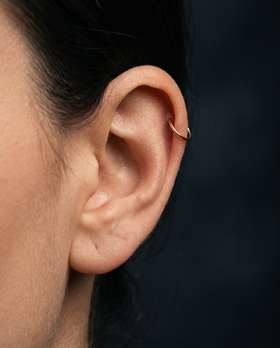
Helix styling ideas
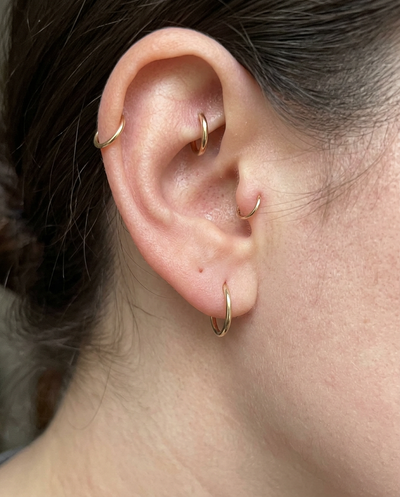
The helix is where curated ears begin. A single thin gold hoop is quietly striking on its own, but the real magic is in combination — layering helix hoops with other ear piercings to create a cohesive, intentional look.
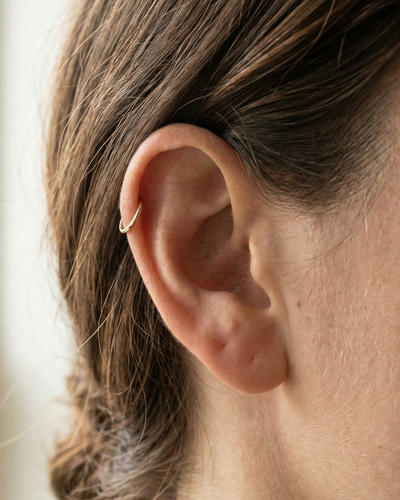
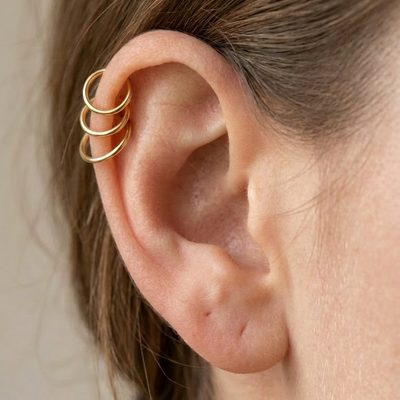
Styling tips
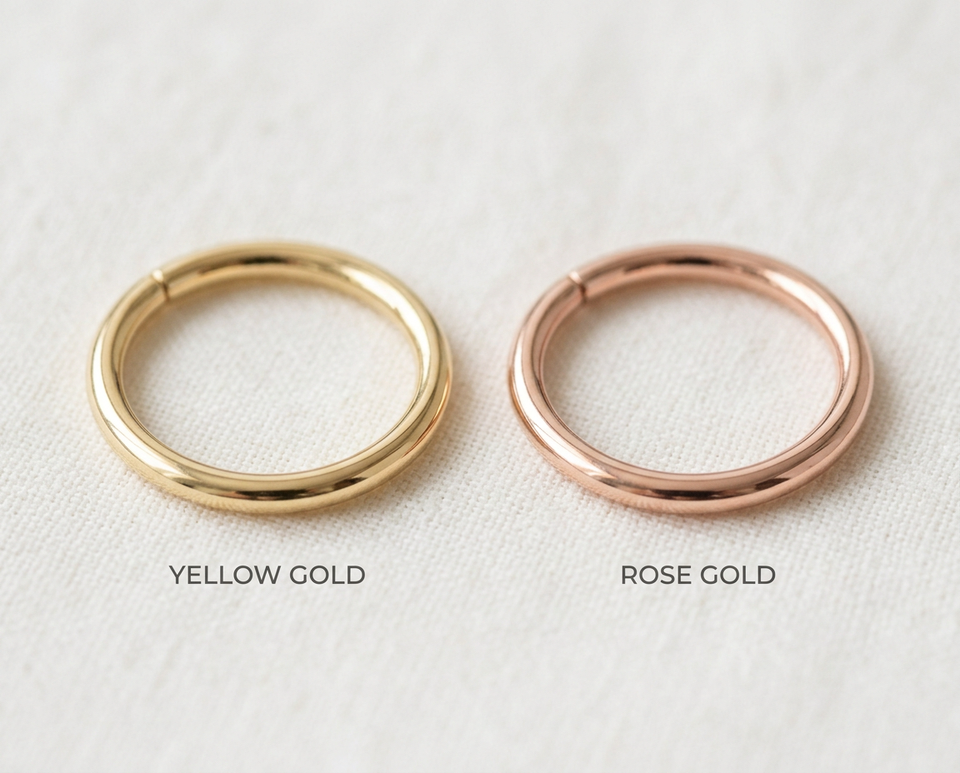
Single hoop: Start with 8mm in 18G for the classic, understated helix look. Yellow gold suits warm and olive tones; rose gold flatters cool and fair complexions.
Stacked hoops (2–3): Use the same gauge and colour but vary the diameter slightly (e.g. 7mm, 8mm, 9mm ascending up the ear) for a graduated, organic effect.
Mixed ear curation: Pair helix hoops with a conch hoop, tragus stud, and lobe studs or huggies. Keep metals consistent for cohesion.
Hair consideration: Short hair, updos, and ponytails showcase helix jewellery beautifully. If you often wear hair down, consider 9–10mm hoops that remain visible beneath hair.
Gold colour options
Yellow Gold
- Traditional warm gold tone — the most popular choice
- Complements warm, olive, and medium skin tones
- Alloyed with silver and copper for strength
- Versatile — matches most existing jewellery
Rose Gold
- Warm pinkish-gold hue — softer, more romantic
- Flatters fair, cool, and neutral skin tones
- Higher copper ratio in the alloy
- Currently trending — pairs with rose gold ear stacks
Both colours are 14K solid gold (58.3% pure gold) with nickel-free alloys. Both are equally biocompatible, equally tarnish-proof, and equally suitable for long-term cartilage wear.
Aftercare
Helix aftercare is a marathon, not a sprint. The biggest challenge is maintaining the routine for 6–12 months and avoiding the everyday habits that disrupt cartilage healing.
Correct aftercare
- Spray sterile saline (0.9% NaCl) 2x daily on both sides of the piercing
- Sleep on the opposite side, or use a travel/donut pillow
- Keep hair, hats, and headphones away from the piercing
- Let crusties soften with saline and fall off naturally
- Downsize the initial stud at 6–8 weeks (ask your piercer)
- Wash hands before any contact with the piercing
Common mistakes
- Sleep on the pierced ear — the single biggest cause of irritation bumps
- Touch, twist, rotate, or “clean by turning” the jewellery
- Use TCP, Dettol, hydrogen peroxide, alcohol, or tea tree oil
- Change to a hoop before your piercer confirms full healing
- Wear over-ear headphones on the pierced side during healing
- Pull jumpers, hoodies, or scarves over the ear without care
- Assume it is healed because it looks fine from the outside
Helix vs lobe: comparison
| Helix | Earlobe | |
|---|---|---|
| Tissue | Cartilage (firm, avascular) | Soft tissue (fleshy, good blood supply) |
| Pain | 4–5/10 | 2–3/10 |
| Healing | 6–12 months | 6–8 weeks |
| Initial jewellery | Flat-back titanium stud | Stud or small hoop |
| When to switch to hoop | 6–12 months | 6–8 weeks |
| Sleep impact | Significant — avoid for months | Minimal after 1–2 weeks |
| Common gauge | 18G (UK) / 16G (US) | 20G or 18G |
| Irritation bumps | Common if aftercare lapses | Rare |
| UK cost | £25–£40 | £20–£30 |
Why Stepoy?
Every 14K gold helix ring we make is handcrafted to the exact gauge and diameter you order. No mass production, no plating, no nickel. Just solid gold, shaped and finished by hand, checked before it ships.