Cartilage Piercing: Complete Guide to Types, Pain, Healing, Bumps & Jewellery

- Cartilage is avascular — no direct blood supply. Nutrients reach it through slow diffusion, which is why healing takes 3–18 months instead of the 6–8 weeks a lobe needs
- Cartilage does not regenerate. Damage from a piercing gun, infection, or low-quality jewellery is replaced by scar tissue, not new cartilage. Method and material are permanent decisions
- ~35% of cartilage piercings develop some complication. Most are preventable with proper technique, material, and aftercare. The most common: irritation bumps from sleeping on it or wearing nickel
- Needle only, never gun. The APP has explicitly banned gun use on cartilage — blunt force can shatter the cartilage structure
- 14K solid gold or implant-grade titanium (ASTM F-136) are the only materials recommended by the APP. Surgical steel contains 10–14% nickel
- Most piercers recommend a maximum of 3–4 healing piercings at once. Each piercing competes for your body’s healing resources
What is a cartilage piercing?
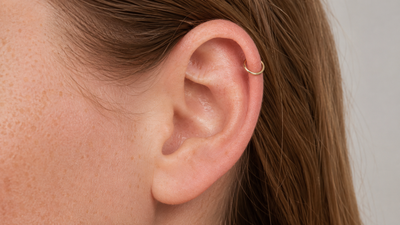
A cartilage piercing is any piercing through the firm, flexible tissue of the ear — everything above the soft earlobe. This includes the helix, forward helix, flat, rook, daith, conch, tragus, anti-tragus, snug, and industrial. Each location has different cartilage thickness, different anatomy, and different healing behaviour, but they all share three biological characteristics that make them fundamentally different from lobe piercings.
Cartilage is avascular. Unlike the earlobe, which has a rich network of blood vessels, cartilage receives nutrients through slow diffusion from the surrounding perichondrium (the membrane that wraps around cartilage). Less blood flow means a slower immune response, slower delivery of healing nutrients, and greater vulnerability to infection and irritation. This single biological fact explains why cartilage piercings take months to heal, why they are more painful, and why they are more sensitive to low-quality metals.
Cartilage does not regenerate. If cartilage is damaged — whether by a piercing gun, excessive trauma, or severe infection — the body cannot grow new cartilage to replace it. Instead, it fills the gap with fibrous scar tissue, which is structurally weaker and more prone to complications. A clean needle separates tissue fibres; a gun uses blunt force that can crush or shatter the cartilage structure.
Cartilage reacts badly to nickel. The long healing window means your jewellery sits in direct contact with forming tissue for months. Metals that release nickel — including 316L surgical steel (10–14% nickel despite its name) — can trigger persistent contact dermatitis in the estimated 10–15% of the population with nickel sensitivity (15–20% of women). The APP recommends only implant-grade titanium (ASTM F-136) or 14K+ solid gold with nickel-free alloys for cartilage piercings.
Cartilage piercing types & locations
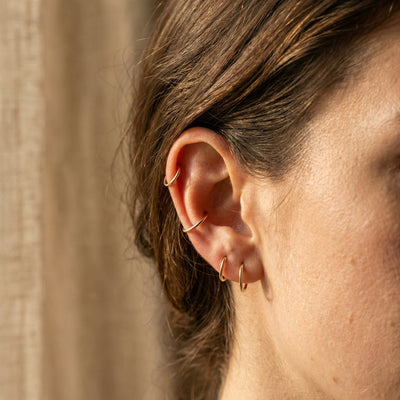
There are 11+ distinct cartilage piercing locations on the ear. Each has different anatomy, different pain, different healing, and different jewellery requirements:

| Piercing | Location | Pain | Healing | Hoop size (healed) |
|---|---|---|---|---|
| Helix | Upper outer rim | 4–5/10 | 3–9 months | 6–8mm Most popular |
| Forward helix | Front rim near face | 5–6/10 | 4–9 months | 5–6mm |
| Flat / flat helix | Flat upper inner area | 5–7/10 | 6–12 months | Studs only — no hoops No edge to wrap |
| Tragus | Small flap covering ear canal | 5–6/10 | 3–6 months | 6–7mm |
| Anti-tragus | Ridge opposite tragus | 6–7/10 | 6–12 months | 6–8mm |
| Conch (inner) | Central bowl | 5–6/10 | 6–12 months | 8–10mm |
| Conch (outer) | Flat area near rim | 5–6/10 | 6–12 months | 10–12mm |
| Daith | Innermost fold above canal | 5–6/10 | 6–12 months | 7–10mm |
| Rook | Antihelix fold | 6–7/10 | 6–18 months | 6–8mm |
| Snug | Antihelix ridge (inner rim) | 7–8/10 | 8–18 months | 6–8mm High rejection |
| Industrial | Two holes + one barbell | 6–7/10 | 6–12 months | Barbell only |
Anatomy check: not everyone can get every piercing
Cartilage anatomy varies dramatically. The rook requires a pronounced antihelix fold — some people have a flat fold that cannot support it. The snug requires a defined antihelix ridge. The industrial requires specific helix curvature for the barbell to sit correctly — thin cartilage can tear or reject the barbell. The daith requires enough depth in the innermost fold. A responsible piercer will assess your anatomy and tell you honestly if a location will not work for your ear.
How much does a cartilage piercing hurt?
Every cartilage piercing hurts more than a lobe. The needle passes through firm tissue that resists penetration. But pain varies significantly by location, driven primarily by cartilage thickness — thicker cartilage = more resistance = more pain.

| Piercing | Pain | Why |
|---|---|---|
| Helix | 4–5/10 | Thinnest cartilage, quick needle pass |
| Forward helix | 5–6/10 | Thin but tight space; pressure felt acutely |
| Flat | 5–7/10 | Varies with individual cartilage thickness in this area |
| Tragus | 5–6/10 | Thick but small; “crunch” sound due to proximity to ear canal |
| Conch | 5–6/10 | Thick, flat cartilage; strong pressure sensation |
| Daith | 5–6/10 | Thick fold, awkward angle for the piercer |
| Anti-tragus | 6–7/10 | Small, thick ridge with many nerve endings |
| Rook | 6–7/10 | Thickest cartilage fold; most resistance |
| Snug | 7–8/10 | Thickest ridge + high nerve density; widely considered most painful ear piercing |
| Industrial | 6–7/10 | Two piercings in one session; second hurts more as adrenaline fades |
What does it feel like? A sharp pressure lasting 1–2 seconds, followed by a warm, throbbing ache for several hours. The initial sharp moment is intense but extremely brief. By the next day, most people report only tenderness when the piercing is touched or bumped.
Healing timeline
Cartilage heals from the outside in. The surface skin closes in weeks, but the internal channel takes months to fully form. This is why cartilage piercings look healed long before they actually are — and why changing jewellery too early is the single most common cause of complications.

| Phase | Timeline | What to expect | What to do |
|---|---|---|---|
| Inflammatory | Week 1–2 | Swelling, redness, warmth, throbbing. Clear/pale yellow lymph discharge. Bruising possible. | Saline spray 2x daily. Do not touch. Sleep on opposite side. No earbuds on that ear. |
| Swelling subsides | Week 3–6 | Swelling reduces. Crusty discharge (dried lymph — normal). Still tender to bumps. | Continue saline. Downsize appointment: swap long initial post (8mm) for shorter one (6mm) that fits flush. Prevents snagging. |
| Proliferative | Month 2–6 | Looks healed externally. Internal channel forming but fragile. Irritation bumps if bumped or slept on. | Do not change jewellery. Reduce saline to 1x daily. Avoid sleeping on it. Careful with hairbrushes, headphones, hats. |
| Maturation | Month 6–18 | Internal channel strengthens. Sensitivity decreases. Piercing feels settled. | After 6+ months (helix/tragus) or 9–12 months (rook/daith/conch), visit piercer to confirm full healing before changing to a hoop. |
Bumps & scars: irritation bump vs keloid vs hypertrophic scar
Approximately 35% of cartilage piercings develop some complication. The most common is a bump. Not all bumps are the same — there are three distinct types, and telling them apart determines whether you need a simple aftercare adjustment or medical treatment.

| Type | Appearance | Cause | Treatment |
|---|---|---|---|
| Irritation bump | Small, soft, red or skin-coloured. Stays at piercing site. | Friction, sleeping on it, touching, nickel, jewellery too long/short/tight. | Fix the cause: switch to titanium or 14K gold, stop touching/sleeping on it, downsize. Resolves in 2–6 weeks. |
| Hypertrophic scar | Firm, raised, red. Larger but stays within wound boundary. | Repeated trauma, slow healing. More common in helix and rook. | Same as irritation bump. May take weeks to months. Silicone scar sheets can help. |
| Keloid Rare | Firm, shiny, grows beyond original wound. Continues growing. | Genetic predisposition. Not caused by aftercare mistakes. | Requires medical treatment: corticosteroid injections, cryotherapy, laser. See a dermatologist. |
The quick test: Fix the likely cause. If the bump shrinks within 2–4 weeks, it was an irritation bump. If it continues growing despite perfect care, see your piercer, then a dermatologist.
Migration and rejection — when the body pushes jewellery out
Migration is when the body gradually moves jewellery toward the surface. Rejection is when it pushes jewellery completely out. Both are uncommon with standard cartilage piercings but more common with snug piercings (the highest rejection rate of any ear cartilage piercing) and industrial piercings (if anatomy does not support the barbell angle).
Signs of migration/rejection: The tissue over the jewellery is getting thinner over time. The entry and exit holes are moving closer together. The piercing develops a V-shape rather than a C-shape around the jewellery. Irritation bumps that form, scab, fall off, and reform repeatedly — each time with thinner skin underneath. If you notice these signs, see your piercer immediately. Removing jewellery early minimises scarring; leaving it to fully reject causes worse damage.
Choosing jewellery for cartilage piercings
During healing: flat-back labret studs
For helix, forward helix, flat, tragus, conch, and anti-tragus, your piercer will typically install a flat-back labret stud. The flat disc sits flush against the back of your ear (no butterfly back to catch on pillows), while the decorative end faces forward. The post starts at 8mm to accommodate swelling and is downsized to 6mm at your follow-up.
For rook and daith, a curved barbell is standard because it follows the natural curve of the fold. For industrial, a straight barbell (14G, 32–38mm) connects both holes.

Threadless vs internally threaded vs externally threaded
The way the decorative top attaches to the post matters for your comfort and healing:
Threadless (push-pin): The modern standard. A slightly bent pin on the decorative top pushes into a hollow post and holds by tension. Smoothest insertion, easiest to swap tops without removing the post. Most piercers recommend this system.
Internally threaded: The thread is inside the post (not on the outside). The decorative top screws into the post. Smooth insertion because the post has no external threads that could scrape the channel. Safe and reliable.
Externally threaded: The thread is on the outside of the post. When inserted or removed, these external threads scrape against the delicate piercing channel like a tiny bolt through soft tissue. Avoid for cartilage. The scraping delays healing and causes irritation.
Once healed: seamless hoops in 14K solid gold
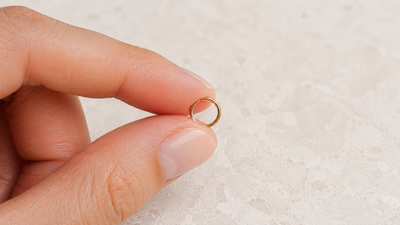
After your piercer confirms full healing, seamless hoops are the most popular upgrade for helix, tragus, conch, daith, and rook. A seamless hoop is a continuous circle of wire with no clasp, ball, or hinge — just a nearly invisible seam. The smooth interior is comfortable inside the channel, and the clean shape creates a minimal, elegant look.
Note: Flat piercings and industrial piercings cannot wear hoops. Flat piercings are studs-only (no edge to wrap a hoop around). Industrial piercings use barbells only.
Size guide: gauge & diameter by location
| Piercing | Gauge | Hoop diameter (inner) | Notes |
|---|---|---|---|
| Standard helix | 16G or 18G | 6–8mm 8mm most popular | 6mm flush hugger; 8mm visible hoop |
| Forward helix | 16G or 18G | 5–6mm | Tight space; small diameter essential |
| Flat | 16G | N/A — studs only | 6mm or 8mm post length depending on cartilage thickness |
| Tragus | 16G or 18G | 6–7mm | Must clear tragus bump; too large interferes with earbuds |
| Anti-tragus | 16G | 6–8mm | Depends on ridge size |
| Inner conch | 16G | 8–10mm 10mm most popular | Must reach from conch to outer rim |
| Outer conch | 16G | 10–12mm | Largest ear hoop diameter; wraps outer rim |
| Daith | 16G | 7–10mm | 8mm smaller ears, 10mm larger; sits inside fold |
| Rook | 16G or 18G | 6–8mm 7mm most popular | Curved barbell also popular |
| Snug | 16G | 6–8mm | Curved barbell more common; high rejection rate |
| Industrial | 14G | N/A — barbell only | 32–38mm barbell depending on ear width |
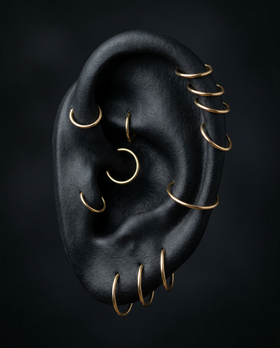
Cartilage piercing aftercare
The only cleaning product you need: Sterile saline solution (0.9% sodium chloride). Spray directly onto front and back of the piercing twice daily for the first 3 months, then once daily until healed. Air-dry or pat gently with a clean tissue. Nothing else should go on or near your piercing.
Correct aftercare
- Spray with sterile saline 2x daily (first 3 months), then 1x daily
- Let warm water run over it in the shower
- Sleep on the opposite side — use a travel/donut pillow if needed
- Keep hair tied back and away from the piercing
- Return for your downsize appointment at week 4–6
- Leave the jewellery completely alone between cleanings
Common mistakes
- Touch, twist, rotate, or “move” the jewellery
- Use TCP, Dettol, hydrogen peroxide, alcohol, or tea tree oil
- Submerge in pools, baths, or sea for at least 3 months
- Sleep on the pierced ear
- Use earbuds or in-ear headphones on the pierced ear during healing
- Change jewellery before your piercer confirms full healing
- Get more than 3–4 piercings healing at the same time
How to find a good piercer
Needle only, no guns. Non-negotiable for cartilage.
Autoclave sterilisation. Ask to see it. Ask about spore testing schedule.
Single-use needles and gloves. Everything sealed, opened in front of you.
Implant-grade jewellery. Initial jewellery should be ASTM F-136 titanium or 14K+ solid gold with nickel-free alloy. Not “surgical steel.”
Portfolio of healed work. Fresh piercings all look good; healed results show true skill.
Honest anatomy assessment. A good piercer tells you if your anatomy does not suit a piercing. A bad one pierces anything you ask for.
Threadless or internally threaded jewellery. If a piercer uses externally threaded studs, find a different piercer.
Cartilage vs lobe: key differences
| Cartilage piercings | Lobe piercings | |
|---|---|---|
| Tissue | Firm, avascular cartilage | Soft, vascular tissue |
| Pain | 4–8/10 depending on location | 2–3/10 |
| Healing | 3–18 months | 6–8 weeks |
| Complication rate | ~35% | Significantly lower |
| Material | 14K gold or titanium essential | More forgiving, but gold/titanium still best |
| Method | Hollow needle only (guns banned) | Needle recommended; guns tolerated |
| Aftercare | 6–12+ months active care | 4–6 weeks active care |
| Sleeping | Avoid pierced side for months | Comfortable within 2–3 weeks |
| Closing speed | Hours (healing), days (healed) | Established lobes stay open years |