Septum Piercing: Complete Guide to Pain, Healing, Smell, Sizing & Gold Rings

- The sweet spot is everything. A septum piercing should pass through a thin membrane (columella), not cartilage. When placed correctly: pain 3–4/10, healing 6–8 weeks. When missed: pain 7–8/10, healing 6+ months
- 16G is the standard gauge for septum. 18G is a secondary option for a finer look. 20G is not standard for septum piercings
- You can flip it up to hide it — even during healing (if you pick one position and leave it). Smaller rings (8–9mm) are easiest to conceal
- Yes, it will smell sometimes. “Septum funk” is normal and universal. 14K solid gold reduces it because gold is non-porous and does not harbour bacteria like cheaper metals
- Not everyone has a sweet spot. Some people’s anatomy makes a comfortable septum piercing impossible. A good piercer will tell you honestly
What is a septum piercing?
A septum piercing passes through the thin membrane between your nostrils — not through the hard cartilage wall that divides your nose. This thin area is called the columella, or the “sweet spot” as piercers call it. When placed correctly through this membrane, the piercing heals faster than almost any other facial piercing (6–8 weeks) because membrane tissue has better blood supply than cartilage.
The septum ring hangs between your nostrils, creating one of the most versatile piercing looks available: bold and visible when worn down, completely invisible when flipped up inside the nose. This hide-ability is the septum’s defining advantage over every other nose piercing. A nostril piercing is always visible; a septum piercing is visible only when you choose.
Septum piercings have a history spanning thousands of years across Indigenous Australian, South Asian, African, and Central American cultures. In contemporary fashion, they gained mainstream popularity through celebrities like Rihanna, Zoë Kravitz, and Jessica Biel, and are now one of the most requested piercings at UK studios.

The sweet spot — anatomy that determines everything
Pinch the bottom of your septum between your thumb and forefinger. Feel around — you will find a thin, flexible area toward the tip of your nose where the tissue gives easily. Behind it, closer to your face, the tissue becomes firm and rigid (that is cartilage). The thin, flexible membrane in front is your sweet spot.
This is the only area that should be pierced. The sweet spot is membrane tissue with reasonable blood supply — it heals in weeks, not months. The cartilage behind it is dense, avascular, and heals like any ear cartilage piercing (6–12+ months). The difference in pain and healing between hitting the sweet spot and missing it is dramatic:
| Sweet spot (correct) | Through cartilage (incorrect) | |
|---|---|---|
| Pain | 3–4/10 — quick, sharp pinch | 7–8/10 — intense pressure, crunching |
| Healing | 6–8 weeks | 6–12+ months |
| Sensation | “Weird pressure, then eyes water” | “Felt like my nose was being broken” |
| Ongoing comfort | Comfortable within days | Sore for weeks, prone to bumps |
Deviated septum — can you still get pierced?
A deviated septum is when the cartilage wall between your nostrils is not centred — it leans to one side. It is surprisingly common (some estimates suggest up to 80% of people have some degree of deviation). In most cases, a deviated septum does not prevent you from getting a septum piercing. However:
Mild deviation: An experienced piercer can work around it. The jewellery may sit very slightly off-centre, but this is usually imperceptible.
Significant deviation: The piercing may be noticeably asymmetric — the ring hangs lower on one side. Some people are comfortable with this; others are not. Your piercer should show you the planned angle before piercing so you can decide.
Severe deviation or previous nasal surgery: If you have had rhinoplasty, septoplasty, or a broken nose, consult both your surgeon and your piercer. After rhinoplasty, most surgeons recommend waiting at least 8–10 weeks (some recommend a full year) before getting a septum pierced, because the nasal structure is still healing and soft.
How much does a septum piercing hurt?
3–4 out of 10 when pierced through the sweet spot — comparable to a nostril piercing and significantly less than any cartilage piercing. The actual needle pass takes 1–2 seconds. Most people describe it as a sharp pinch followed by immediate eye-watering (the trigeminal nerve reflex, same as nostril piercings).
What actually hurts the most: Many people report that the clamps (the tool that holds the tissue in position before the needle) are more uncomfortable than the needle itself. The clamping creates a firm pressure on the septum that lasts several seconds while the piercer aligns the needle. The needle pass after that is almost a relief by comparison. Not all piercers use clamps — some use a freehand technique or a receiving tube instead. If you are anxious about the clamps, ask your piercer about their technique beforehand.
After the piercing: Expect a dull ache for a few hours, watery eyes for 5–10 minutes, possible sneezing, and a “stuffy nose” feeling for 1–2 days. Tenderness at the tip of the nose for about a week. By week two, most people report no discomfort unless the ring is accidentally bumped.
| Piercing | Pain |
|---|---|
| Earlobe | 2–3/10 |
| Septum (sweet spot) This piercing | 3–4/10 |
| Nostril | 3–4/10 |
| Helix | 4–5/10 |
| Tragus / Conch / Daith | 5–6/10 |
| Rook | 6–7/10 |
Healing timeline
6–8 weeks for initial healing — making the septum one of the fastest-healing piercings. This is because the sweet spot is membrane tissue (not cartilage) with better blood supply. Full maturation of the internal channel takes 3–6 months, but most piercers consider the piercing healed enough for a jewellery change at 6–8 weeks.
| Phase | Timeline | What to expect | What to do |
|---|---|---|---|
| Inflammatory | Week 1–2 | Tenderness, swelling between nostrils. Runny nose and sneezing (reflex). Eyes watering on day 1. Nose may feel congested. | Saline spray 2x daily (outside and inside both nostrils). Do not flip the ring. Do not touch. Keep one position — up or down. |
| Early healing | Week 2–4 | Swelling reduces. Crusty discharge on jewellery (normal dried lymph). Nose feels less congested. Still tender if bumped. | Continue saline. You can begin carefully flipping if absolutely necessary (e.g. for work), but minimise how often you switch positions. |
| Intermediate | Week 4–6 | Much more comfortable. Flipping up and down is easier and less tender. External healing looks complete. | Continue saline 1x daily. You can flip more freely but still be gentle — internal channel is still maturing. |
| Healed | Week 6–8 | Most septum piercings are healed enough for a jewellery change. No tenderness, no discharge, no swelling. | Visit your piercer to confirm full healing before switching jewellery. First change should ideally be done by your piercer. |
Flipping your septum ring up and down
The ability to hide a septum piercing by flipping the ring up inside the nose is its most unique feature. But there is a right way and a wrong way to do it, especially during healing.
Can you heal a septum flipped up?
Yes. Contrary to popular belief, you can heal your septum piercing in the flipped-up position from day one. The key is not which position you choose — it is how often you change position. Every time you flip the ring, you rotate the jewellery inside the healing channel, disturbing the forming tissue. Healing flipped up permanently is fine. Healing flipped down permanently is fine. Flipping back and forth three times a day is not fine.
When can you start flipping freely?
Week 2–3: You can flip if necessary (e.g. for work), but do it once and leave it. Rinse with warm saline before flipping to soften any crusties and reduce friction.
Week 4+: Flipping becomes easier and less tender. You can flip once or twice a day with minimal irritation.
Week 6–8 (healed): Flip as often as you want. The channel is formed and stable.
Which ring size flips up best?
8–9mm inner diameter rings are the easiest to conceal when flipped up. They sit snugly inside the nostrils without poking out. 10mm works for most people but may show a slight curve at the bottom of the nostrils depending on anatomy. 11–12mm rings are harder to fully conceal and may be visible from certain angles when flipped up.
The septum smell — “septum funk”
This is the topic that no guide warns you about, but every septum piercing owner discovers: sometimes, your septum piercing smells. The smell is often described as cheesy, funky, or similar to body odour. It happens when the jewellery moves and releases trapped buildup from the piercing channel — and because the piercing is inside your nose, the odour goes directly into your nostrils.
Why does it happen?
Your body continuously produces sebum (natural skin oil) and sheds dead skin cells. Inside the piercing channel, these substances accumulate along with bacteria. When the jewellery shifts, it disturbs this buildup and releases the odour. This is completely normal and happens with every piercing — but you only notice it with septum piercings because the source is literally inside your nose.
Key reassurance: Nobody else can smell it. You only notice it because the jewellery is millimetres from your olfactory receptors. It is not a sign of infection (unless accompanied by pain, swelling, and coloured discharge).
How to minimise septum funk
Regular saline cleaning: Even after healing, spray saline 1–2 times per week to flush out buildup from the channel. This is the single most effective prevention.
Remove and soak (once healed): Once your piercing is fully healed, you can periodically remove the ring, soak it in warm water with mild soap for 2 minutes, and gently clean the piercing channel with saline. This removes the accumulated sebum and dead cells.
Use non-porous, high-quality jewellery: This is where material matters enormously. Porous materials (acrylic, low-grade alloys, coated metals) have microscopic surface irregularities where bacteria colonise and thrive. 14K solid gold is non-porous — its smooth, dense surface does not harbour bacteria the way cheap metals do. Customers who switch from surgical steel or plated jewellery to 14K gold consistently report a significant reduction in septum funk.
Jewellery types for septum piercings
| Style | Best for | Pros | Cons |
|---|---|---|---|
| Circular barbell (horseshoe) | Initial piercing & healing | Easy to flip up. Accommodates swelling. Ball ends keep it in place. | Balls can unscrew and fall out (check tightness weekly). Visible balls create a less clean look than a seamless ring. |
| Captive bead ring | Initial or healed piercings | Secure — bead held by tension. Full circle look. | Bead can be fiddly to insert/remove. May need pliers. |
| Seamless hoop Most popular upgrade | Healed piercings only | Clean, uninterrupted circle of gold. No visible hardware. Comfortable smooth interior. The most refined septum look. | Not for initial piercings — seam can rotate into channel during healing. Requires correct diameter. |
| Clicker | Healed piercings | Hinged segment clicks open/shut — easiest to insert/remove. Decorative options available. | Hinge is a potential weak point. Bulkier than a seamless ring. |
| Retainer | Hiding during healing or work | Staple-shaped — sits fully inside the nose, invisible. | Not decorative. Purely functional for concealment. |
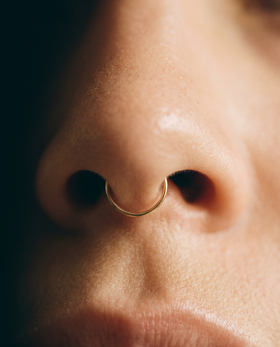
Size guide: gauge & diameter
Gauge (wire thickness)
16G (1.2mm) is the standard gauge for septum piercings. Most professional piercers use a 16G needle for septum piercings because the slightly thicker wire is more stable in the septum, less prone to migration, and provides a more visible, substantial look that suits the septum’s position between the nostrils.
| Gauge | Thickness | Notes |
|---|---|---|
| 16G Standard | 1.2mm | Industry standard for septum. Most stable, widest jewellery selection. Used by most piercers as default. |
| 18G | 1.0mm | Finer, more delicate look. Good secondary option. Slightly less jewellery selection than 16G. |
Diameter (ring size)
Septum ring diameter is measured as inner diameter — the distance from one inner edge of the ring to the other. The right diameter depends on your nose width and how you want the ring to sit:

| Diameter | Look | Best for | Flip-up? |
|---|---|---|---|
| 8mm | Tight, snug fit barely visible below nose | Minimal, discreet, easy to hide | Easiest — fully concealed |
| 9mm | Close fit, small visible curve | Understated everyday wear | Easy — conceals well |
| 10mm Most Popular | Classic septum ring look | Most face shapes, balanced visible/discreet | Good — may show slight curve |
| 11mm | Relaxed, bohemian feel | Wider noses, more presence | Possible — may peek out |
| 12mm | Bold statement hoop | Maximum visual impact | Difficult — too large to fully conceal |
Gold colour options

Yellow Gold
- Traditional warm gold tone — the most popular choice for septum rings
- Complements warm, olive, and medium skin tones
- Alloyed with silver and copper
- Versatile — works with both casual and dressed-up looks
Rose Gold
- Warm pinkish-gold hue — softer, more feminine aesthetic
- Flatters fair, cool, and neutral skin tones
- Higher copper ratio in the alloy
- Currently trending — pairs beautifully with rose gold ear jewellery
Both colours are 14K solid gold (58.3% pure gold) with nickel-free alloys. Both are equally biocompatible, equally tarnish-proof, and equally suitable for the moist nasal environment. The choice is purely aesthetic.
Aftercare
Septum aftercare is identical to other piercing aftercare with one unique consideration: your piercing is inside your nose, exposed to mucus, bacteria, and constant moisture. This makes consistent cleaning more important, not less.
Correct aftercare
- Spray sterile saline (0.9% NaCl) 2x daily — outside and inside both nostrils
- Pick one position (up or down) and keep it for the first 2–3 weeks
- Rinse with warm saline before flipping to loosen crusties and reduce friction
- Blow nose very gently for the first 2 weeks — light pressure, one side at a time
- Check horseshoe barbell balls weekly — they can unscrew and fall out
- Wash hands before any contact with the piercing
Common mistakes
- Flip the ring back and forth multiple times a day during healing
- Touch, twist, rotate, or play with the jewellery
- Use TCP, Dettol, hydrogen peroxide, alcohol, or tea tree oil
- Submerge in pools, baths, or natural water for at least 6 weeks
- Blow your nose forcefully in the first 2 weeks
- Change jewellery before your piercer confirms healing
- Pull your shirt off over your face without unbuttoning — a common day-one accident that catches the ring
Septum vs nostril: comparison
| Septum | Nostril | |
|---|---|---|
| Location | Through membrane between nostrils | Through nostril wing (outside) |
| Pain | 3–4/10 (if sweet spot hit) | 3–4/10 |
| Healing | 6–8 weeks (one of the fastest) | 3–6 months |
| Can hide? | Yes — flip up inside nose | No — always visible |
| Standard gauge | 16G | 20G (UK) |
| Jewellery | Seamless hoop, clicker, horseshoe, retainer | Hoop, L-stud, corkscrew, bone stud |
| The smell | Yes — septum funk is universal | Less common (jewellery partly outside the nose) |
| Scar if retired | Hidden inside nose — virtually invisible | Small dot on nostril — usually fades |
| UK cost | £25–£40 | £20–£35 |