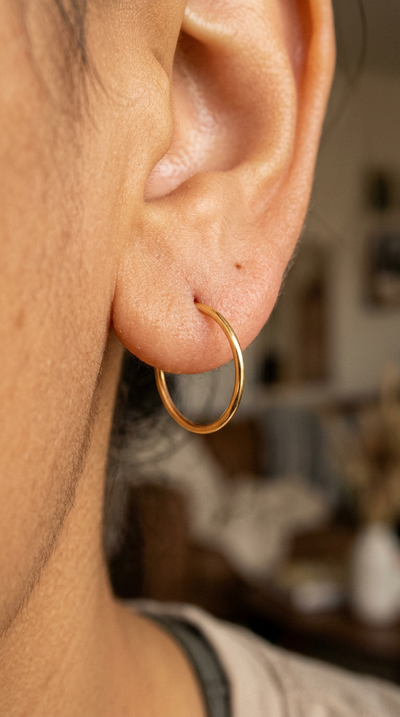
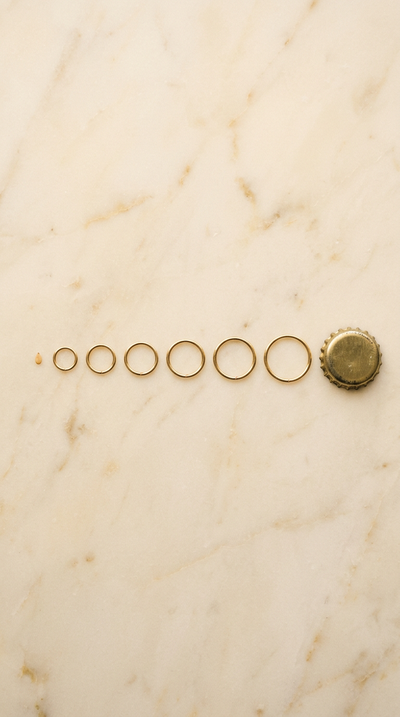
New 14ct Solid Gold Piercing Hoop
Gold Hoop Earrings for Sensitive Ears: Why 14K Solid Gold Works
- "Sensitive ears" is almost always nickel contact dermatitis — the most common metal allergy in the UK, affecting up to 17% of women
- 14K solid gold (nickel-free alloy) and implant-grade titanium are the two materials that eliminate reactions
- Gold-plated, gold-filled, vermeil and sterling silver all eventually expose base metal or tarnish inside the piercing
- "Hypoallergenic" is an unregulated marketing term — it does not guarantee nickel-free or safe for piercings
- Surgical steel contains nickel despite being marketed as safe — it is the single most misleading material label in earring sales
- Switching from cheap metal to 14K gold resolves most ear sensitivity within days, not weeks
Why your ears react
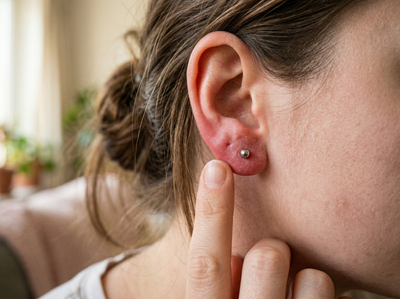
The reaction you experience when wearing certain earrings — itching, redness, swelling, crusting, weeping, green marks on the skin — is not a sign that your ears are unusually sensitive. It is nickel contact dermatitis: an allergic immune response triggered when nickel ions leach from the metal surface into the skin.
Nickel is the most common contact allergen in Europe. An estimated 10–17% of women and 1–3% of men in the UK are sensitised to nickel, and that number increases with each exposure. The more cheap earrings you wear, the more likely you are to develop the allergy, and once it develops, it is permanent. There is no desensitisation treatment. The only management is avoidance.
The reason some earrings trigger a reaction and others do not has nothing to do with ear sensitivity and everything to do with the nickel content of the metal. Earrings made from nickel-free materials never cause this reaction, even on the most "sensitive" ears.
The gold hierarchy
Not all gold jewellery is the same. The word "gold" on a product listing can mean five completely different things, and only one of them is safe for sensitive ears long-term.
| Material | What it actually is | Safe for sensitive ears? | Lifespan | UK price per hoop |
|---|---|---|---|---|
| 14K solid gold RECOMMENDED | 58.3% pure gold alloyed with silver, copper, zinc. Same material all the way through. | Yes — nickel-free when properly alloyed | Lifetime | £30–£120 |
| 18K solid gold | 75% pure gold. Softer, more yellow, more expensive. | Yes — if nickel-free alloy | Lifetime (bends more easily) | £50–£180 |
| Gold-filled | Thick gold layer (5% of weight) bonded to brass core. | Acceptable for 2–5 years. Eventually wears through. | 2–5 years | £15–£50 |
| Gold vermeil | Sterling silver base with gold plating (2.5 microns min). | Short-term only. Plating wears, silver tarnishes in channel. | 6–18 months | £15–£50 |
| Gold-plated | Base metal (usually brass) with thin gold coating (0.5–2 microns). | No. Plating wears through within months. | 1–6 months | £5–£30 |
14K solid gold — the permanent fix
14K gold is 58.3% pure gold mixed with alloy metals that add strength and colour. When the alloy is nickel-free (using silver, copper and zinc instead of nickel), the resulting metal is completely biocompatible. It does not corrode, does not tarnish, does not leach anything into the skin, and lasts a lifetime. This is why piercers, dermatologists and allergists all recommend solid gold for nickel-sensitive patients.
Why 14K and not 18K or 24K? 14K hits the sweet spot between purity and durability. 18K is softer and bends more easily on thin-wire hoops. 24K is pure gold and far too soft for any jewellery that experiences daily wear. 14K is hard enough to hold its shape as a hoop, strong enough for hinge mechanisms on huggies, and pure enough to be fully biocompatible.
Gold-plated — the problem disguised as a solution
Gold-plated earrings are the leading cause of the "I can’t wear earrings" belief. People buy earrings labelled "gold," wear them, get a reaction, and conclude they are allergic to gold. They are not allergic to gold. They are allergic to the brass, copper or nickel base metal underneath a plating that has worn through.
Gold plating on earrings is typically 0.5–2 microns thick. To put that in perspective: a human hair is 70 microns thick. The plating wears through with daily contact, showering and skin acids within weeks to months, exposing the base metal directly to the piercing channel. Once exposed, the base metal triggers the same reaction as any other cheap earring.
Implant-grade titanium — the alternative
If solid gold is out of budget, implant-grade titanium (ASTM F136) is the best alternative for sensitive ears. Titanium is completely nickel-free, lighter than gold, and forms a natural oxide layer on its surface that prevents any metal from leaching into the skin.
The tradeoff: titanium is a grey metal. It does not look like gold. Some titanium jewellery is anodised to create colours (blue, purple, rainbow), but it cannot replicate the warm yellow of gold. For people who want the gold look, titanium is not a visual substitute — but for people who just want their ears to stop reacting, it works perfectly at a fraction of the price.
Materials that lie
Several common earring materials are marketed as safe for sensitive ears but are not. Here are the ones to watch for:
"Hypoallergenic"
This word is not regulated in the UK or EU for jewellery. Any manufacturer can label any earring "hypoallergenic" without meeting any standard. A brass earring with nickel content can legally be called hypoallergenic. The word means nothing without an accompanying material specification. Ignore it and check the actual metal composition instead.
"Surgical steel" / "stainless steel"
Surgical steel (316L) contains 10–14% nickel. It is the most misleading material label in the earring industry. The term "surgical" implies medical safety, but the nickel content is high enough to trigger reactions in sensitised individuals. It is widely used in gun piercings and cheap body jewellery because it is inexpensive. If you react to "surgical steel" earrings, nickel is the cause.
"Sterling silver"
Sterling silver (925) is 92.5% silver and 7.5% copper. It does not contain nickel in its standard alloy, but it tarnishes inside the piercing channel, depositing black silver sulphide into the skin. This tarnish is a persistent irritant. Some sterling silver alloys also use nickel as a hardening agent, especially in cheaper products. For short-term wear (a few hours), sterling silver is acceptable. For daily or permanent wear, it is not suitable for sensitive ears.
"Nickel-free" (without verification)
Some brands label products "nickel-free" without third-party testing. In the EU, the REACH regulation limits nickel release to 0.5 μg/cm²/week for items inserted into piercings, but enforcement depends on testing. If a brand cannot provide a test certificate or does not specify compliance with EN 1811 (the nickel release test), treat the claim with caution.
The buying checklist
Before buying any earring for sensitive ears, check these five things. If any answer is "no" or "unclear," do not buy.
1. Is the material stated explicitly? "14K solid gold," "implant-grade titanium (ASTM F136)" — not "gold-tone," "hypoallergenic metal" or just "metal." If the listing does not name the exact material, assume the worst.
2. Is it solid, not plated? Look for the word "solid." If the listing says "plated," "filled," "vermeil," "coated" or "finished," the base metal will eventually contact your skin.
3. Is it nickel-free? Stated explicitly, ideally with reference to EU REACH compliance or EN 1811 testing. "Hypoallergenic" alone is not sufficient.
4. Does the brand specialise in body piercing jewellery? Piercing jewellery brands design for permanent wear inside the body. Fashion jewellery brands design for appearance. The material standards are different. Buy from brands that understand biocompatibility.
5. Is the gauge listed? A brand that lists the gauge on every product understands piercing compatibility. A brand that does not is selling fashion accessories, not piercing jewellery. See our lobe gauge guide for why this matters.
What happens when you switch
If you have been wearing reactive earrings and switch to 14K solid gold or implant-grade titanium, here is the typical recovery timeline:
Day 1–2: Itching and redness begin to subside. The new metal is not triggering an immune response, so the inflammation starts calming.
Day 3–5: Discharge and crusting reduce significantly. The piercing channel is no longer being chemically irritated.
Day 7–10: Most symptoms have resolved. The lobe feels comfortable, looks normal, and the earring sits without irritation.
Week 3–4: Any remaining dryness or roughness around the hole settles. The skin inside the channel has fully recovered from the reactive metal.
If symptoms do not improve within 10 days of switching to confirmed nickel-free 14K gold, the issue may not be metal allergy. See a GP or piercer for assessment — other possibilities include infection, mechanical irritation from the earring shape, or a reaction to a skincare product rather than the metal. See our infected lobe guide for diagnosis.