✓
Your helix piercing is fully healed
🇬🇧
You want a fine-gauge gold hoop for everyday wear
◯
You are choosing between 6mm, 8mm and 10mm
This guide is for healed helix piercings only
A helix hoop is best worn only after the piercing is fully healed. Fresh helix piercings usually heal more easily with a flat-back stud than a hoop, because hoops move more and can irritate cartilage that is still recovering. If your helix is still sore, swollen, crusting, or developing bumps, it is too early to switch. Wait until your piercer confirms healing is complete.
Quick answer
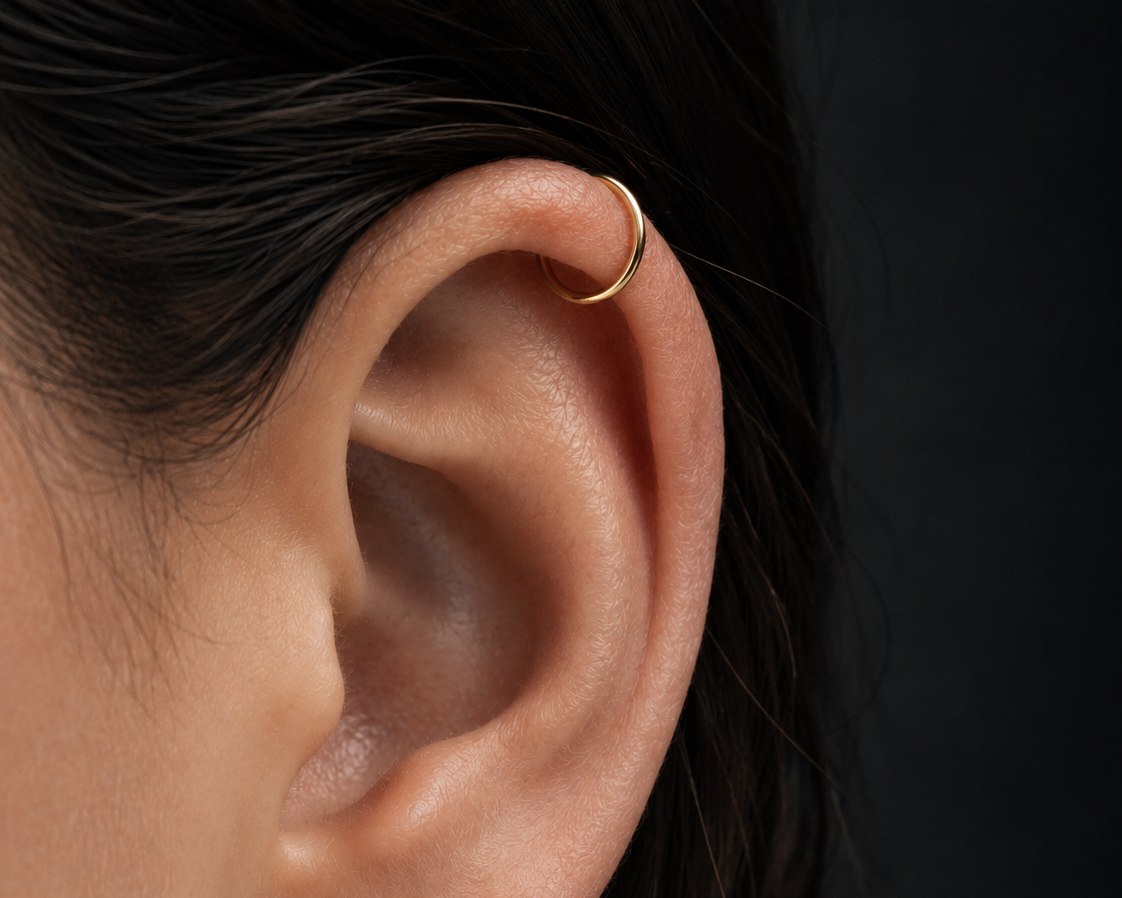
For many healed helix piercings, 8mm in 18G or 20G is a reliable starting point. It fits a wide range of low-to-mid helix placements and gives a balanced look that sits close to the ear without pressing into the cartilage.
Choose 6mm for a very close fit near the edge of the ear. Choose 10mm if your piercing sits higher or you want more visible space around the hoop. Choose 18G for a slightly stronger feel, or 20G for a finer, lighter look.
- 8mm is the best starting size for many healed helix piercings — balanced fit, close to the ear without pressure
- 6mm gives a very snug fit; 10mm gives more space. The right size depends on placement and how close you want the hoop to sit
- 18G gives a slightly stronger feel; 20G is finer and lighter. Both are suited to healed helix piercings
- Wait until your helix is fully healed before switching from a stud to a hoop
- Inner diameter determines fit. Always check that the listing states inner diameter, not outer
- 14K solid gold is among the materials listed by the APP as suitable for body piercings
Which size fits your helix?
The right helix hoop size depends on where your piercing sits on the ear and how close you want the hoop to hug the cartilage. A lower helix (near the ear rim) usually needs a smaller diameter. A higher helix needs a larger one to clear the thicker cartilage above. The size of your ear does not determine your hoop size — placement does.
Size by placement
| Diameter | Look | Best for | Choose this if… |
|---|
| 6mm | Very snug, close to the ear | Low helix, close-to-edge placement | You want the hoop to hug the ear tightly with minimal visible gap |
| 7mm | Snug, subtle | Low-to-mid helix, slightly more room than 6mm | You want a close fit with a little breathing room |
| 8mm Best starting point | Balanced, everyday fit | Many healed low-to-mid helix piercings | You want the safest all-round starting point |
| 9mm | Slightly relaxed | Mid helix, wider ear rim | You want a little more visible space between the hoop and your ear |
| 10mm | Relaxed, more visible | Higher placement, wider gap | Your piercing sits higher or you want the hoop to stand away from the ear more |
Size guidance based on common helix placement positions and
APP fitting principles.
Not sure between two sizes?
Choose the larger of the two. A hoop that is slightly bigger sits comfortably and allows a small gap between the wire and your ear. A hoop that is too tight presses into the cartilage, causes discomfort, and can be difficult to insert. If you are still unsure,
contact us for free size advice.
If you already own a helix hoop that fits well, measuring its inner diameter is the easiest way to choose your next size. Place the hoop flat on a surface and measure straight across the inside opening in millimetres.
Should you choose 18G or 20G?
Gauge is the thickness of the wire, not the size of the hoop. Our helix hoops are available in 18G (1.0mm) and 20G (0.8mm) — both are fine gauges suited to healed helix piercings where you want a lightweight, refined gold look rather than a bulky ring.
| Gauge | Thickness | Notes |
|---|
| 18G Recommended start | 1.0mm | Slightly stronger feel. More visible jewellery presence. A good starting point if you are unsure |
| 20G | 0.8mm | Finer, lighter wire. More delicate appearance. Choose this if you want the subtlest possible look |
Gauge and diameter are not the same thing
You need to know both to order correctly. For example, “8mm 18G” means an 8mm inner-diameter hoop made from 1.0mm-thick wire. If you only specify one measurement, you may receive the wrong jewellery.
Can I wear a finer gauge in a thicker helix piercing?
In many cases, yes. A thinner hoop can usually sit in a slightly larger healed piercing hole. However, it may feel lighter and sit differently than what you are used to. If you want the most stable fit, match the gauge your piercing already accommodates comfortably. Going from a finer gauge to a thicker one may require gradual stretching and should be done carefully.
When can you wear a helix hoop?
Helix piercings go through cartilage, which heals more slowly than soft tissue. A helix typically takes longer to heal than a lobe piercing, and switching to a hoop too early is one of the most common causes of irritation bumps and healing setbacks.
Before switching from a stud to a hoop, make sure your helix shows no pain, swelling, crusting, or discharge. If you can gently move the jewellery without discomfort and the area looks and feels settled, your piercing is likely ready. When in doubt, ask your piercer to confirm.
Why wait?
A hoop moves more than a flat-back stud, which can disturb healing cartilage. Switching too early often leads to irritation bumps, prolonged healing, or discomfort. Waiting until the piercing is fully settled gives you the best experience with your new hoop.
Why your helix hoop feels tight or sticks out
The two most common helix hoop fit issues are the hoop pressing into the ear (too tight) or standing away from the ear more than you expected (too loose for the look you want). Both come down to diameter.
Feels tight or presses into the cartilage
The diameter is too small for your placement. A hoop that is too snug puts pressure on the piercing, can cause discomfort, and may irritate the surrounding cartilage. Try moving up one size — for example, from 6mm to 7mm, or from 8mm to 9mm. You should aim for a small visible gap between the wire and your ear, not a hoop that clamps against the skin.
Sticks out or sits far from the ear
The diameter is larger than your placement requires. While this is not harmful, it may look different from what you intended. If you want a closer fit, try one size smaller. Keep in mind that a hoop should never press tightly — a small gap is normal and comfortable.
How much room should a helix hoop have?
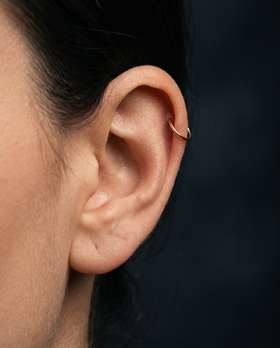
Aim for a small, visible gap between the wire and your ear — roughly 1–2mm. This allows the hoop to sit comfortably, rotate gently, and not press into the cartilage. A hoop that touches the ear with zero clearance is too tight for comfortable daily wear.
Why 14K solid gold for your helix hoop?
Helix piercings sit in cartilage, which can be more sensitive to low-quality metals than lobe piercings. A fine-gauge gold hoop is designed for long-term, everyday wear in a healed piercing. The Association of Professional Piercers (APP) lists several material categories as suitable for body piercings, including solid gold (14K minimum) and implant-grade titanium (ASTM F136).
| Material | Gold content | Nickel risk | Durability | Verdict |
|---|
| 14K solid gold Recommended | 58.3% pure gold | Very low (nickel-free alloy available) | Lifetime — solid all the way through | Suitable for everyday wear, sensitive skin, long-term use |
| Implant-grade titanium | N/A | None | Excellent — medical-grade | Great alternative if you prefer a lighter weight |
| 9K gold | 37.5% pure gold | Low, but higher alloy ratio | Good | Common in UK traditional jewellery, but 14K preferred for body piercings |
| Gold-filled | 5% gold layer over brass | Possible if layer wears through | Moderate — layer can erode | Better than plated, but not solid. May degrade over time |
| Gold-plated Avoid | Thin coating (<1%) | High — base metal exposed within weeks | Poor — flakes and peels | Not safe for body piercings. Plating exposes reactive base metals |
| Surgical steel Avoid | N/A | High — typically contains 10–14% nickel | Good | May cause irritation in nickel-sensitive wearers (estimated 8–19% of population). Not listed by the APP |
Shop by size
Know your size? Go straight to the right hoop. Available in 6mm to 10mm, in 18G and 20G, in solid 14K yellow gold.
6mm
Snug fit
Very close to the ear. Best for low helix placement near the ear rim.
Shop 6mm →
8mm
Best starting point
Balanced everyday fit for many healed low-to-mid helix piercings.
Shop 8mm →
10mm
Relaxed fit
More space around the hoop. Ideal for higher placement or a more visible look.
Shop 10mm →
6mm–10mmFive helix sizes
18G & 20GTwo gauge options
Free UK deliveryRoyal Mail
Our best seller
14K Solid Gold Helix Hoop
Handmade seamless helix hoop. 14K solid gold, nickel-free alloy. Available in 18G and 20G. Sizes 6mm to 10mm. Ships from the UK.
Shop helix hoops →
Frequently asked questions
What size helix hoop should I buy?
For many healed helix piercings, 8mm in 18G or 20G is a reliable starting point. It fits a wide range of low-to-mid helix placements and sits close to the ear with a small comfortable gap. Choose 6mm for a very snug look near the ear edge, or 10mm if your piercing is higher or you want more visible space.
Is 6mm too small for a helix hoop?
Not if your piercing placement supports it. 6mm works well for low helix piercings that sit close to the ear rim, giving a tight, barely-there look. However, if your piercing is in a mid or higher position, 6mm will be too tight — it will press into the cartilage and be difficult to insert. Measure before you buy, or start with 8mm if you are unsure.
Is 8mm the best helix hoop size?
For many healed helix piercings with standard low-to-mid placement, 8mm is a reliable starting point. It sits close to the ear without pressing into the cartilage and suits a wide range of ear shapes. That said, the best size depends on your individual placement and anatomy — there is no single size that works for everyone.
Is 10mm too big for a helix hoop?
Not necessarily. 10mm works well for higher helix placements or wider ear rims where a smaller hoop would press into the cartilage. It also suits customers who prefer a more visible, relaxed look with more space between the hoop and the ear. If you want a closer fit, 8mm or 9mm may be a better choice.
Should I choose 18G or 20G for a helix hoop?
18G (1.0mm) gives a slightly stronger feel and more visible jewellery presence — it is a reliable starting gauge for many healed helix piercings. 20G (0.8mm) is finer and lighter, giving a more delicate, barely-there look. Both are fine gauges suited to everyday wear in a healed piercing. Choose based on the look and feel you prefer.
Is 20G too thin for a helix hoop?
Not for a healed helix piercing. 20G is a fine gauge that gives a delicate, lightweight appearance. It is well suited to customers who want a subtle, refined look. However, because the wire is thinner, it is important to choose a diameter that gives comfortable clearance — a very tight 20G hoop can feel like it is pressing into the skin more than a slightly thicker wire would.
Can I change my helix to a hoop yet?
Your helix is ready for a hoop when it shows no pain, swelling, crusting, or discharge, and when you can gently move the jewellery without discomfort. If any of these signs are still present, your piercing is still healing. When in doubt, ask your piercer to confirm before switching.
Why does my helix hoop feel tight?
The diameter is likely too small for your placement. A hoop that presses into the ear or feels restrictive needs to be replaced with a larger size — for example, moving from 6mm to 7mm, or from 8mm to 9mm. A correctly fitted hoop should leave a small visible gap between the wire and your ear.
Why does my helix hoop stick out?
The diameter is probably larger than your placement requires. While this is not harmful, the hoop sits further from the ear than you may have expected. If you want a closer fit, try one size smaller. Keep in mind that a small gap between the hoop and your ear is normal and comfortable — a hoop that touches the ear with zero clearance is too tight.
Is 14K solid gold good for a healed helix piercing?
14K solid gold is a strong long-term choice for a healed helix hoop. It contains 58.3% pure gold and is alloyed with biocompatible metals (typically silver, copper, and palladium — no nickel). It is
listed by the APP as suitable for body piercings, will not flake or peel like plated jewellery, and is designed for everyday wear.
Can I sleep in a helix hoop?
Many wearers sleep in their helix hoop without issues, especially with a seamless design that has no clasps or openings to catch on pillows. If you sleep on the side with your helix, a correctly sized hoop that is not too tight tends to be more comfortable than one that presses into the ear. Some people prefer to sleep on the opposite side while adjusting to a new hoop.
The gold helix hoop you’ll never take off
14K solid gold • Seamless • 6mm to 10mm • 18G for a stronger feel, 20G for a finer look • Free UK delivery
Shop helix hoops →
S
Stepoy
Piercing Jewellery Specialists
We craft handmade 14K solid gold helix hoops in 18G and 20G, from 6mm to 10mm. Every recommendation in this guide is based on our experience as jewellery makers and the material and quality standards published by the
Association of Professional Piercers.