Rook Piercing: Complete Guide to Pain, Healing, Jewellery & 14K Gold Rook Earrings

| Rook Piercing Quick Facts | |
|---|---|
| Piercing type | Inner-ear cartilage piercing through the anti-helix fold |
| Pain level | 6–7 out of 10 |
| Healing time | 6–12 months |
| Standard gauge | 16G (1.2mm) |
| Starter jewellery | Curved barbell (8–10mm length) |
| Best healed jewellery | 14K gold curved barbell or seamless hoop |
| Most popular hoop size | 7mm inner diameter |
| Best material | Implant-grade titanium (healing) • 14K solid gold (healed) |
| Anatomy dependent? | Yes — requires a pronounced anti-helix fold |
| UK piercing cost | £25–£40 including basic titanium jewellery |
- A rook piercing goes through the anti-helix fold, not the outer rim. Not everyone has the anatomy for one — your piercer must assess your ear first
- Pain is 6–7/10. The rook is one of the more painful ear piercings because the cartilage fold is thick
- Healing takes 6–12 months. Do not change jewellery until your piercer confirms the channel is fully mature
- Start with a curved barbell, not a hoop. Hoops rotate and cause irritation bumps in fresh cartilage piercings
- Do not sleep on a fresh rook piercing. Pressure is the number-one cause of bumps and delayed healing
- 14K solid gold and implant-grade titanium are widely recommended high-quality materials that meet safe body jewellery standards. Surgical steel contains 10–14% nickel
Most asked questions about rook piercings
How painful is a rook piercing?
Quick answer: Rook piercing pain is 6–7 out of 10. The needle passes through a thick cartilage fold, so it is more painful than a helix, tragus, or nostril piercing. The piercing takes 2–3 seconds. Expect throbbing soreness for several hours afterwards.
How long does a rook piercing take to heal?
Quick answer: A rook piercing takes 6–12 months to heal fully. The thick cartilage and enclosed position make it one of the slowest-healing ear piercings. The surface looks healed long before the internal channel is ready for a jewellery change.
Can everyone get a rook piercing?
Quick answer: No. A rook piercing requires a pronounced anti-helix fold. If the fold is flat or shallow, there is not enough cartilage to support the jewellery safely. A professional piercer must examine your ear anatomy before proceeding.
What is the best jewellery for a rook piercing?
Quick answer: A 16G curved barbell in implant-grade titanium is best for initial healing. Once fully healed (6–12 months), switch to a 14K solid gold curved barbell, seamless hoop, or clicker. The most popular rook hoop size is 7mm inner diameter.
Can I wear AirPods with a rook piercing?
Standard AirPods usually sit below the rook and do not make contact. AirPods Pro with silicone tips sit slightly higher and may press against the jewellery in some ear shapes — test gently after the first week. Over-ear headphones are the bigger concern: avoid them on the pierced side for 3–6 months.
What is a rook piercing?
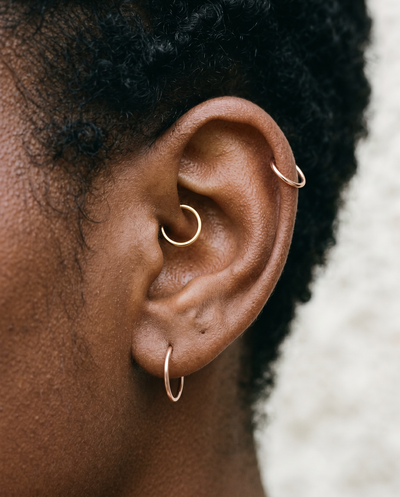
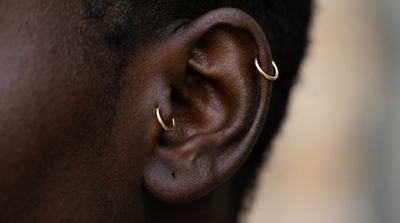
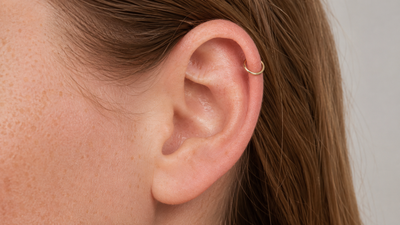
Quick answer: A rook piercing is a cartilage piercing through the anti-helix fold — the ridge of cartilage in the upper inner ear, above the daith and below the forward helix. It is usually worn with a curved barbell during healing and a small gold hoop or decorative rook earring once healed.
The rook was popularised in the early 1990s by piercer Erik Dakota. It remains a favourite for people who want an inner-ear piercing that is visually interesting without being immediately obvious from the front.
From the side, a rook earring catches the light beautifully. This makes the rook well suited to curated ear stacks — it fills a unique position that does not compete with helix, conch, or lobe piercings.
Can everyone get a rook piercing?
Quick answer: No. A rook piercing requires a pronounced anti-helix fold. If the fold is flat, shallow, or barely visible, there is not enough cartilage to support the jewellery. Forcing a rook into unsuitable anatomy leads to rejection, migration, and chronic irritation.
A responsible piercer will examine your ear from the front, side, and behind before agreeing to pierce. They will tell you honestly if your anatomy is not suitable for this inner-ear cartilage piercing.

How to check your rook anatomy at home
Look at your ear in a mirror. Find the innermost ridge of cartilage above the ear canal opening. If you can pinch that ridge between your thumb and index finger and feel a distinct fold, you likely have enough depth.
If the area feels flat with no ridge to pinch, your anatomy may not support a rook. Only a professional piercer can give a definitive assessment — visit in person before booking.
Where should a rook piercing be placed?
Quick answer: A rook piercing is placed through the anti-helix fold at a slight angle that follows the ear’s natural curve. The exact position and angle affect healing, comfort, and what hoop diameter you can wear later.
If the piercing is too shallow, the jewellery sits on the surface and is prone to migration. If it is too deep, the curved barbell presses into the flat of your ear, causing constant pressure and difficult healing.
Does rook placement affect hoop size?
Yes. A piercing closer to the edge of the fold allows a smaller, snugger rook hoop. A piercing deeper into the fold needs a larger diameter to clear the cartilage. If you want a small gold hoop eventually, tell your piercer before they mark the spot.
How much does a rook piercing hurt?
Quick answer: Rook piercing pain is 6–7 out of 10. It is more painful than a lobe, helix, nostril, or tragus piercing because the needle passes through a thick fold of cartilage. The piercing itself takes 2–3 seconds.
Most people describe the sensation as a deep pressure followed by a sharp pinch. Expect a dull throbbing ache for several hours afterwards, and soreness when the ear is touched for the first week or two.
| Piercing | Pain level |
|---|---|
| Earlobe | 2–3/10 |
| Nostril | 3–4/10 |
| Helix | 4–5/10 |
| Tragus | 5–6/10 |
| Daith | 5–6/10 |
| Rook This piercing | 6–7/10 |
| Industrial | 7–8/10 |
How to reduce rook piercing pain
Eat a full meal before your appointment — low blood sugar makes pain feel worse. Stay hydrated. Avoid caffeine and alcohol for 24 hours beforehand. Breathe steadily during the piercing; your piercer will usually ask you to exhale as the needle goes through.
How long does a rook piercing take to heal?
Quick answer: A rook piercing heals in 6–12 months. The thick anti-helix cartilage and the enclosed position (less airflow than outer-ear piercings) make it one of the slowest-healing ear cartilage piercings.
| Phase | Timeline | What to expect | What to do |
|---|---|---|---|
| Fresh | Day 1–7 | Swelling, throbbing, warmth. Some bleeding on day one. Ear may feel hot. | Saline spray 2x daily. Do not touch. Sleep on the opposite side. No over-ear headphones. |
| Early healing | Week 2–8 | Swelling subsides. Crusty buildup around jewellery (dried lymph — normal). Occasional twinges if bumped. | Do not rotate jewellery. Let shower water soften crusties. Downsize at week 6–8 if piercer recommends. |
| Mid healing | Month 2–6 | Looks calmer externally. Internal channel still fragile. Bumps may appear from pressure or snagging. | Do not change jewellery. Reduce saline to 1x daily. Stay strict about not sleeping on the pierced ear. |
| Mature | Month 6–12 | Channel becomes solid and stable. Ready for jewellery change at 6–9 months; some need the full 12. | Visit piercer to confirm healing. First change done by your piercer. |
What jewellery is best for a rook piercing?
Quick answer: A 16G curved barbell in implant-grade titanium is the best initial rook jewellery. For healed rook piercings, the most popular upgrade is a 14K solid gold seamless hoop or a decorative gold curved barbell.
| Style | Best for | Pros | Cons |
|---|---|---|---|
| Curved barbell Best for healing | Initial piercing & healing | Follows rook anatomy. Minimal movement. Sits securely. Easiest to heal with. | Only the two end pieces are visible. |
| Captive bead ring | Healed rook piercings | Classic hoop look. Ball closure keeps it secure. | Moves more than a barbell. Ball can be fiddly. |
| Clicker hoop | Fully healed rook piercings | Easy hinged opening. Decorative options. Clicks shut securely. | Not for fresh piercings. Needs correct diameter. |
| Seamless hoop Most popular upgrade | Fully healed rook piercings | Clean minimal gold circle. No visible hardware. Comfortable. | Must wait for full healing. Rotates freely. |
| Decorative curved barbell | Healed rook piercings | Elegant ends (gems, opals, gold balls). Secure and stable. | Length and curve must match your fold anatomy. |

What size jewellery for a rook piercing?
Quick answer: Rook piercings are pierced at 16G (1.2mm). Initial curved barbell length is 8–10mm, downsized to 6–8mm after swelling. The most popular rook hoop diameter is 7mm. Actual sizes depend on your ear anatomy.
What gauge is a rook piercing?
16G (1.2mm) is the standard gauge for rook piercings and virtually all ear cartilage piercings. Unlike nostril piercings where gauge varies, the rook is almost always 16G.
Curved barbell length
| Stage | Length | Why |
|---|---|---|
| Initial (with swelling room) | 8–10mm | Extra length prevents the bar from embedding into swollen tissue. |
| Downsized Week 6–8 | 6–8mm | Shorter bar reduces snagging on hair and headphones. Less movement = faster healing. |
What is the best hoop size for a rook piercing?
| Diameter | Look | Best for |
|---|---|---|
| 6mm | Very snug, tight within the fold | Shallow rook folds. Subtle look. |
| 7mm Most Popular | Classic fit — visible but nestled | Average rook anatomy. Most universally flattering. |
| 8mm | Slightly relaxed, more visible loop | Deeper folds or a more prominent rook hoop style. |
How to choose: Your piercer can measure the fold depth directly. If ordering online, 7mm is the safest starting point. Too tight = pressure bumps. Too loose = the hoop sticks out awkwardly.
Should I start my rook piercing with a hoop or barbell?
Quick answer: Start with a curved barbell. Switch to a rook hoop only after the piercing is fully healed (6–12 months). A barbell is more stable, moves less, and heals with fewer bumps than a hoop in fresh cartilage.
Curved Barbell
- Recommended by most piercers for fresh rook piercings
- Less movement in the piercing channel
- Extra length accommodates swelling
- Sits securely without rotating
- Fewer irritation bumps during healing
Hoop
- Best once the channel is fully mature (6–12 months)
- More visible, decorative inner-ear jewellery
- Rotates freely — irritates fresh cartilage tissue
- Needs accurate diameter to sit properly in the fold
- Beautiful in 14K gold once the rook piercing is ready
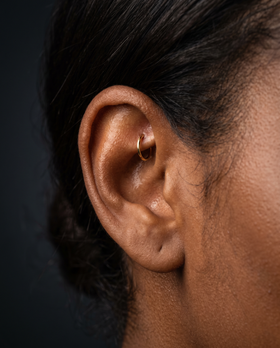
Is yellow gold or rose gold better for a rook earring?
Both are equally safe and beautiful. 14K yellow gold and 14K rose gold contain the same 58.3% pure gold — the difference is in the alloy metals. Yellow gold suits warm and olive skin tones; rose gold flatters fair and cool skin tones. The choice is purely aesthetic.
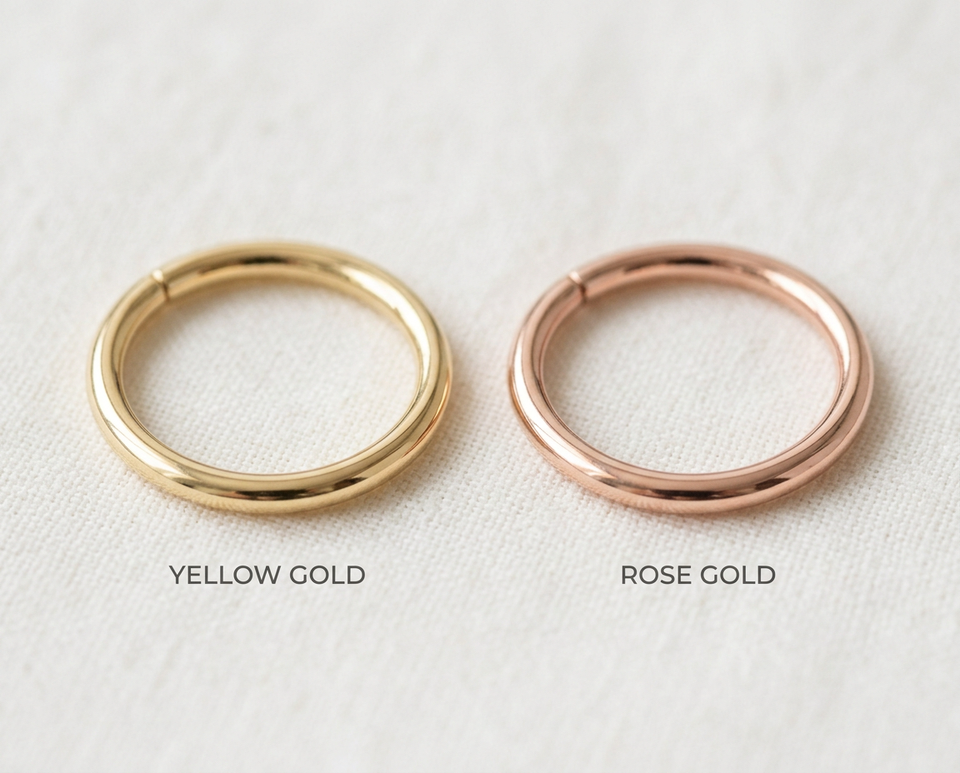
Yellow Gold
- Traditional warm gold tone
- Alloyed with silver and copper
- Complements warm, olive, and medium skin tones
- The most popular choice for rook jewellery
Rose Gold
- Warm pinkish-gold hue
- Higher copper ratio in the alloy
- Flatters fair, cool, and neutral skin tones
- Trendy, feminine, soft aesthetic
Why does my rook piercing have a bump?
Quick answer: Most rook piercing bumps are irritation bumps caused by sleeping on the ear, headphone pressure, touching, low-quality metal, or jewellery that is too tight or too long. Remove the cause and the bump usually resolves in 2–4 weeks.
Rook piercings are particularly prone to bumps because the thick cartilage heals slowly, the tucked position traps moisture, and headphones, pillows, and hair create friction easily.

| Type | Appearance | Cause | Solution |
|---|---|---|---|
| Irritation bump | Small, soft, red or skin-coloured. Stays at the piercing site. | Sleeping on it, headphone pressure, touching, low-quality metal, jewellery too tight or too long. | Remove the irritant. Switch to titanium or 14K gold. Resolves in 2–4 weeks. |
| Hypertrophic scar | Firm, raised, red. Stays within the wound boundary. | Repeated or prolonged irritation. | Same approach as irritation bump. May take months. Silicone scar sheets can help. |
| Keloid Rare | Firm, shiny, grows beyond the wound. Keeps growing. | Genetic predisposition. | Requires medical treatment. See a dermatologist. |
How do I care for a new rook piercing?
Quick answer: Spray with sterile saline 1–2 times daily. Do not touch, twist, or rotate the jewellery. Sleep on the opposite side. Avoid over-ear headphones. Do not change jewellery until your piercer confirms healing at 6–12 months.
Correct aftercare
- Spray sterile saline (0.9% NaCl) 1–2 times daily
- Let warm shower water run over the ear to loosen crusties
- Pat ear dry with clean tissue — never rub
- Sleep on the opposite side (use a travel pillow with a hole if needed)
- Keep hair tied back and away from the rook jewellery
- Keep hairspray, conditioner, and styling products away from the piercing
- Use in-ear earbuds on the opposite ear, or bone-conduction headphones
Common mistakes
- Touch, twist, rotate, or fiddle with the rook earring
- Use tea tree oil, TCP, Dettol, hydrogen peroxide, or alcohol
- Sleep on the pierced ear
- Wear over-ear headphones on the pierced side for 3–6 months
- Pull jumpers, hoodies, or scarves over the ear carelessly
- Submerge in pools, baths, or natural water for at least 3 months
- Change jewellery before your piercer confirms full healing
- Let hair wrap around the curved barbell ends
How do I sleep with a rook piercing?
Sleep on the opposite side. If you cannot switch sides, use a travel or donut pillow — position the hole so your ear sits in the opening with zero pressure on the cartilage. A body pillow behind your back helps prevent rolling onto the pierced side overnight.
Can I wear headphones with a rook piercing?
Avoid over-ear headphones on the pierced side for 3–6 months. Standard in-ear earbuds usually do not touch the rook. AirPods Pro may press against the jewellery in some ears — test gently after the first week. Bone-conduction headphones are the safest option during healing.
When can I change my rook piercing?
Quick answer: Wait at least 6 months. Many rook piercings need 9–12 months before the first jewellery change. Your piercer must confirm the internal channel is fully healed. Changing too early causes bumps and healing setbacks.
Downsizing is not the same as changing
Your piercer may recommend a downsize at 6–8 weeks — swapping the initial longer bar for a shorter one of the same style. This is part of the healing process, not a decorative change. A shorter bar catches less on hair and headphones.
Your first rook jewellery change
When your piercer confirms healing, you can switch to your chosen rook hoop, clicker, or decorative barbell. Have your piercer do the first change. The rook is an awkward angle to reach yourself, and a piercer has the right tools to handle seamless hoops without scratching the gold.
Rook vs daith vs tragus: which inner-ear piercing is best?
Quick answer: The rook is best for a hidden, elegant look in the anti-helix fold. The daith is best for hoop-focused styling in the inner cartilage fold. The tragus is best for a minimal stud near the ear canal. All three are cartilage piercings with similar healing demands.
| Rook | Daith | Tragus | |
|---|---|---|---|
| Location | Anti-helix fold (upper inner ear) | Innermost cartilage fold (above ear canal) | Small cartilage flap in front of ear canal |
| Pain | 6–7/10 | 5–6/10 | 5–6/10 |
| Healing | 6–12 months | 6–12 months | 6–9 months |
| Initial jewellery | Curved barbell | Curved barbell or hoop | Flat-back labret stud |
| Best healed jewellery | Gold hoop, clicker, curved barbell | Gold hoop, clicker, heart ring | Stud, tiny hoop |
| Best for | Hidden, elegant inner-ear look | Hoop-focused statement ring | Minimal, discreet stud look |
| Headphone impact | Over-ear headphones problematic | In-ear earbuds may not fit | In-ear earbuds may not fit |
| Anatomy dependent? | Yes — needs pronounced fold | Yes — needs defined inner fold | Most people have suitable anatomy |