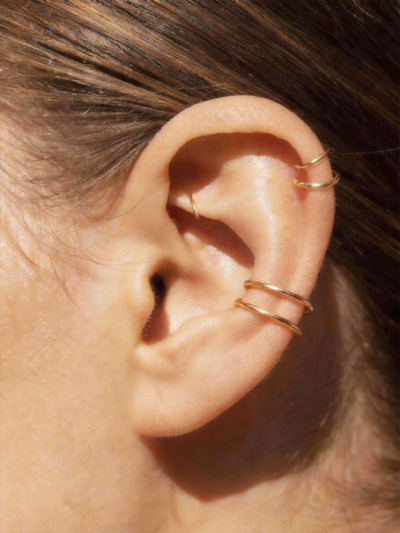
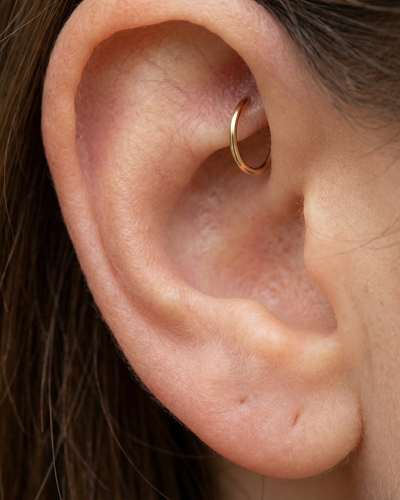
Rook Piercing Aftercare: Daily Routine for Fast Healing
- The entire aftercare routine is: saline spray twice a day, do not touch it, do not sleep on it. That is it.
- Rook piercings take 9–12 months to fully heal — longer than lobe, helix or nostril
- The rook heals slowly because of thick cartilage and poor blood supply — you cannot speed this up
- Over-cleaning is the most common aftercare mistake — more cleaning does not equal faster healing
- Swelling, clear discharge and light crusting are normal for the first 4–8 weeks
- A bump at any point almost always means something is pressing on the piercing — not an infection
The one rule that covers 90% of rook aftercare
Leave it alone.
This sounds passive, but for a rook piercing it is the most active thing you can do. The rook sits inside the ear bowl, surrounded by cartilage on multiple sides, and the piercing passes through a thick vertical fold. It heals from the outside in, and the channel matures slowly because cartilage has almost no direct blood supply. The body knows how to heal this. Your job is to not interfere.
Every touch, every twist, every product you apply, every time you sleep on it — each one interrupts the healing process. The people who heal rook piercings fastest are invariably the people who do the least. The ones who struggle are almost always the ones who are "doing everything right" — cleaning four times a day, rotating the jewellery, applying tea tree oil, checking it constantly. That level of attention is the problem, not the solution.
The daily routine
This is the complete daily aftercare routine for a rook piercing. It takes under two minutes, morning and night.
Morning
Evening
That is the entire routine. Twice a day, every day, for the full healing period. There is no step three. There is no weekly deep clean. There is no special product for month two. Consistency and minimalism are the method.
Month-by-month healing timeline
Knowing what is normal at each stage prevents the panic that leads to over-treatment. Here is what to expect from a rook piercing, month by month.
| Period | What you will see | What is normal | Action |
|---|---|---|---|
| Day 1–3 | Swelling, redness, mild throbbing | The ear bowl feels warm and full. The rook fold looks puffy. | Saline 2x/day. Ibuprofen for pain if needed. Do not touch. |
| Week 1–2 | Peak swelling, clear to light yellow discharge, crusting around barbell balls | Crust on the jewellery is lymph fluid drying — not pus, not infection. Completely normal. | Saline 2x/day. Shower rinse. Do not pick crust off. |
| Week 3–6 | Swelling begins to reduce. Discharge lessens. Crust becomes lighter. | The piercing may feel fine some days and sore others. This fluctuation is normal for cartilage. | Same routine. This is the danger zone for "it feels better so I’ll touch it" — do not. |
| Month 2–3 | Most visible swelling gone. Little to no discharge. Crust is occasional. | The piercing looks healed on the surface. It is not. The internal channel is still immature. | Book a downsize appointment with your piercer at month 3–4. |
| Month 4–6 | Downsized barbell in place. Piercing feels comfortable most days. | Occasional soreness after sleeping wrong or bumping it. This is normal. | Continue saline 2x/day. Reduce to 1x/day if the piercing is consistently comfortable. |
| Month 6–9 | No discharge, no crust, no soreness day to day. | The channel is maturing but still not fully healed internally. Feels healed. Is not. | Maintain 1x/day saline. Do not change jewellery yet. |
| Month 9–12 | Zero symptoms for at least 4 continuous weeks. | The piercing is approaching full maturity. | Book a piercer check. If confirmed healed, you can switch to a hoop. |
The downsize appointment
At month 3–4, your piercer will swap the initial curved barbell for a shorter one that fits your actual anatomy now that swelling has subsided. This is the most important aftercare appointment after the piercing itself.
Why it matters: The initial barbell is deliberately longer than needed — it accommodates the swelling that peaks in week 1–2. Once swelling settles, that extra length means the barbell sticks out further than it should, catches on things more easily, and moves more freely in the channel. Each movement is a micro-irritation. Downsizing to a shorter bar reduces movement, reduces catching, and significantly lowers the chance of an irritation bump from month 3 onwards.
What happens: The piercer unscrews one ball, slides the long barbell out, and immediately inserts a shorter curved barbell. The process takes under a minute. The downsized barbell should sit close to the fold with the balls resting against the skin — no excess post visible.
Cost: Most UK piercing studios charge £10–£20 for a downsize, or include it free if you buy the replacement barbell from them.
Sleeping with a healing rook
Sleep is the longest sustained pressure your rook experiences, and sleeping position is the number one cause of rook complications. The rules are straightforward:
Months 0–6: do not sleep on the pierced ear. Train yourself to sleep on the opposite side. If you are a natural side-sleeper on the pierced side, use a travel pillow with an ear cut-out (u-shaped pillow, or a donut pillow). The ear hangs through the hole and makes zero contact with the pillow surface.
Months 6–12: cautious return. If the piercing has been symptom-free for at least 4 weeks, you can test sleeping on that side. If you wake up with soreness, go back to the opposite side or the travel pillow. The rook is more forgiving than the helix for side-sleeping because it sits inside the ear bowl, but it is not immune.
After full healing: Most people can sleep normally on a healed rook without issues. A low-profile curved barbell is more comfortable for sleeping than a hoop.
What not to do
For rook aftercare, the "do not" list is more important than the "do" list. Every item below is something people commonly do thinking it helps. Every item makes healing slower, not faster.
Do not touch the jewellery. Not to twist it, not to rotate it, not to check if it moves, not to clean under the balls. Every touch transfers bacteria and moves the barbell in the channel. The old advice to "turn it so it doesn’t stick" is a myth that causes more bumps than any other single behaviour.
Do not use tea tree oil, hydrogen peroxide, rubbing alcohol, Bactine, Savlon, TCP, Dettol, or any antiseptic. These kill healing tissue alongside bacteria and create chemical burns inside the channel. Saline only. If a product is not sterile 0.9% saline, it does not go on the piercing.
Do not use cotton buds (Q-tips) to clean around the jewellery. Cotton fibres snag on the barbell, get trapped in the channel, and act as a long-term irritant. If you need to remove visible crust, let the shower water soften it and it will fall away. Do not pick at it.
Do not submerge the piercing in bath water, swimming pools, hot tubs, lakes or the sea. All of these contain bacteria that a healing rook channel cannot fight off. Showers are fine. Baths are not until the piercing is fully healed. Swimming is not until fully healed. No exceptions — this includes hotel pools on holiday.
Do not wear headphones on the pierced ear for the first 6 weeks. Over-ear headphones compress the rook from outside. In-ear earbuds push against it from inside. Both cause irritation bumps. See our full guide on rook piercings and headphones.
Do not change the jewellery before month 9 at the earliest. The one exception is the downsize at month 3–4, performed by a piercer. All other jewellery changes — especially swapping to a hoop — must wait until the piercing is confirmed fully healed. See our guide on when and how to change a rook piercing.
Do not apply moisturiser, face cream, sunscreen or makeup near the ear. Products that contain fragrance, oil or silicone coat the piercing and act as a persistent chemical irritant inside the channel. Apply facial products before the ear and wipe the ear area clean afterwards.
Do not remove the jewellery if you get a bump. Removing the jewellery closes the channel over the bump and traps scar tissue inside. Leave the jewellery in and treat the bump with the jewellery in place.
Showering, hair washing and product residue
The rook sits inside the ear bowl, which means it collects residue from every product that runs down the side of your head. Shampoo, conditioner, hair dye, hairspray and dry shampoo all pool in the ear bowl and coat the piercing if they are not rinsed away.
Always rinse the ear last. At the end of your shower, after all products have been washed out of your hair, tilt your head so clean water runs through the ear bowl for 30 seconds. This clears any residue that settled during the wash.
Avoid ear-first showering. Do not tilt the pierced ear directly under the shower head at the start — this just forces product-laden water into the ear bowl before you have rinsed your hair.
Hair dye and bleach: If you colour your hair during the healing period, apply a thin layer of petroleum jelly around (not on) the piercing before dyeing. This creates a barrier. Rinse thoroughly afterwards and follow with a saline spray. Chemical dye in a healing piercing channel causes immediate irritation.
Signs of normal healing vs signs of a problem
| Normal | Problem — see a piercer | Urgent — see a doctor |
|---|---|---|
| Swelling for the first 2–3 weeks | Swelling that returns after subsiding | Swelling of the entire ear, hot to touch |
| Clear to light yellow discharge | Thick white discharge that smells | Green or brown discharge, thick pus |
| Light crust on the barbell | Persistent heavy crust past month 2 | Crust with spreading redness beyond piercing |
| Mild soreness when bumped | Soreness that increases week over week | Throbbing pain that does not ease, fever |
| Good days and bad days in weeks 3–8 | A bump that has lasted 4+ weeks | Spreading red area, hot skin, feeling unwell |
| Slight redness around piercing holes | Barbell sitting at a new angle | Visible pus, fever, body aches |
The middle column — "see a piercer" — is where most rook issues live. These are not emergencies and they are not infections. They are irritation responses that a piercer can diagnose and fix, usually by identifying a pressure source, adjusting the jewellery, or confirming that the bar needs downsizing.
Lifestyle adjustments during healing
The rook interacts with more daily activities than you expect. Here are the ones that matter:
Phone calls. Hold your phone on the unpierced side. Pressing a phone against the pierced ear compresses the rook. Use speaker mode or switch to the other ear for the full healing period.
Glasses and sunglasses. The arms of glasses sit on the helix, not the rook, so glasses are usually fine. However, taking glasses on and off can bump the upper ear and knock the rook. Be deliberate when removing them.
Hats, beanies and helmets. Anything that compresses the ear bowl presses on the rook. Avoid tight hats on the pierced side. If you cycle with a helmet, ensure the helmet does not squeeze the ear flat — adjust the strap or add padding.
Exercise. Sweat is salty and irritating to a healing piercing. After any workout, rinse the ear with clean water and follow with a saline spray. Avoid contact sports for the first 3 months — a single knock to the ear can set healing back weeks.
Hair. Long hair catches on rook barbells constantly. Tie hair back during healing, especially when sleeping. A single hair wrapped around the barbell ball creates constant tension on the piercing channel.