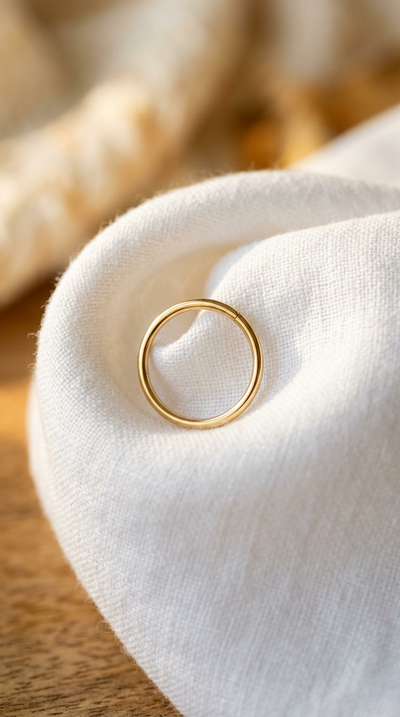
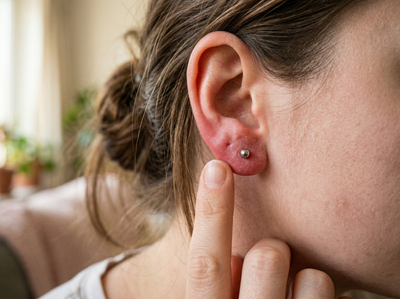
New 14ct Solid Gold Piercing Hoop
Rook Hoop Size Guide: 5mm, 6mm & 7mm
- Rook hoops typically range from 5mm to 7mm — smaller than helix, tragus or conch hoops
- 6mm is the most common rook hoop size — fits most anatomies once the piercing is fully healed
- 5mm suits shallow rook folds where 6mm would press against the inner curve
- 7mm is for deeper rook ridges — less common, and only after healing confirms the fit
- Standard rook gauge is 16G (1.2mm) — thicker than helix or nostril wire
- Never start with a hoop. The rook must heal on a curved barbell first (9–12 months)
How rook hoops are measured
Like every body piercing ring, a rook hoop is defined by two numbers: inner diameter (the width of the circle, edge to edge inside the ring) and gauge (how thick the metal wire is).
The rook is the vertical fold of cartilage above the tragus, running along the upper inner ear. A rook piercing passes through this ridge from front to back, and a hoop wraps around the ridge so both sides of the ring sit flush against the cartilage. Because the fold is narrow and sits deep inside the ear bowl, rook hoops are among the smallest rings used in ear piercing — typically 5–7mm in diameter.
At this scale, every millimetre matters. A 5mm ring hugs the fold tightly with almost no visible gap. A 7mm ring stands proud of the ridge and risks catching on the surrounding anti-helix. Sizing correctly is the difference between a clean inner-ear accent and a ring that constantly irritates.
5mm vs 6mm vs 7mm
| Diameter | Fit | Look | Best for |
|---|---|---|---|
| 5mm | Very tight | Hugs the fold, almost no gap | Shallow rook folds, petite ear anatomy, minimal aesthetic |
| 6mm MOST POPULAR | Snug | Close fit, small gap, clean circle | Standard rook anatomy — fits most fully healed piercings |
| 7mm | Relaxed | Visible gap, ring sits further off the ridge | Deeper rook folds, thicker cartilage, people with roomier inner ear |
5mm — the tightest rook hoop
5mm is the smallest diameter commonly sold for rook piercings. On a shallow rook fold — where the ridge is close to the anti-helix wall — 5mm is the only size that will fit without pressing on surrounding cartilage. It creates an almost flush ring, essentially flat against the fold, which reads as subtle and precise rather than statement.
5mm is not right for every rook. If your rook ridge is more pronounced, a 5mm ring may pinch the fold uncomfortably and cause swelling or bumps. Measure before ordering.
6mm — the default
6mm is the most commonly purchased rook hoop size. On a standard, fully healed rook piercing it creates a snug ring with a small visible gap between the metal and the ridge. The hoop sits cleanly within the inner ear without knocking against the anti-helix above. This is the size most people are searching for when they picture a tiny gold ring in the inner ear.
If you are buying your first rook hoop, do not have a measurement, and have a typical ear anatomy, 6mm is the safest starting point.
7mm — for deeper folds only
7mm is the upper limit for rook hoops. It is only correct when the rook fold is deep enough that the hoop has room to hang without the outer edge of the ring touching the anti-helix. On most rook piercings, 7mm will rub or sit at an angle, which is a leading cause of irritation bumps on this piercing.
If you are considering 7mm, test the clearance first: place your fingertip between your rook ridge and the anti-helix wall. If you can fit a full fingernail in the gap comfortably, 7mm may work. If the space is tight, stay at 6mm.
Curved barbell first, hoop later
This is the single most important rule for rook jewellery, and it applies to every rook hoop size discussion below. A rook piercing must heal on a curved barbell, not a hoop.
The rook is one of the deeper ear piercings, sitting inside the cartilage ridge where swelling, drainage and movement all interact. A curved barbell (or "banana bar") has two fixed balls at either end that cannot rotate or slide through the piercing channel. A hoop, by contrast, rotates with every movement, dragging bacteria and dead skin through the healing channel. For a rook, that rotation almost guarantees a bump.
The standard sequence is:
Rook anatomy changes your size
Unlike the helix rim, which is a long curve with predictable thickness, the rook is a single vertical fold — and folds vary dramatically between people. Some rooks are deep, pronounced ridges that stand clearly away from the anti-helix. Others are shallow, almost flat, with barely any fold at all.
Shallow rook
The fold sits close to the anti-helix wall. There is limited room between the ridge and the surrounding cartilage. On a shallow rook, 5mm or 6mm is typical, and a 7mm ring will almost certainly interfere with the anti-helix. Many piercers will actually refuse to pierce a very shallow rook, because there is not enough tissue to anchor the jewellery.
Standard rook
A clearly defined fold with moderate depth. This is the most common anatomy. 6mm works for the majority of standard rooks once healed. Some anatomies take 5mm, some take 7mm, but 6mm is the starting point.
Deep rook
A pronounced, prominent fold with clear space between the ridge and the anti-helix. 6mm or 7mm works here, and 5mm may actually look too small — swallowed by the surrounding ear. A deep rook is the only anatomy where 7mm is genuinely a natural choice rather than a stretch.
| Rook anatomy | Typical hoop size | Fold depth |
|---|---|---|
| Shallow | 5–6mm | Close to anti-helix |
| Standard | 6mm MOST COMMON | Moderate fold |
| Deep | 6–7mm | Pronounced ridge |
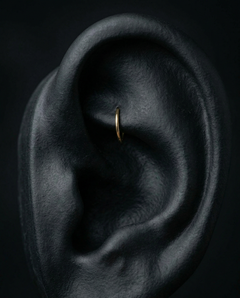
How to measure your rook
The rook is the hardest ear piercing to measure on yourself — it sits deep inside the ear and faces partly forward, partly inward. A mirror alone is usually not enough. The most reliable methods are:
Rook gauge guide
| Gauge | Thickness | Notes |
|---|---|---|
| 18G (1.0mm) | Thin | Uncommon for rook. Only used on already-healed piercings with an 18G channel. Most piercers do not pierce a rook at 18G. |
| 16G (1.2mm) STANDARD | Standard | The default gauge for rook piercings. Balances strength and a clean look. Almost every rook sold in the UK is 16G. |
| 14G (1.6mm) | Thick | Occasionally used on thicker cartilage. Less common. Creates a bolder ring. Check your existing barbell gauge before ordering. |
Unlike helix piercings, which sit between 18G and 16G, the rook is almost universally 16G. Cartilage at this depth needs the structural support of a thicker post — thinner wire is more likely to migrate or cause bumps. If you do not know your rook gauge, assume 16G, and confirm by measuring your current curved barbell before ordering a hoop.
Seamless vs clicker vs captive bead
Once you have the right diameter and gauge, the last decision is the hoop style. Three types dominate the rook market:
Seamless rings. A single continuous circle with a small gap that opens by twisting. No visible hinge or bead. The cleanest, most minimal look. Best for healed rooks where you want the metal itself to be the feature. Requires a small amount of dexterity to open and close — tricky inside the ear, so most people have the first one inserted by a piercer.
Clickers. A ring with a hinged segment that snaps open and clicks shut. Easier to insert and remove than seamless rings, which matters a lot for the rook because the piercing is hard to see. The hinge is slightly visible on close inspection but invisible at normal distance. The most practical choice for most people.
Captive bead rings. A ring held closed by a small bead that snaps into two dimples. Classic, but fiddly — the bead is easy to drop and hard to re-seat, especially inside the inner ear. We generally recommend clickers over captive bead rings for rook placements.
Sleeping with a rook hoop
The rook sits inside the ear bowl, which is its one structural advantage: the surrounding cartilage shields it from direct pillow contact. Unlike the helix, which bears full pillow pressure, a rook ring is mostly protected even when you sleep on that side.
During healing: Avoid sleeping on the pierced ear for the first 6 months. A travel pillow with an ear hole helps. Even though the rook is recessed, side-sleeping pressure compresses the whole ear bowl inward and can disturb the new channel.
After healing, with a hoop: Most people can sleep on a healed rook hoop without issue. If you wake up with any soreness, check that the ring is not rotating against the surrounding cartilage during the night — a smaller ring or a switch back to a curved barbell for sleeping usually resolves this quickly.
Common mistakes
Ordering a hoop in the first month. The rook heals in 9–12 months, and a hoop at month 3 will almost certainly cause a persistent bump. Wait until your piercer confirms the piercing is fully healed.
Assuming rook size matches helix size. Rook hoops run 1–2mm smaller than the same person's helix hoops. Do not buy based on your helix measurement.
Choosing 7mm because "bigger looks bolder". On an average rook, 7mm will rub against the anti-helix and cause constant low-level irritation. 6mm is the right default for a reason.
Using 18G because it looks daintier. Rooks are 16G. Forcing a thinner ring through a 16G channel is a direct path to migration and bumps. Choose a finer-polished 16G seamless ring if you want a delicate look.
Cheap metals in deep cartilage. The rook is recessed and slow to heal, which makes it unusually intolerant of nickel and plated jewellery. Stick to 14K solid gold or implant-grade titanium.