Key takeaways
- Do not change your rook piercing until it is fully healed — 9 to 12 months minimum
- The rook is the hardest ear piercing to change yourself — a clicker is almost always easier than a seamless ring for your first swap
- You need two mirrors (or a phone front camera) to see the rook clearly — one mirror is not enough
- Remove the curved barbell and insert the hoop within 60 seconds — cartilage channels contract fast
- If the hoop will not re-seat after 2–3 tries, stop — put the barbell back and see a piercer
- Match the gauge exactly (almost always 16G) — a thinner hoop will migrate through the channel
Before you start
The rook is not a piercing to experiment on. It sits inside the ear bowl, runs through thick cartilage, and heals more slowly than almost any other ear piercing. Changing it wrong causes bumps that take months to settle. Before you touch the jewellery, check all three of these conditions:
1. The piercing is fully healed
A rook needs 9–12 months of healing before the first jewellery change — and that is a minimum, not an average. "Fully healed" means zero tenderness when you touch the piercing, zero discharge, zero crust, zero bumps, and the channel has been symptom-free for at least four consecutive weeks. If any of those conditions fail, the piercing is not ready. Forcing a change on an unhealed rook almost guarantees an irritation bump.
2. You have the right replacement
A rook hoop is typically 16G (1.2mm) in 5mm, 6mm or 7mm inner diameter. Before removing the current jewellery, confirm:
• Gauge matches exactly. If your barbell is 16G, your hoop must be 16G. A thinner ring will slide through the channel and may migrate over time.
• Diameter is correct. Rook hoops run smaller than helix or tragus hoops — 6mm is the most common fit. See our rook hoop size guide if you are unsure.
• Material is implant-safe. 14K solid gold or implant-grade titanium. Nothing plated, nothing cheap.
3. You have 15 minutes and good light
Rushing this is how people end up with a barbell out, a hoop that will not go in, and a piercing that starts to close. Set aside real time, with daylight or a bright lamp. The rook is hard to see even in ideal conditions.
Never change the jewellery while showering or on the first try after drinking
Wet skin and wet jewellery slip. Alcohol reduces fine motor control. This is a piercing where a two-minute fumble can close the channel partially before you get the new ring seated. Do it sober, dry, in a well-lit room, sitting down, in front of a mirror that will not move.
Why changing a rook is harder than a helix
Every guide you read on changing an ear piercing assumes the helix or lobe. The rook is different in three specific ways, and each makes self-insertion harder.
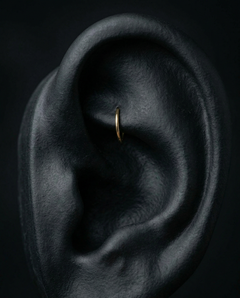
You cannot see it directly. The rook sits inside the ear bowl, facing partly inward. In a single mirror, you see a blurry, angled view of the fold — not the front and back holes you need to line up. A helix, by contrast, sits on the outer rim and is visible straight on.
The channel is thick and curved. A rook piercing passes through a vertical fold of cartilage that is often 4–6mm thick, with natural curvature. A straight hoop post has to find that curved channel by feel. Lobes and helix have almost no depth in comparison.
Your hand blocks your view. The rook is inside the ear, so your fingers holding the hoop sit between your eyes and the piercing. You are working partly by touch the entire time.
Most people have their first rook hoop inserted by a piercer
For £10–£20, a piercer will swap your barbell for a hoop in under a minute — with sterile tools, the right angle, and no channel-closure risk. If this is your first rook change, going to a professional for the first swap, watching exactly how they do it, and doing future swaps yourself is a reasonable approach. Nothing in this guide replaces that option.
| Tool | Purpose | Required? |
|---|
| Two mirrors (or phone + mirror) | See the front and back of the rook at once | Yes |
| Bright light source | The rook is inside the ear bowl — it is naturally shadowed | Yes |
| Sterile saline | Clean the piercing before and after | Yes |
| Clean paper towel | Lay out the new jewellery, dry hands | Yes |
| Ring opening pliers | Only for seamless rings — clickers do not need them | If seamless |
| Disposable gloves | Keep hands cleaner than soap alone can | Recommended |
You do not need antiseptic cream, rubbing alcohol, tea tree oil, or anything else your internet search may have suggested. Sterile saline only. Stronger disinfectants damage healing tissue even on a fully-healed piercing.
The two-mirror setup
This is the single step that separates a smooth rook change from a 20-minute struggle. The rook faces two directions — partly forward, partly inward into the ear bowl. No single mirror angle shows both the entry hole and the exit hole at once. You need a second reflective surface.
Option A: bathroom mirror + hand mirror
Stand or sit facing your bathroom mirror, pierced ear side facing the glass. Hold a hand mirror up behind that ear, angled so you see the reflection of the back of your ear in the main mirror. Now the main mirror shows you both the front (directly) and the back (via the hand mirror). Both holes are visible. Your working hand is still free.
Option B: phone front camera + mirror
Open your phone’s camera in selfie mode and prop it on a stable surface showing your ear in close-up. Use a regular mirror to see the front of the ear directly, and glance at the phone screen for the back. The phone has the advantage of not needing one of your hands — useful because rook changes often need both hands.
Mirror images are reversed — practice first
Every movement your hand makes appears reversed in a mirror. The first 30 seconds at the mirror, practise moving the empty hoop towards your ear and watch how your hand responds in the reflection. If you go straight from picking up the hoop to pushing it in, your hand will flinch in the wrong direction on the first attempt. Two or three dry runs eliminate the flinch.
How to change a rook piercing with a clicker
A clicker is a hinged ring that snaps open and shut with audible feedback. It is the easiest hoop type for a self-change on a rook, because you can open it with one hand, insert it through the channel, and snap it closed without any extra tools. If this is your first time changing a rook piercing, start with a clicker.
Easy-fit clickers
14K Gold Rook Clicker
Hinged clicker. 5-7mm in 16G. Single-hand open & snap close. 14K solid gold.
Shop rook clickers ->
Wash and sit down
Wash your hands thoroughly with soap for 30 seconds. Sit at your mirror setup with good light. Lay the new clicker on a clean paper towel where you can pick it up quickly.
Clean the piercing
Soak a clean cotton pad in sterile saline and gently wipe the front and back of the rook. This removes any dried discharge from around the barbell balls that would otherwise block smooth removal.
Open the clicker
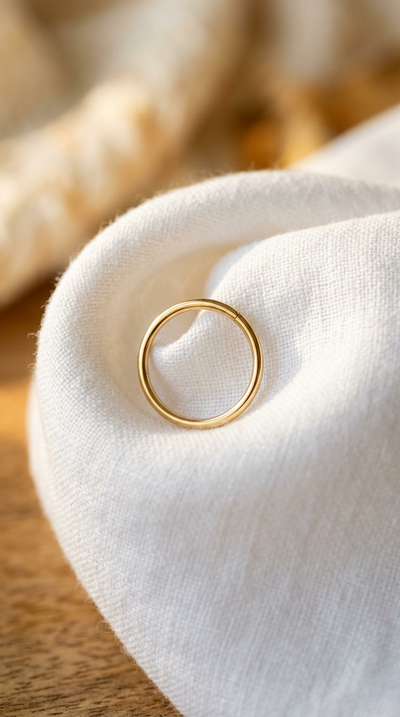
Hold the clicker with both hands. Gently pull the hinged segment open until it clicks into the open position. Do not force it past the natural stop. You should now have a C-shape ring with a small opening at one end.
Unscrew one ball of the curved barbell
Hold the top ball steady and unscrew the bottom ball counter-clockwise. Set the ball somewhere it cannot roll away — a small bowl works. Do not remove the barbell yet.
Slide the barbell out, slide the clicker in
In one continuous movement: gently pull the curved barbell out of the piercing from the top. Immediately insert the open end of the clicker through the front hole and guide it through the channel. Do not pause between these two actions — the channel can begin to contract within 60 seconds.
Snap the clicker closed
Once the clicker post has passed through both holes, gently press the hinged segment closed. You will hear a small click when it locks. The ring should now sit freely around the rook fold.
Check the fit
The clicker should hang vertically, sit flush against the fold, and rotate freely. If it tilts, pulls on the piercing, or sits at an angle, the diameter is wrong — put the barbell back and re-size. Finish with another saline wipe.
How to change a rook piercing with a seamless ring
A seamless ring is a continuous circle with a tiny gap that opens by twisting. It is the cleanest-looking rook hoop once it is in, but harder to insert yourself than a clicker because you need two-handed opening pressure and a steady hand for the final twist closed. If you have never changed your rook before, we recommend a clicker for the first swap and a seamless ring later.
Wash, sit, clean — same first steps
Clean hands, mirror setup, saline wipe of the piercing. Identical to the clicker process.
Open the seamless ring
Hold the ring with both hands on either side of the small gap. Twist the two halves in opposite directions — one towards you, one away. Do not pull the ends apart sideways; this deforms the ring and you will never get it back to a perfect circle. You only need a 2–3mm opening, just enough to pass around the cartilage.
Remove the curved barbell
Unscrew one ball and slide the barbell out from the top. Speed matters — have the seamless ring already open before this step.
Feed the ring through
Use one end of the open ring to enter the front piercing hole, feed it through the channel, and bring the end out of the back hole. The ring will now be hooked around the rook fold with its gap still open.
Twist closed
With both hands, twist the two ends back together in the reverse direction of Step 2. A well-made seamless ring snaps almost invisibly closed. Line up the gap so you cannot feel a seam when you run a fingernail around the ring — a misaligned seam will snag on clothing and hair.
Saline wipe and check
Clean once more and check that the ring rotates freely and sits flush. The seam should be almost invisible. If you have any gap you can feel, the ring is slightly deformed — most jewellers will correct this for free if it happened on first insertion.
Do not force a seamless ring open with pliers on thin gold
Ring-opening pliers can help on thicker 14G rings but are risky on 16G or 18G solid gold seamless rings. The pressure point is tiny and pliers can kink the wire, permanently warping the circle. If you cannot open a seamless ring with your fingers, it is either poorly made or you are twisting the wrong direction — not that you need more force.
The first change — our recommendation
If this is the first time you are changing your rook piercing, regardless of which hoop type you bought, we strongly suggest one of the following:
Go to a piercer for the first swap. £10–£20 and the whole process is done in 60 seconds with sterile tools. Watch exactly how the piercer holds the mirror, positions the hoop, and seats it. This visual reference is worth more than any written guide for your next self-change.
If going in person is impossible, start with a clicker. Seamless rings are the cleanest look but the trickiest insertion. On your first rook change, choose a clicker you can snap open and shut one-handed. Once you are confident with clickers, move to seamless rings for the aesthetic upgrade.
Do not attempt a captive bead ring as your first self-change. Captive bead rings use a tiny bead held in place by two dimples, and that bead will drop down the plughole the first time you try to seat it inside the ear bowl. We do not recommend CBRs for rook at all for most people.
When the hoop will not go in
The channel is partially closed. This is the single most common problem during a rook change. The moment the barbell comes out, the channel begins to contract — in a fully healed piercing this is slow, but it is not zero. If 60 seconds have passed and the new ring will not pass through the front hole, do not force it. Each time you push against a partially-closed channel you damage tissue and create micro-tears that heal into bumps.
Try once more, slowly
Approach the front hole straight on, not at an angle. Apply light, steady pressure — not a jab. If it does not enter within 3–4 seconds of gentle pressure, stop.
Put the barbell back
If the hoop is not going in, re-insert the original curved barbell immediately. The barbell is a different shape and often passes through where the hoop will not. Re-securing the barbell preserves the channel.
Wait and try again — or see a piercer
If the barbell went back in cleanly, wait 24 hours, check that no soreness has appeared, and try the hoop again. If even the barbell is hard to re-seat, the channel has already started closing significantly — book an urgent appointment with your piercer. They have tools (insertion tapers) that can re-open the channel without further damage.
Do not "push harder" as a solution
If the hoop will not enter with gentle pressure, forcing it will either create a new piercing channel next to the existing one (a false route) or tear the existing channel. Both are serious — false routes can require re-piercing and tears cause bumps that last for months. Stop the moment gentle pressure fails.
What to do afterwards
Once the hoop is in, treat the piercing gently for 48 hours. Even on a fully healed rook, changing jewellery is a small trauma and the channel is briefly more sensitive. Wipe with sterile saline twice on day one. Do not touch or rotate the ring beyond the saline wipe. Sleep on the opposite side for the first two nights.
A small amount of redness or mild soreness for 24–48 hours after a change is normal. Persistent soreness lasting more than three days, visible bump forming, or any discharge means the hoop is the wrong size or gauge — check both and consider going back to the curved barbell while you sort it out.
Common mistakes
Trying to change it at month 6. The rook is not close to healed at month 6, even if it looks and feels fine. The deep cartilage channel is still immature. First change at 9–12 months minimum.
Using only one mirror. You cannot see the front and back of a rook in one reflection. Always set up a second mirror or a phone camera before starting.
Removing the barbell before the hoop is open and ready. The window between "barbell out" and "channel contracting" is short. Open the ring first, unscrew second, swap third.
Downsizing the gauge to a "daintier" 18G hoop. A smaller gauge ring will slide freely through a 16G channel and can migrate over weeks. Gauge must match exactly.
Forcing the insertion. If a hoop does not enter with gentle steady pressure, stop. The answer is never more force.
Attempting a seamless ring on the first self-change. Start with a clicker. The seamless aesthetic is worth waiting until your second or third swap.
Frequently asked questions
How do I change my rook piercing for the first time?
Wait until it is fully healed (9–12 months), confirm the new hoop matches your gauge (almost always 16G) and diameter (usually 6mm), set up two mirrors, and start with a clicker rather than a seamless ring. Unscrew the bottom ball of your curved barbell, slide the barbell out, and immediately insert the open clicker through the front hole and snap it closed. If you have never done this before, going to a piercer for the first swap and watching the process is a safer option.
When can I change my rook from a barbell to a hoop?
9 to 12 months after the original piercing, and only once the rook has been symptom-free (no tenderness, discharge, crust or bumps) for at least four continuous weeks. Rook cartilage heals slowly because of its depth, and changing too early is the number one cause of long-lasting irritation bumps on this piercing.
Is a clicker or seamless ring easier to put in?
Clicker, by a wide margin, for a self-change on a rook. A clicker opens with a hinge and snaps shut with audible feedback — you can do it one-handed and you always know when it is closed. A seamless ring needs two hands to twist open, two hands to twist shut, and there is no audible "locked" signal. For the first rook change you do yourself, always start with a clicker.
My rook hoop won’t go in — what do I do?
Stop pushing immediately. The channel is contracting or the hoop is at the wrong angle. Put the original curved barbell back in straight away to preserve the channel, wait 24 hours, and try again with slower, straighter insertion. If even the barbell will not re-seat cleanly, see a piercer — they can use an insertion taper to re-open the channel without damage. Never force a ring through a channel that is resisting.
How long does a rook take to close if I leave it empty?
On a fully-healed rook, the channel begins contracting within minutes of the barbell being removed and can be difficult to re-insert a ring into within 15–30 minutes. Full closure takes weeks to months, but the channel narrowing that blocks new jewellery happens quickly. Never leave the rook empty while you go look for a lost bead — put the old barbell back in, then deal with the replacement.
Can I change my rook piercing in the shower to use the steam?
No. Wet hands, wet jewellery and condensed mirrors make a hard process much harder. Steam does not actually open the piercing channel — that is a myth. Change the jewellery dry, in good light, with a stable mirror setup and a saline wipe before and after.
Does changing the jewellery hurt?
A fully-healed rook should feel like mild pressure, not pain. A short pinch as the new ring passes through the channel is normal. Sharp pain, burning, or pain that continues after the hoop is seated means something is wrong — usually a too-small ring, wrong gauge, or the channel is not as healed as you thought. Stop, re-insert the barbell, and check the size.
←
Rook Hoop Size Guide: 5mm, 6mm & 7mm
Size comparison, anatomy and gauge before you buy
Rook hoops made for easy swaps
14K solid gold clickers. 16G. Single-hand open & close. Nickel-free.
Shop rook hoops ->S
Stepoy
Piercing Jewellery Specialists
We craft handmade 14K solid gold piercing jewellery and publish in-depth guides to help you make informed decisions about your piercings.