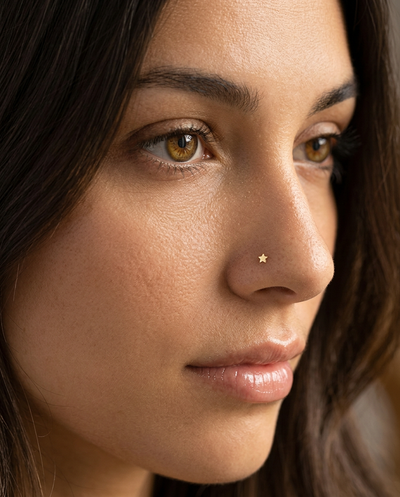
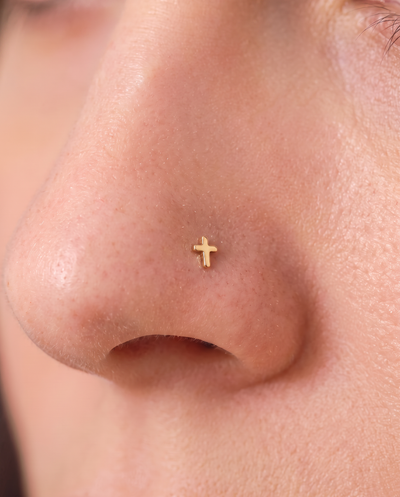
New 14ct Solid Gold Piercing Hoop


Nostril Ring Nirvana: Discovering Your Signature 14K Gold Seamless Look
- Most UK nostril piercings are 20G (0.8mm) — some are 22G for an ultra-fine look. Confirm yours before ordering a 14K gold seamless nostril ring
- An 8mm 14K gold nose ring is the most popular diameter — a relaxed fit with a slightly visible hoop that balances subtlety and style
- Piercing placement height — not nose size — determines your diameter. A higher piercing needs a larger ring to reach the nostril edge
- A minimalist 14K gold nose ring in seamless design is the ultimate “set it and forget it” jewellery — no clasp, no ball, no maintenance beyond basic cleaning
- Always verify inner diameter vs outer diameter before purchasing. Some sellers list outer diameter, making rings appear 1–2mm larger than they actually are
Finding your signature nostril ring
A nostril ring is one of the few pieces of jewellery you wear every waking moment. It becomes part of your face — as natural as your eyebrows. That is why the right ring matters more here than almost anywhere else. A poorly chosen ring draws attention for the wrong reasons: it droops, irritates, catches on things, or turns your skin green.
A 14K solid gold seamless nostril ring does the opposite. It sits quietly, catches light beautifully, and never causes problems. It becomes your signature — the detail people notice but cannot quite place, the piece that elevates your everyday appearance without effort.
Why 14K solid gold is ideal for nostril rings
The nostril is a high-traffic area. You touch your nose, blow it, apply skincare around it, sleep on it. Your nose ring is exposed to moisture, friction, and chemicals every day.
14K solid gold thrives in this environment. At 58.3% pure gold alloyed with palladium, silver, and copper, it is chemically inert against skin contact, nasal moisture, and common skincare ingredients. The nickel-free composition eliminates the risk of contact dermatitis — the itching, redness, and bumps that affect 15–20% of women wearing nickel-containing jewellery.
14K Solid Gold Seamless Ring
- 58.3% pure gold throughout — no base metal core, no coating to wear off
- Nickel-free alloy safe for sensitive skin and long-term nostril wear
- Does not tarnish, corrode, or discolour from moisture or skincare products
- APP-approved for body jewellery, including initial piercings
Plated & Filled
- Plated: Thin gold layer (0.5–5µm) over brass or steel. Wears off within weeks to months on a nostril
- Filled: Thicker layer bonded to brass. Lasts longer but eventually exposes base metal
- Base metals typically contain nickel — the most common contact allergen
- Green discolouration, irritation bumps, and frequent replacement costs
Why 14K specifically — not 9K, 18K, or 24K?
24K (100% gold): Too soft. The fine 20G wire would bend out of shape within days. 18K (75% gold): Beautiful but softer than 14K. More expensive with marginal practical benefit. 14K (58.3% gold): The ideal balance — enough gold for rich colour and biocompatibility, enough structural alloy for the wire to hold its shape in thin gauges. This is why the APP recommends 14K as the minimum karat for body jewellery. 9K (37.5% gold): More alloy than gold. Higher risk of skin reactions. Not recommended for piercings.
Choosing your nostril ring gauge
| Gauge | Thickness | Nostril use | Notes |
|---|---|---|---|
| 18G | 1.0mm | Some nostrils (US standard) | Slightly thicker; creates a bolder wire profile |
| 20G UK Standard | 0.8mm | Most UK nostril piercings | The standard for a 20G 14K gold nose ring — delicate and refined |
| 22G | 0.6mm | Ultra-fine / very delicate | Extremely thin wire for maximum minimalism |
A 20G 14K gold nose ring is the standard for UK nostril piercings. The 0.8mm wire is thin enough for a barely-there look but sturdy enough to hold a circular shape. If you were pierced by a professional in the UK, you are almost certainly 20G.
Finding your perfect nostril ring diameter
Your diameter has nothing to do with the size of your nose. It depends entirely on where your piercing sits on the nostril — the height of the placement relative to the nostril edge.
How piercing placement determines diameter
Low piercing (near the bottom curve of your nostril): 6mm or 7mm. The ring travels a short distance from hole to edge. Tight hugger look.
Medium piercing (standard position): An 8mm 14K gold nose ring is the classic choice. Visible but proportionate.
High piercing (higher on the nostril, toward the bridge): 9mm — not because your nose is larger, but because the starting point is higher.
How to measure at home
Paper strip method: Cut a narrow strip of paper. Hold one end at the bottom edge of your nostril. Bring it up and thread through the piercing hole. Mark and measure — this is your minimum inner diameter.
Existing ring method: Lay your current ring flat on a ruler. Measure from one inner edge to the opposite inner edge. Size up or down from this known measurement.
When in doubt, go smaller. A slightly snug ring looks elegant and intentional. A slightly too-large ring droops below the nostril and creates leverage on the channel.
The minimalist 14K gold nose ring — why seamless wins
A minimalist 14K gold nose ring is defined by what it does not have: no clasp, no ball, no hinge, no visible hardware. It is simply a circle of gold wire hugging your nostril. This is exactly what a seamless ring delivers.
Visual simplicity: The precision seam is virtually invisible once closed. No hardware competes for attention.
Physical comfort: Nothing presses against the inside of your nostril. Nothing catches on towels, face masks, or pillowcases.
Low maintenance: No moving parts, no adjustment needed. Once inserted, it simply stays — for weeks, months, or years.
Seamless vs L-shape vs bone stud — an honest comparison
Seamless hoop: Best aesthetic for a ring look. Most comfortable for long-term wear. Requires a healed piercing and some technique to insert.
L-shape stud: Easy to insert and remove but the L-bend inside the nostril can irritate some people, particularly at night.
Bone stud: Simple ball-end design. The ball can resist removal and re-insertion, which is frustrating for jewellery changes but means it stays put.
Screw/corkscrew: Twisted post that screws into the channel. Secure but can be uncomfortable and fiddly to insert.
For a minimalist ring look, a seamless hoop is the clear winner. For a stud look, an L-shape or flat-back labret is most comfortable.
Choosing your gold colour
| Colour | Alloy | Look | Best suits |
|---|---|---|---|
| Yellow gold Classic | Silver + copper | Traditional warm gold | Warm, olive, and medium skin tones |
| Rose gold | Higher copper ratio | Warm pinkish-gold | Fair, cool, and neutral skin tones |
| White gold Check alloy | Palladium or nickel | Cool silvery-white | Cool skin tones; silver jewellery wearers |
How to insert your 14K gold seamless nostril ring
Wash your hands
Antibacterial soap, warm water, dry with clean paper towel. Nitrile gloves recommended for grip.
Find the seam
Run your fingernail around the ring until you feel the catch where the two ends meet.
Twist open — never pull
Push one end away, pull the other toward you. Open just 2–3mm. Pulling apart sideways permanently distorts the ring.
Slide through the piercing
Insert one end into the outside of your piercing hole and guide through. Sterile saline lubricates if needed. Never force.
Twist closed and align
Reverse the twist until the ends sit flush. Rotate so the seam sits inside the nostril, hidden from view.
Caring for your 14K gold seamless nostril ring
- Spray with sterile saline once daily if the piercing is under a year old
- Let warm shower water run over the ring to loosen dried lymph and skin oils
- Pat dry with a clean tissue after showering
- Do not twist, spin, or rotate the ring during healing
- Harsh chemicals, alcohol, hydrogen peroxide, or tea tree oil near the ring
- Applying perfume, hairspray, or skincare directly over the piercing
- Swimming in pools or natural water with an unhealed piercing
- Sleeping face-down on the piercing — use a travel pillow if needed
- Removing the ring for extended periods if the piercing is under a year old
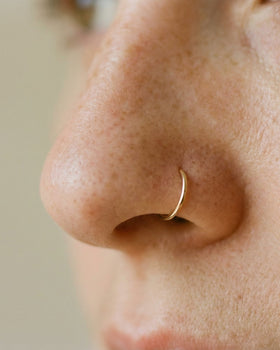
The 5 most common nostril ring mistakes
1. Not knowing their gauge
People assume all nose rings are the same thickness. A 20G ring will not fit in an 18G hole without wobbling, and an 18G ring will not pass through a 20G piercing. Always confirm your gauge.
2. Copying a friend’s diameter
Your friend wears 7mm. You order 7mm. But your piercing is placed higher than hers, so 7mm is too small and pinches. Always measure from your own piercing hole to your own nostril edge.
3. Confusing inner and outer diameter
An “8mm” ring from a seller measuring outer diameter actually has a 6.4mm inner diameter at 20G. Dramatically different fit. Check every listing.
4. Buying “gold” without verifying the type
“Gold-plated,” “gold-filled,” “gold-tone,” and “gold PVD coating” are not solid gold. Only “14K solid gold” (585 or 14ct) means gold all the way through. Look for the karat stamp.
5. Opening the ring by pulling instead of twisting
Creates an oval that will never close flush. Twist: one end forward, one end backward. The ring stays circular and the seam closes perfectly.