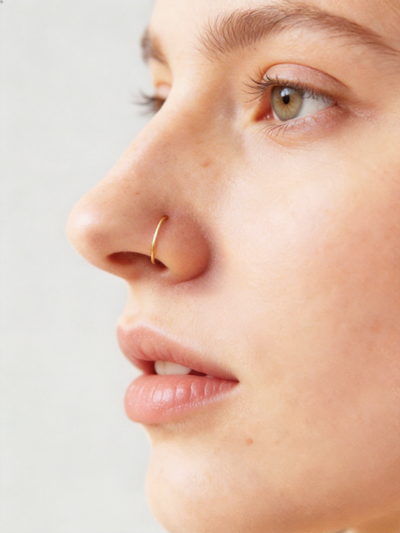
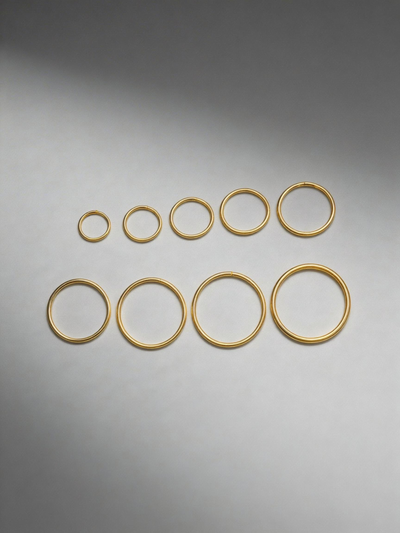
New 14ct Solid Gold Piercing Hoop


Nose Hoop Size Guide for Healed Nostril Piercings
Quick Answer
For most healed nostril piercings, 7mm or 8mm is the easiest starting point: 7mm gives a snug everyday fit, while 8mm leaves a little more room. 6mm is very close and only suits suitable low placements, while 9mm and 10mm work better for higher placements, wider nostrils or a relaxed look. If one full size feels too tight and the next feels too loose, a 0.5mm half size can solve the fit problem.
- Gauge = wire thickness. Diameter = inside hoop size.
- 6mm is a very close fit for suitable low nostril placements.
- 7mm is a snug everyday fit for many healed nostril piercings.
- 8mm is a common starting point if you are unsure.
- 9mm and 10mm are larger options for higher placements, wider nostrils or a relaxed look.
- Half sizes like 6.5mm, 7.5mm and 8.5mm help when one full size is too tight and the next is too loose.
How nose hoop sizing works
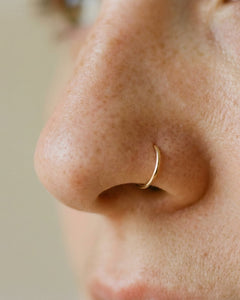
Two measurements define a nose hoop: diameter and gauge. They are separate measurements, and you need both before you buy.
Diameter means the inside hoop size, measured from one inner edge of the hoop to the opposite inner edge. This controls how close the hoop sits to your nostril.
Gauge means wire thickness. Common nostril gauges are 22G (0.6mm), 20G (0.8mm) and 18G (1.0mm). Gauge affects how the jewellery feels in the piercing channel, but it does not tell you the hoop diameter.
Nose hoop size table
Use this table as a starting point for healed nostril piercings. The same size can look different from person to person because fit depends on anatomy, piercing placement and personal preference.
| Inside diameter | Typical fit | Best for |
|---|---|---|
| 6mm | Very close fit | Suitable low placements or very small nostrils |
| 7mm | Snug everyday fit | Many healed nostril piercings with a standard or slightly low placement |
| 8mm COMMON START | Comfortable standard fit | First nose hoop size for many standard nostril placements |
| 9mm | More relaxed fit | Higher placements, wider nostrils or more visible space under the hoop |
| 10mm | Larger fit | Wider nostril placement, higher piercing placement or a looser look |
| Half sizes | In-between fit | 5.5mm, 6.5mm, 7.5mm, 8.5mm, 9.5mm and 10.5mm for full-size fit problems |
Snug, standard and relaxed fit
Snug fit means the hoop sits close to the nostril with minimal visible gap. It can look clean and intentional, but it should never press into the skin or pull on the piercing.
Standard fit means the hoop follows the nostril shape with a small, comfortable gap. For many people, this is 7mm or 8mm.
Relaxed fit means the hoop has more visible space and movement. This may suit higher placements, wider nostrils or anyone who dislikes a close fit.
Half-size nose hoops
Full millimetre jumps can feel larger than expected on a nostril piercing. A 1mm difference can change a hoop from pinching to sticking out, especially on small or low placements.
Half sizes give you a more precise fit. Choose 5.5mm, 6.5mm, 7.5mm, 8.5mm, 9.5mm or 10.5mm when your ideal size sits between two standard diameters.
6mm too tight, 7mm too loose?
If 6mm pinches or presses into your nostril but 7mm sticks out more than you like, try 6.5mm. This is a common in-between choice for low nostril placements where a full 1mm jump changes the look too much.
7mm too tight, 8mm too loose?
If 7mm feels tight or leaves pressure marks but 8mm creates too much visible gap, try 7.5mm. This is often the best half size for healed nostril piercings that sit close to standard placement but need a cleaner fit than 8mm.
Why your nose hoop sticks out
A nose hoop usually sticks out because the diameter is too large for your placement, the piercing sits lower than expected, or the hoop shape is not matching your nostril curve. If your hoop hangs away from the skin, try sizing down by 0.5mm or 1mm.
If the hoop fits through the piercing comfortably but looks too roomy, diameter is the issue, not gauge. Gauge affects wire thickness, while diameter controls how far the hoop sits from your nostril.
Why your nose hoop feels too tight
A nose hoop feels too tight when the inside diameter is too small for the distance from your piercing hole to the nostril edge. It may also feel tight if the placement is higher, the nostril tissue is thicker, or the piercing channel is irritated.
Do not force a tight hoop. Forcing jewellery through a healed piercing can cause soreness or irritation. Size up by 0.5mm or 1mm, and only wear hoops in healed piercings.
How to measure for a nose hoop
The most accurate way to choose a nose hoop is to measure. If you already have a comfortable hoop, measure the inside diameter from inner edge to inner edge. Do not measure the outside of the ring.
If you do not have a hoop, measure from your nostril piercing hole to the lower edge of your nostril, then add room depending on the fit you want: about 1mm for snug, 1.5mm for standard, or 2mm for relaxed.
Gauge guide: 18G vs 20G vs 22G
Gauge is the wire thickness, not the hoop size. A smaller gauge number means thicker wire. If you are unsure which gauge you currently wear, check your original piercing jewellery, ask your piercer, measure an existing hoop, or contact us.
| Gauge | Wire thickness | Typical use | Buying note |
|---|---|---|---|
| 22G | 0.6mm | Very fine healed nostril jewellery | Delicate look, may feel loose if your piercing was made at 20G |
| 20G COMMON | 0.8mm | Common healed nostril hoop gauge | A balanced everyday choice for many nostril piercings |
| 18G | 1.0mm | Thicker healed nostril piercings or bolder look | Do not force into a smaller piercing channel |
Gauge can affect comfort because thicker wire takes more space in the piercing channel, but it does not automatically mean you need a larger diameter. Diameter should still be chosen from your anatomy and placement.
Material trust: 14ct solid gold
STEPOY nose hoops are made from 14ct solid gold, not gold plating. They are nickel-free and designed for sensitive, healed piercings. This matters for everyday hoops because the jewellery sits in close contact with the piercing channel for long periods.
These hoops are for healed piercings only and are not for fresh piercings. If your nostril piercing is still healing, wait until it is fully healed before switching from a stud to a hoop.