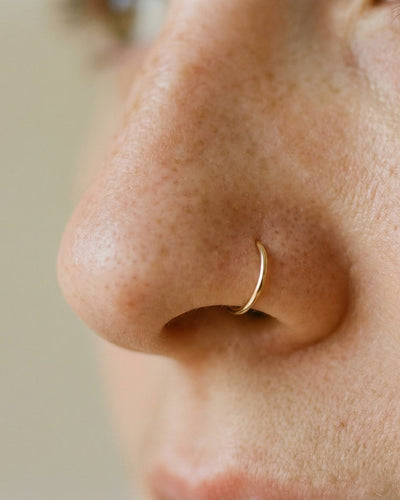
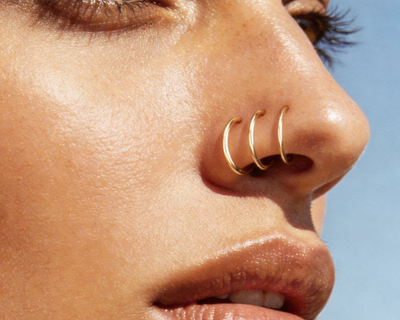
New 14ct Solid Gold Piercing Hoop


Best Nose Ring for Sensitive Skin: 14K Gold & Hypoallergenic Options
- Most piercing reactions are caused by nickel in cheap jewellery — not by your skin being “too sensitive” or the piercing itself
- The term “hypoallergenic” is not regulated in the UK — any brand can use it regardless of what metals are in the product
- Only two materials are reliably safe for sensitive skin: 14K solid gold (nickel-free alloy) and implant-grade titanium (ASTM F-136)
- Gold-plated, gold-filled, “surgical steel” and sterling silver all contain or expose irritants — avoid them entirely
- Switching to 14K solid gold typically resolves chronic piercing irritation within 1–2 weeks
Why your nose ring irritates your skin
You got your nose pierced. It healed. You put in a ring you bought online. Within days, the piercing is red, itchy, crusty, or developing a bump. You try a different ring — same problem. You start wondering if your body is rejecting the piercing. It is not.
In the vast majority of cases, the irritation has nothing to do with the piercing itself and everything to do with the metal sitting inside it. Specifically, one metal: nickel.
Nickel is the most common contact allergen in the United Kingdom. Research estimates that 15–20% of women and 2–5% of men in the UK have a nickel allergy. Many more have a low-level sensitivity that only becomes apparent when nickel is in prolonged direct contact with open tissue — which is exactly what happens inside a piercing channel.
The cruel irony: nickel is present in almost every cheap nose ring on the market. It is in “surgical steel”. It is in the base metal under gold plating. It is in unspecified alloys sold as “hypoallergenic”. Unless you specifically choose a nickel-free material, you are almost certainly wearing nickel inside your piercing.
How to recognise a metal reaction
Nickel reactions in piercings look different from infections. Knowing the difference saves you from unnecessary antibiotics and panicked trips to the GP.
The “hypoallergenic” problem
If you have sensitive skin, you have probably searched for “hypoallergenic nose ring” and found dozens of options claiming to be safe. Here is the problem: “hypoallergenic” is not a regulated term in the UK. There is no legal definition, no testing requirement, and no enforcement body. Any manufacturer can stamp “hypoallergenic” on any product regardless of what it contains.
A £3 brass ring with 0.5 microns of gold plating can legally be sold as “hypoallergenic”. A ring made from 316L stainless steel containing 14% nickel can legally be sold as “hypoallergenic”. The word tells you nothing about the actual metal composition.
This is why material names matter more than marketing labels. Instead of looking for “hypoallergenic”, look for the specific material declaration:
- “14K solid gold” or “585 gold” — confirmed nickel-free alloy
- “Implant-grade titanium” or “ASTM F-136 titanium”
- “Niobium” — a rare hypoallergenic metal, safe but harder to find
- Explicit statement: “nickel-free” with specific alloy details
- “Surgical steel” or “316L stainless steel” — contains 10–14% nickel
- “Gold-plated” or “gold tone” — thin gold over nickel-containing base
- “Gold-filled” — brass core eventually exposed through wear
- “Sterling silver” — oxidises inside piercings, stains tissue black
- “Hypoallergenic” without a specific material name — meaningless marketing
- “Premium metal”, “high quality alloy” or other vague terms — these hide the actual composition
Materials that are safe for sensitive skin
There are exactly three metals that are reliably safe for people with sensitive skin in piercings. Everything else is either unsafe or carries risk.
| Material | Nickel | Biocompatibility | Tarnish | Sensitive skin |
|---|---|---|---|---|
| 14K solid gold BEST FOR SENSITIVE SKIN | None (nickel-free alloy) | Excellent | Never | Ideal — zero reactivity |
| Implant-grade titanium SAFE | None | Excellent (ASTM F-136) | Never | Excellent — used in medical implants |
| Niobium SAFE | None | Excellent | Never | Excellent — rare, less widely available |
| “Surgical steel” AVOID | 10–14% | Poor for sensitised skin | Can corrode | Primary cause of reactions |
| Gold-plated AVOID | In base metal | Degrades | Plating flakes | Triggers reactions when plating wears |
| Gold-filled AVOID | In brass core | Temporary | Eventually | Delayed reactions as gold layer thins |
| Sterling silver AVOID | None, but oxidises | Poor — reacts with body | Severely | Stains skin, causes irritation |
Why 14K solid gold is ideal for sensitive skin
If you have sensitive skin and want a gold nose ring, 14K solid gold is not just a good option — it is the only gold option that is actually safe. Here is why:
No hidden base metals
The entire ring is made from 14-karat gold alloy. There is no brass underneath. There is no steel core. There is no coating that can wear off. The surface your skin contacts today is the same material it will contact in five years. For sensitive skin, this permanence is everything — reactions happen when materials change or degrade, and solid gold does neither.
Nickel-free when properly alloyed
14K gold is 58.3% pure gold, alloyed with other metals for structural strength. In quality body jewellery, those alloy metals are palladium, silver and copper — all of which have very low reactivity. No nickel is used. This is the critical distinction: the alloy composition must be explicitly nickel-free. Not all 14K gold is created equal — cheap 14K gold from unspecified sources sometimes uses nickel as a filler alloy because it is inexpensive and hardens the metal well. Always confirm the specific alloy is nickel-free.
Chemically inert in the body
Gold does not react with sweat, body oils, saline, water, or the slightly acidic environment inside a piercing channel. It does not corrode, oxidise, or release ions into surrounding tissue. This chemical stability is why gold has been used in dental work and medical devices for centuries — the body tolerates it exceptionally well.
Warm tone without compromise
Many people with sensitive skin want the warm gold aesthetic but have been burned (literally) by plated rings. 14K solid gold gives you the exact look you want — rich yellow gold, rose gold, or white gold — without any risk. The colour is inherent to the metal, not a surface coating.
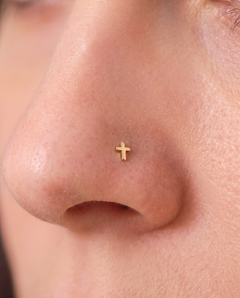
14K gold vs titanium for sensitive skin
Both are safe. Both are nickel-free. The choice between them is aesthetic and practical, not medical:
| 14K solid gold | Implant-grade titanium | |
|---|---|---|
| Sensitive skin safety | Excellent — zero reactivity | Excellent — medical-grade |
| Nickel content | None (nickel-free alloy) | None |
| Look | Warm gold lustre — yellow, rose, or white | Silver-grey or anodised colours |
| Weight | Slightly heavier — substantial feel | Very light — barely noticeable |
| Durability | Softer — handle with care in thin gauges | Very hard — scratch-resistant |
| Lifespan | Decades — retains material value | Decades — no resale value |
| Price | £30–£60 for a nose hoop | £8–£15 for a nose hoop |
| Best for | Long-term wear, gold aesthetic, premium feel | Budget-friendly, healing period, silver look |
Our recommendation: if you want a gold nose ring, choose 14K solid gold. If you want a silver-toned ring or need a budget option for the healing period, choose implant-grade titanium. Both will resolve your sensitive skin issues completely. Many people start with titanium during healing and switch to solid gold for everyday wear.
How to switch from a problem ring
If you are currently experiencing a reaction from your nose ring, here is how to resolve it:
Step 1: Remove the irritating jewellery. Take out the ring or stud that is causing the reaction. Do not leave a reacting piece of metal in your piercing — the irritation will only intensify with continued exposure.
Step 2: Clean the piercing. Spray sterile saline solution (0.9% sodium chloride, no additives) on both sides of the piercing. Do this 2–3 times on the first day. Do not use alcohol, hydrogen peroxide, tea tree oil, or any product that is not pure saline.
Step 3: Insert safe jewellery immediately. Put in your 14K solid gold or implant-grade titanium replacement as soon as possible. Do not leave the piercing empty for extended periods — nostril piercings can begin to close within hours, especially if they are less than a year old.
Step 4: Wait. Continue twice-daily saline sprays for a week. Most nickel reactions begin to calm within 48–72 hours of removing the offending metal. Irritation bumps typically flatten within 2–4 weeks. Full resolution can take up to 6 weeks for severe or prolonged reactions.
Choosing the right size and gauge
Sensitive skin benefits from a well-fitted ring. Jewellery that is too large, too heavy, or too thick creates additional friction inside the piercing channel, which compounds any existing irritation.
Gauge for sensitive skin
Match the gauge of your new ring to the gauge of your piercing. If you were pierced at 20G (the UK standard), wear 20G jewellery. Wearing a thinner gauge (e.g. 22G in a 20G hole) leaves extra room for the ring to move and shift, which can irritate a sensitised piercing. A snug gauge fit minimises movement and friction. For full gauge details, see our 18G vs 20G vs 22G guide.
Diameter for sensitive skin
A ring that is too large hangs below the nostril and pulls on the piercing under its own weight. This constant downward pressure irritates the piercing channel and slows healing. Choose a diameter that fits snugly against your nostril — 6mm for tight fit, 7mm for standard fit, 8mm for relaxed fit. When in doubt, go smaller. See our nose ring size guide for measuring instructions.
UK and EU nickel regulation
The EU Nickel Directive (retained in UK law post-Brexit as the REACH Regulation, Annex XVII, Entry 27) sets limits on nickel release in jewellery that comes into direct and prolonged contact with skin. For post assemblies inserted into piercings, the limit is 0.2 μg/cm²/week of nickel release.
However, enforcement is limited. Cheap imported jewellery sold online often does not comply. Third-party marketplace sellers frequently ship products from outside the UK that have never been tested against these standards. The regulation exists, but compliance is largely self-policed by manufacturers.
The safest approach: rather than relying on regulation to protect you, choose materials that contain no nickel in the first place. 14K solid gold with a nickel-free alloy and implant-grade titanium both achieve zero nickel release not by meeting a threshold, but by not containing any nickel to release.