
Lobe Piercing: Complete Guide to Stacking, Sizing, Nickel Safety & Gold Hoops

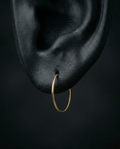
- Ear piercing is the number-one cause of nickel allergy worldwide. The material of your very first earrings matters enormously — 14K solid gold or implant-grade titanium from day one prevents nickel sensitisation that lasts a lifetime
- Piercing guns should be avoided — even for lobes. Guns use nickel-containing studs, cannot be sterilised, and create blunt-force trauma. Always choose a professional piercer with a sterile needle
- Most earlobes can support 2–3 piercings, some can fit 4. Spacing of at least 8mm between holes prevents crowding. Anatomy (detached vs attached lobes) determines your maximum
- Huggie hoops are the safest long-term lobe earring — lightweight, close-fitting, and no momentum to stretch holes. Heavy earrings over years cause irreversible hole elongation
- Healing takes 6–8 weeks — the fastest of all piercings. Do not twist, rotate, or change jewellery until healed
What is a lobe piercing?
A lobe piercing passes through the soft, fleshy tissue at the bottom of the ear — the earlobe. Unlike every other ear piercing, the lobe contains no cartilage. It is soft tissue with a rich blood supply, which is why lobe piercings are the least painful, fastest healing, and most forgiving piercings you can get.
A single lobe piercing is a classic. But the real potential of lobe piercings emerges when you start stacking: second lobes, third lobes, stacked lobes, constellation clusters. The lobe is the foundation layer of the “curated ear” trend — the base that helix, tragus, conch, and daith piercings build upon. Planning your lobe piercings with future cartilage piercings in mind creates a cohesive, intentional aesthetic rather than a random collection of holes.
Almost everyone is anatomically suited for at least two lobe piercings. Many people can fit three or four. But the number you can support depends on your individual lobe size, shape, and whether your lobes are detached (hanging freely from the face) or attached (merging directly into the jawline with less available surface area).
Why your first earring matters more than any other
This is the most important section in this guide, and the one that almost every lobe piercing article fails to cover.
Ear piercing is the single most common cause of nickel allergy in the world. This is not an opinion — it is a finding confirmed by multiple peer-reviewed studies published in medical journals. A 2001 study demonstrated that men with ear piercings had a nickel sensitisation rate nearly three times higher than men without piercings. A paediatric study found that children with pierced ears were 2.8 times more likely to react to nickel than children without piercings.
Why? When you pierce the ear, you create a wound — an open channel directly into the dermis. Whatever metal sits in that channel during healing has prolonged, intimate contact with exposed tissue and immune cells. If that metal releases nickel (as surgical steel, fashion jewellery alloys, and many “hypoallergenic” studs do), the immune system can become permanently sensitised to nickel. Once sensitised, you have a nickel allergy for life — affecting not just earrings but belt buckles, watch backs, glasses frames, and even some foods.
What contains nickel? More than you think. Surgical steel (316L) contains 10–14% nickel. Many “hypoallergenic” fashion studs contain unlisted nickel. Piercing gun studs are almost universally nickel-containing alloys with a thin gold or rhodium coating that wears off within weeks. Even some 10K and 14K gold alloys can contain trace nickel — which is why specifying a nickel-free alloy (palladium-silver-copper) is essential, not just “14K gold.”
Piercing gun vs needle — why it matters even for lobes
Many high-street jewellers and shopping-centre kiosks use piercing guns for lobe piercings. They are fast, cheap, and familiar. They are also the source of the majority of lobe piercing complications. Here is why:

| Piercing gun | Sterile needle (professional piercer) | |
|---|---|---|
| Mechanism | Blunt-force spring pushes a stud through tissue | Sharp hollow needle cleanly separates tissue fibres |
| Sterilisation | Cannot be autoclaved (plastic components melt). Wiped with disinfectant — not sterile. | Single-use, sterile, individually packaged. Autoclaved reusable tools. |
| Stud material | Almost always nickel-containing alloy with coating | Implant-grade titanium or 14K solid gold — your choice |
| Tissue trauma | Blunt force crushes tissue — more swelling, slower healing | Sharp cut separates tissue — less trauma, faster healing |
| Operator training | Often minimal (a few hours of in-store training) | Years of apprenticeship, anatomy knowledge, infection control |
| Regulation (UK) | Not regulated — anyone can operate a gun | Licensed, inspected, bound by local authority standards |
| Butterfly back | Yes — traps bacteria, embeds in swollen tissue | No — flat-back labret used instead, sits flush |
Lobe piercing types & stacking layouts
There are more ways to arrange lobe piercings than most people realise. Understanding the options helps you plan an intentional, curated layout rather than adding piercings randomly.

| Layout | Description | Best for |
|---|---|---|
| Standard line Classic | Piercings follow the natural curve of the earlobe bottom, spaced 8–10mm apart horizontally | Traditional 1st/2nd/3rd lobe look. Works with all lobe sizes. |
| Vertical stack | Piercings placed directly above each other in a vertical column up the lobe | Modern, dimensional look. Requires longer lobes with enough vertical space. |
| Offset / diagonal | Second piercing placed slightly above and to one side, creating a diagonal line | Smaller lobes where vertical stacking is not possible. Creates visual interest. |
| Constellation / cluster | Multiple piercings arranged in a pattern (triangle, arc, scatter) rather than a line | 3+ piercings for an artistic, unique arrangement. Requires consultation with piercer. |
| Graduated cascade | Standard line but with deliberately graduated jewellery sizes (small at top, larger at bottom) | Huggie hoops: 8mm top, 9mm middle, 10mm bottom. Elegant, coordinated look. |
Spacing and anatomy
Minimum 8mm between piercings. Closer than 8mm crowds the jewellery, increases the risk of tissue tearing between holes, and limits your jewellery options (hoops need clearance to avoid overlapping). Your piercer will mark proposed positions on your ear and have you approve the placement before piercing — take this step seriously and look from multiple angles.
Detached vs attached lobes: Detached earlobes (hanging freely from the face) offer more surface area and can typically support 3–4 piercings. Attached earlobes (merging directly into the jawline) have less available space and may support 1–2 piercings comfortably. This is not a limitation to be frustrated by — a well-placed single or double lobe looks better than a crowded triple.
How much does a lobe piercing hurt?
2–3 out of 10 — the gentlest piercing you can get. The earlobe is soft tissue with no cartilage, no bone, and minimal nerve density. Most people describe it as a brief pinch — like a quick snap of a rubber band. It is over before you have processed that it happened.
Second and third lobes hurt the same as the first. Unlike cartilage piercings where location dramatically affects pain, all lobe piercings are through the same soft tissue. There is no escalation — your fifth lobe piercing will feel the same as your first.
After the piercing: Mild tenderness for 1–2 days. You may feel warmth and slight throbbing for a few hours. By day 3, most people report no discomfort unless the ear is bumped or pressed (e.g. sleeping on it).
| Piercing | Pain |
|---|---|
| Lobe This piercing | 2–3/10 |
| Nostril / Septum | 3–4/10 |
| Helix | 4–5/10 |
| Tragus | 5–6/10 |
| Conch / Daith | 5–6/10 |
| Rook | 6–7/10 |
Healing timeline
6–8 weeks — the fastest healing of all piercings. Soft tissue with rich blood supply heals dramatically faster than cartilage. Do not let this speed make you complacent with aftercare — infections can still happen.
| Phase | Timeline | What to expect | What to do |
|---|---|---|---|
| Fresh | Day 1–3 | Slight tenderness, mild redness. Much less dramatic than cartilage piercings. You may barely notice it after day 1. | Saline spray 2x daily (front and back). Do not touch or twist. |
| Early healing | Week 1–3 | Tenderness fades. Small crust may form around jewellery (normal dried lymph). Do not pick it off. | Continue saline. Avoid sleeping directly on the piercing for 2–3 weeks. Let shower water loosen crusties. |
| Nearly healed | Week 3–6 | Feels completely normal. Resist changing jewellery yet — internal channel is still maturing. | Reduce saline to 1x daily. Continue avoiding snagging. |
| Healed | Week 6–8 | Ready for jewellery change. No tenderness, no discharge, no redness. | Visit your piercer for first jewellery change if switching to hoops. |
Size guide: huggie hoops for lobe piercings
Gauge (wire thickness)
20G (0.8mm) is the standard gauge for lobe piercings in the UK — this is what most piercers use for lobes and what gun piercings create. 22G (0.6mm) is a finer, more delicate option for an ultra-dainty look. Both are comfortable for everyday wear.
Diameter (hoop size)

| Diameter | Look | Best for |
|---|---|---|
| 8mm | Small, close-fitting huggie | Third lobe, upper stacked position, subtle |
| 9mm | Classic huggie size | Second lobe, everyday wear |
| 10mm Most Popular | Standard lobe hoop | First lobe, the most universally flattering |
| 11–12mm | Larger, more visible | Statement look, larger earlobes, single bold hoop |
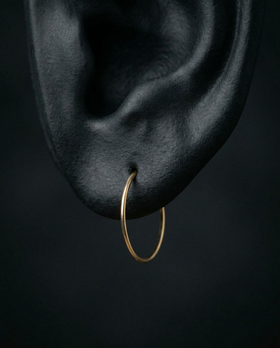
Gold colour options

Yellow Gold
- Traditional warm gold tone — the most popular choice
- Complements warm, olive, and medium skin tones
- Mixes beautifully with other yellow gold pieces across the ear
Rose Gold
- Warm pinkish-gold hue — softer, more feminine
- Flatters fair, cool, and neutral skin tones
- Currently trending — pairs with rose gold cartilage jewellery
Both are 14K solid gold (58.3% pure gold) with nickel-free alloys. Metal consistency across your ear stack creates the most cohesive look — all yellow gold or all rose gold. Mixing metals (gold + silver) is also a deliberate trend, but works best when the mix looks intentional rather than accidental.
Preventing stretched earring holes
This is the long-term issue that no one warns you about when you get your first lobe piercing. Over years and decades, earring holes can gradually elongate from a round dot into a vertical slit. In severe cases, the earlobe can tear completely. Once stretched, earring holes do not shrink back — surgical repair is the only option, costing £500–£2,000.
What causes stretching?
Heavy earrings over time. Every gram of earring weight pulls downward on the piercing hole. Large hoops, chandelier earrings, and heavy statement pieces create momentum that accelerates stretching. The damage is cumulative — you will not notice it happening day by day, but over years the hole gradually elongates.
Sleeping in earrings. Side-sleeping with earrings creates hours of sustained lateral pressure on the hole. Over years, this contributes to elongation and thinning of the lobe tissue around the piercing.
Snagging accidents. A single violent snag (towel, clothing, child pulling) can tear an already-weakened hole instantly.
Why huggie hoops are the safest everyday earring
Huggie hoops solve the weight problem. A 14K gold huggie hoop in 8–10mm weighs well under 1 gram — negligible downward force on the piercing. They sit close to the earlobe with no hanging momentum, no swing, no leverage. Compare this to a large fashion hoop (3–5 grams) that creates constant pulling force amplified by movement.
If you must wear heavy earrings: Save them for special occasions only. Remove them immediately after the event. Never sleep in heavy earrings. Use supportive earring backs (disc backs distribute weight better than butterfly backs). And for your everyday, leave-in earrings, choose lightweight huggie hoops that your lobes can support indefinitely without stretching.
Aftercare
Correct aftercare
- Spray sterile saline (0.9% NaCl) 2x daily — front and back of the lobe
- Let warm shower water loosen crusties — do not pick them off
- Pat dry with clean tissue (not fabric towel)
- Sleep on the opposite side for 2–3 weeks
- Leave the jewellery completely still — do not twist or rotate
- Be careful removing clothes over your head — hold neckline away from ears
Common mistakes
- Twist, rotate, or “turn” the earring (outdated harmful advice)
- Touch the piercing with unwashed hands
- Use TCP, Dettol, hydrogen peroxide, alcohol, or tea tree oil
- Submerge in pools, baths, or natural water for 4–6 weeks
- Change jewellery before 6–8 weeks
- Let others touch your piercings
- Use phones pressed against a freshly pierced ear — use speakerphone

Lobe vs helix: comparison
| Lobe | Helix | |
|---|---|---|
| Tissue | Soft, vascular — rich blood supply | Firm cartilage — avascular |
| Pain | 2–3/10 | 4–5/10 |
| Healing | 6–8 weeks | 3–9 months |
| Standard gauge | 20G | 16G or 18G |
| Aftercare intensity | Basic, short-term (6–8 weeks) | Strict, long-term (3–9 months) |
| Sleeping | Can sleep on it after 2–3 weeks | Avoid sleeping on it for 3–6 months |
| Stretching risk | Yes — hole can elongate with heavy earrings over years | No — cartilage resists stretching |
| Best for | Foundation of curated ear, stacking, everyday wear | Statement piece, accent in curated ear |