
Daith Piercing: Complete Guide to Pain, Healing, Migraines, Cleaning & Gold Rings

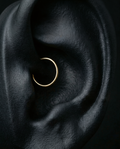
- The daith passes through the thickest inner cartilage fold directly above the ear canal. Pain is 5–6/10 — a deep pressure with a crunch sound, not a sharp sting
- Healing takes 9–12 months, sometimes 18. The inner ear gets less air circulation than outer piercings, which slows healing. Patience is non-negotiable
- The daith is the hardest piercing to clean. It sits in a curved fold you cannot see without a mirror, where shampoo residue and moisture accumulate. Technique matters
- In-ear earbuds are permanently incompatible. Unlike the tragus, this is not a temporary healing restriction — a daith hoop permanently occupies the space earbuds need
- No scientific evidence supports the migraine claim, but we explain the theory, the studies, and what to realistically expect
- The daith is the only cartilage piercing where a hoop is the default initial jewellery — the curved anatomy naturally suits curved jewellery from day one
What is a daith piercing?
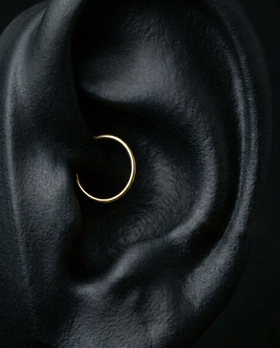
A daith piercing (pronounced “doth,” rhyming with “moth” — though “dayth” is also widely used) passes through the innermost fold of cartilage in your ear, the small thick ridge directly above the ear canal opening. This fold is called the crus of the helix. The name “daith” comes from Hebrew, meaning “knowledge.”
What makes the daith unique is its placement. Unlike helix or tragus piercings that sit on the ear’s outer edges, the daith sits deep inside the ear’s inner curves. Jewellery nestles within the fold rather than projecting outward, creating a subtle, sculptural look that is simultaneously hidden and striking. From the front, a daith piercing is barely visible; from the side, it is a beautiful focal point.

The daith is one of the more challenging piercings for the piercer. The cartilage is thick, the angle is awkward, and precision is critical — the needle must pass through a curved fold at exactly the right depth and angle. A curved needle is used rather than a straight one. The piercing itself takes longer than most (6–10 seconds vs 1–2 for a helix), which extends the sensation. Choose a piercer with specific daith experience and a portfolio of healed daith work.
Anatomy: not everyone can get a daith
The inner cartilage fold must be deep enough and thick enough to support jewellery. If your fold is very shallow, thin, or barely pronounced, a piercer may not be able to safely place a daith. They will examine your ear during consultation and tell you honestly. If your daith anatomy does not work, a rook piercing sits just above the daith area and offers a similar inner-ear aesthetic with different anatomy requirements.
The migraine question: does it really work?
This is the topic that drives more people to search “daith piercing” than any other. The claim is that a daith piercing can reduce or eliminate migraines by permanently stimulating an acupuncture pressure point in the inner ear. Here is what the evidence actually shows:
The theory
In auricular acupuncture, the ear contains pressure points that correspond to different body systems. The daith area is associated with the vagus nerve — the longest cranial nerve, involved in pain modulation, digestion, and autonomic function. The theory is that a piercing in this location applies continuous pressure to this point, mimicking acupuncture and potentially reducing migraine frequency.
The evidence
There is currently no peer-reviewed scientific study that confirms daith piercings treat or prevent migraines. The evidence landscape includes:
A 2017 Cleveland Clinic case report documented a single patient who experienced migraine improvement after a daith piercing — but case reports are the lowest tier of medical evidence and cannot establish causation.
No randomised controlled trial (the gold standard for medical evidence) has ever been conducted on daith piercings and migraines.
The placebo effect is a significant confounding factor. Getting a new piercing is exciting, creates a sense of agency over a chronic condition, and generates a psychological expectation of improvement — all of which can temporarily reduce pain perception regardless of the piercing’s location.
Acupuncturists themselves note that the exact pressure point location varies between individuals, and a piercing is a fixed point that may not correspond to the correct location for a given person.
Our honest position
We sell daith piercing jewellery, so we have a commercial interest in encouraging daith piercings. We are choosing transparency over sales pressure: do not get a daith piercing solely for migraines. If you want a daith for aesthetic reasons and happen to experience migraine relief, consider it a welcome bonus. If you are seeking migraine treatment, consult your GP first — proven treatments exist that should not be bypassed for an unproven alternative.
How much does a daith piercing hurt?
5–6 out of 10. The daith passes through thick cartilage in a curved fold, so the sensation is a deep, firm pressure rather than a sharp sting. Most people describe it as less painful than expected for the thickness of the cartilage.
The crunch and the duration: Like the tragus, you will hear a crunching sound as the needle passes through — amplified by the proximity to your ear canal. But unlike most piercings (which take 1–2 seconds), the daith takes 6–10 seconds because the piercer must carefully navigate the curved fold with a curved needle. This extended duration is the most challenging aspect for most people — it is not sharply painful, but the sustained pressure and sound over several seconds can be psychologically intense.
After the piercing: A dull ache for a few hours. Tenderness for 1–2 weeks. The inner ear may feel warm and slightly congested. By week 2–3, most people only notice the piercing when it is accidentally bumped.
| Piercing | Pain |
|---|---|
| Earlobe | 2–3/10 |
| Nostril / Septum | 3–4/10 |
| Helix | 4–5/10 |
| Tragus / Conch | 5–6/10 |
| Daith This piercing | 5–6/10 |
| Rook | 6–7/10 |
Healing timeline
9–12 months for full healing, with some daith piercings taking up to 18 months. This is on the longer end for cartilage piercings, and there are two reasons beyond cartilage thickness:
Reduced air circulation: The daith sits in a tucked-away inner fold that gets far less air exposure than outer piercings like the helix. Air circulation aids healing; without it, the channel stays moist longer and heals more slowly.
Moisture and residue trapping: The inner ear fold naturally collects moisture, earwax, and hair product residue. This creates a warmer, more humid micro-environment around the piercing — conditions that favour bacterial growth and slow tissue formation.
| Phase | Timeline | What to expect | What to do |
|---|---|---|---|
| Inflammatory | Week 1–2 | Swelling, redness, warmth. The inner ear feels full or congested. Clear/pale lymph discharge. Some bleeding on day 1 is normal. | Saline spray 2x daily — angle the nozzle to reach both sides of the fold. No earbuds. No sleeping on that ear. |
| Early healing | Month 1–3 | Swelling reduces. Crusty discharge around jewellery (dried lymph). Looks much better externally but internal channel is fragile. | Continue saline. Downsize appointment at week 6–8 if initial jewellery was oversized. Rinse inner ear thoroughly after hair washing. |
| Intermediate | Month 3–9 | Appears healed externally. Internal channel forming. Irritation bumps if bumped, slept on, or if moisture/residue accumulates. | Reduce saline to 1x daily. Continue rinsing after showers. Do not change jewellery. Be patient. |
| Maturation | Month 9–12+ | Channel matures and strengthens. Sensitivity decreases. Piercing feels settled and comfortable. | Visit piercer to confirm full healing before changing jewellery. Some daith piercings need 12–18 months. |
Cleaning a daith piercing — the hardest piercing to clean
This is the section most guides underplay, but daith owners consistently cite as their biggest ongoing challenge. The daith sits in a deep, curved inner fold that you cannot see without a mirror and cannot reach easily with your fingers. Standard “spray both sides” advice is not sufficient.
The recommended cleaning technique
Step 1: Tilt your head to the side (pierced ear up). Spray sterile saline directly into the inner ear fold from 3–5cm away. The spray should reach both the front and back of the jewellery. Let it sit for 30 seconds.
Step 2: In the shower, use warm running water (or a removable shower head) to gently rinse the inner ear fold. This loosens crusties and rinses out shampoo, conditioner, or soap residue that accumulates in the fold. This step is critical — product residue is a leading cause of daith irritation bumps.
Step 3: Dry the area thoroughly. Use a hair dryer on a cool, low setting aimed at the inner ear for 30–60 seconds. The inner fold retains moisture longer than any other piercing location, and moisture promotes bacterial growth. Air-drying is not sufficient — the fold is too sheltered to dry naturally.
Earbuds — a permanent lifestyle change
This is the detail most people do not fully appreciate before getting a daith piercing, and the detail that causes the most regret when they do.
In-ear earbuds (AirPods, standard earbuds) are permanently incompatible with a daith hoop. The daith hoop sits in exactly the space where earbuds need to rest. Unlike the tragus (where earbuds can often work around a small hoop once healed), the daith hoop physically occupies the ear canal entrance at all times. This is not a temporary healing restriction — it is a permanent change for as long as you wear a daith ring.
Your options:
Over-ear headphones: Safe at all stages, as long as the ear cup does not compress the inner ear. Large, well-padded cups that surround the ear are ideal.
Bone conduction headphones: Sit on the cheekbones and transmit sound through vibration. Never touch the ear. The perfect daith-friendly alternative for exercise, commuting, and work.
Open-ear earbuds: Some newer designs (e.g. ear-hook styles) sit outside the ear canal rather than inside it. These may work with a daith piercing depending on ear anatomy.
Jewellery types for daith piercings
The daith is unique among cartilage piercings: a hoop is the default initial jewellery, not a stud. The curved inner fold naturally suits curved jewellery. A flat-back labret stud can sometimes be used but often sits awkwardly in the daith anatomy and can put uneven pressure on the channel.

| Style | Best for | Pros | Cons |
|---|---|---|---|
| Captive bead ring | Initial piercing | Secure — bead held by tension. Full circle, sits well in the daith fold. Classic look. | Bead can be difficult to insert/remove without ring-opening pliers. |
| Curved barbell | Initial piercing (alternative) | Easy to clean around. Minimal movement. Some piercers prefer this for healing. | Less visually distinctive than a hoop in the daith position. |
| Clicker ring | Healed piercings | Hinged segment clicks open/shut — easiest to insert in the hard-to-reach daith. Endless decorative options (hearts, moons, gems). | Hinge is a potential weak point. Some users struggle to click it shut in the tight fold. |
| Seamless hoop Most elegant upgrade | Healed piercings | Clean, uninterrupted circle of gold. No visible hardware. The most minimal, refined daith look. | Must twist open to insert — can be tricky in the tight daith fold. Requires correct diameter. |
Size guide: gauge & diameter
Gauge
16G (1.2mm) is the standard gauge for daith piercings. The thick cartilage of the inner fold is pierced with a 16G needle at most professional studios. 18G (1.0mm) is a secondary option that gives a finer, more delicate look. Both are stable in the daith fold.
Diameter

| Diameter | Look | Best for |
|---|---|---|
| 8mm | Snug, sits very close within the fold | Smaller ears, discreet, minimal |
| 9mm | Close fit with slight visible curve | Understated everyday look |
| 10mm Most Popular | Classic daith hoop — fills the fold beautifully | Most ear anatomies, balanced visible/discreet |
| 11mm | More visible, projects slightly from the fold | Larger ears, more presence |
| 12mm | Statement hoop, extends beyond the fold | Bold look, maximum impact |
Initial jewellery is typically oversized (10–12mm) to accommodate swelling. Once healed, you can downsize to a tighter-fitting hoop that sits more snugly in the fold.
Gold colour options
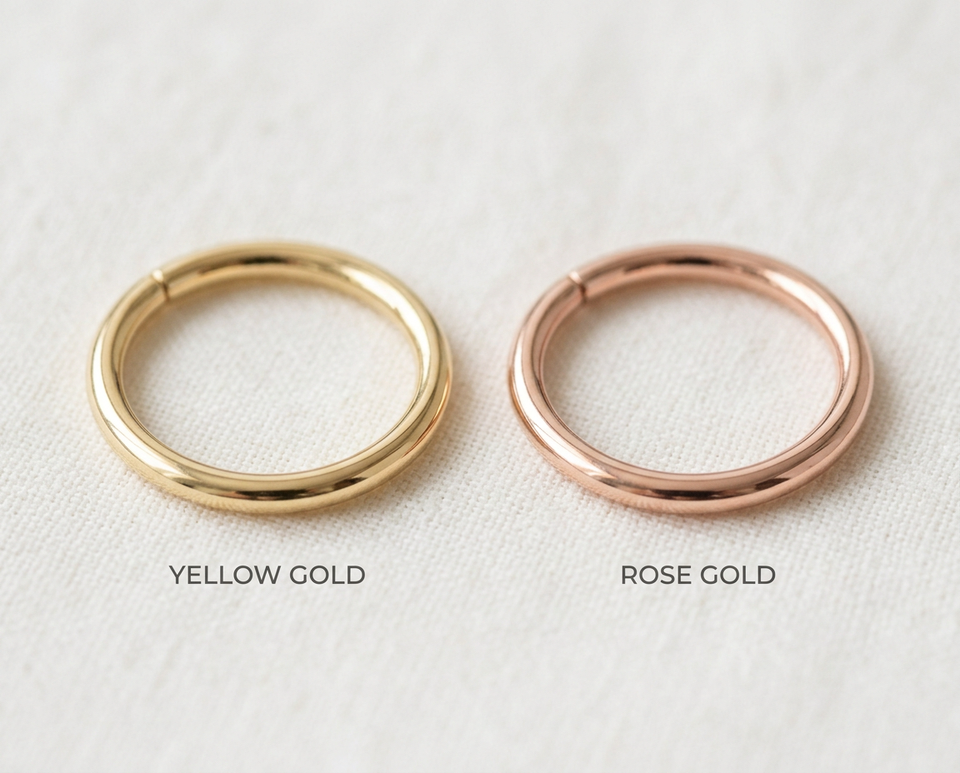
Yellow Gold
- Traditional warm gold — glows beautifully in the inner ear fold
- Complements warm, olive, and medium skin tones
- The most popular choice for daith rings
Rose Gold
- Warm pinkish-gold hue — soft and feminine
- Flatters fair, cool, and neutral skin tones
- Pairs beautifully with rose gold pieces in the ear stack
Aftercare
Correct aftercare
- Spray sterile saline 2x daily — tilt head, angle nozzle into the fold
- Rinse the inner ear fold thoroughly in the shower after hair washing
- Dry the fold with a hair dryer on cool/low setting — moisture is the enemy
- Sleep on the opposite side — donut pillow essential for side-sleepers
- Tie hair back to prevent strands catching on the jewellery
- Leave the jewellery completely still — do not rotate or twist
Common mistakes
- Use cotton buds/Q-tips — fibres get trapped in the piercing
- Use earbuds at any stage — permanently incompatible
- Touch, twist, or rotate the jewellery
- Use TCP, alcohol, hydrogen peroxide, or tea tree oil
- Leave shampoo or conditioner residue in the inner ear fold
- Sleep on the pierced side
- Change jewellery before piercer confirms healing (9–12+ months)

Daith vs rook: comparison
| Daith | Rook | |
|---|---|---|
| Location | Innermost fold above ear canal | Antihelix fold (above the daith) |
| Pain | 5–6/10 (deep pressure, 6–10 seconds) | 6–7/10 (thickest cartilage fold) |
| Healing | 9–12 months (up to 18) | 6–18 months |
| Gauge | 16G standard | 16G or 18G |
| Hoop size | 8–12mm | 6–8mm |
| Initial jewellery | Hoop (captive bead ring or curved barbell) | Curved barbell |
| Earbuds | Permanently incompatible | Compatible — does not contact ear canal |
| Cleaning difficulty | Hardest — deep, hidden fold | Moderate — partially visible |
| Migraine claim | Yes (unproven) | No |
| Visibility | Subtle from front, striking from side | More visible from multiple angles |
| UK cost | £30–£55 | £25–£45 |