New 14ct Solid Gold Piercing Hoop
18G vs 20G Tragus Ring: Gauge Guide for Your Piercing
- Gauge measures wire thickness, not ring diameter — a lower number means thicker wire
- 18G (1.0mm) is the most common tragus piercing gauge in the UK — if unsure, start here
- 20G (0.8mm) is thinner — more delicate look, common on nostril piercings and sometimes used for tragus
- 16G (1.2mm) is thicker — less common for tragus, standard for septum and some cartilage piercings
- You can wear a thinner gauge in a thicker piercing (20G in an 18G hole), but not the reverse without stretching
- Gauge and diameter are completely separate measurements — you need both when ordering
What gauge means
Gauge is a measurement of wire thickness based on the American Wire Gauge (AWG) system. The numbering is counterintuitive: the lower the gauge number, the thicker the wire. An 18G wire is thicker than a 20G wire.
For tragus jewellery, gauge determines the thickness of the metal that passes through your piercing channel. It affects how the ring looks on your ear, how sturdy it feels, and most importantly whether it actually fits through your piercing hole.
Gauge is not the same as diameter. Diameter measures the width of the ring circle (5mm, 6mm, 7mm). Gauge measures the thickness of the wire that makes that circle. You can have a 6mm ring in 18G or 20G — same circle size, different wire thickness. When ordering tragus jewellery, you need both numbers. See our tragus hoop size guide for diameter advice.
18G vs 20G: side by side
| Gauge | Thickness | Visual | Feel | Tragus use |
|---|---|---|---|---|
| 18G UK STANDARD | 1.02mm | Visible wire substance, clean and defined line | Substantial, secure in the piercing | Most common tragus gauge. Standard at majority of UK studios. |
| 20G | 0.81mm | Finer, more delicate wire — barely-there thread | Lightweight, subtle presence | Used by some piercers. Standard for nostrils, occasionally for tragus. |
| 16G | 1.27mm | Noticeably chunkier, bold wire | Substantial, firm — you can feel the thickness | Less common for tragus. Standard for septum. Used when bolder look is wanted. |
The difference between 18G and 20G is only 0.2mm. That sounds insignificant, but on a piece of jewellery this small — a 6mm ring on the tragus — the difference is clearly visible. 18G creates a defined, intentional line. 20G creates a finer, more thread-like appearance. Neither is better; they are different aesthetics.
18G — the tragus standard
Wire thickness: 1.02mm.
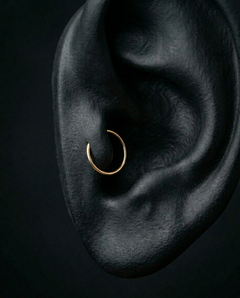
The look: A clear, defined line of metal wrapping around the tragus. The wire has enough visual weight to register immediately as a ring, even from a few feet away. In 14K gold, 18G catches light and reads as a deliberate piece of jewellery. It is the gauge that most people picture when they imagine a tragus hoop.
Who it suits: anyone who wants their tragus ring to be visible and intentional. Men often prefer 18G because the slightly thicker wire looks more proportionate against wider ear structures. It is also the standard healing gauge at most UK studios, which means the vast majority of healed tragus piercings in the UK are 18G.
Practical advantages: 18G wire is sturdier than 20G. On the tragus, where the ring is tiny and handled frequently (insertion, removal, adjusting around earbuds), the extra 0.2mm of metal makes the ring noticeably easier to handle. 18G seamless rings hold their shape better and are less likely to bend or kink when being opened and closed.
In 14K gold: the slightly greater wire volume means 18G rings contain more gold than 20G equivalents, so they are marginally more expensive. The trade-off is increased durability and a more visible gold presence on the ear.
20G — the delicate option
Wire thickness: 0.81mm.
The look: A fine, delicate line. The wire is thin enough that the ring reads as a thread of gold rather than a distinct ring. From a conversational distance, a 20G tragus hoop is barely visible — you see a glint of gold rather than a clear circle. This is the “is that a ring or just light catching?” aesthetic.
Who it suits: people who want maximum subtlety. If you prefer your jewellery to whisper rather than speak, 20G delivers that. It is also the standard gauge for nostril piercings, so if you wear 20G on your nose and want to match the wire thickness across nose and ear, 20G on the tragus creates visual consistency.
Practical considerations: 20G wire is softer and more flexible than 18G. This means the ring is easier to bend open and closed, but also easier to accidentally deform. When handling a tiny 5–6mm ring in 20G, be gentle — excessive force when opening the gap can kink the wire and ruin the circular shape. In 14K gold, this is especially important because gold is softer than titanium or steel.
How to check your gauge
If you do not know what gauge your tragus was pierced at, here are three ways to find out:
Gauge across other piercings
If you have multiple piercings, knowing the standard gauge for each helps when ordering:
| Piercing | Standard gauge | Thickness |
|---|---|---|
| Tragus | 18G or 16G | 1.0–1.2mm |
| Helix | 18G or 16G | 1.0–1.2mm |
| Conch | 16G or 14G | 1.2–1.6mm |
| Nostril | 20G or 18G | 0.8–1.0mm |
| Septum | 16G or 14G | 1.2–1.6mm |
| Lobe | 20G or 18G | 0.8–1.0mm |
| Daith | 16G or 18G | 1.0–1.2mm |
| Rook | 16G or 18G | 1.0–1.2mm |
Notice that tragus and helix share the same standard gauge (18G/16G). If you are building an ear stack, you can often use the same gauge across both piercings for a cohesive look. The difference will be in ring diameter — tragus needs 5–7mm while helix typically needs 6–8mm. For the full gauge breakdown across all piercings, see our complete gauge comparison guide.
Gauge and material
Gauge interacts with material in ways that matter for the tragus:
14K gold at 20G is softer and more flexible than at 18G. On the tragus, where the ring is 5–7mm and handled in a tight space, 20G gold requires gentler handling. The thinner wire bends more easily, which makes opening and closing a seamless ring straightforward but also means the ring can be accidentally kinked by rough handling. Treat 20G gold rings with care.
14K gold at 18G is the sweet spot for tragus hoops. The extra 0.2mm of metal gives the ring meaningful structural integrity. It holds its circular shape better, springs back more predictably when opened, and is less prone to accidental deformation. For most people, 18G is the more practical gauge for a tragus seamless ring in gold.
Titanium at either gauge is harder than gold and holds shape well regardless. If you are concerned about accidentally bending a thin-gauge ring, titanium is more forgiving than gold. However, titanium cannot replicate the warm gold tone — it is silver-grey only (or anodised for colour).
Which gauge to choose
The decision comes down to three factors:
1. What were you pierced at? Match your new jewellery gauge to the gauge your piercing was created with. This is always the safest starting point. If you were pierced at 18G, buy 18G. If 20G, buy 20G.
2. What look do you prefer? If you want the ring to be clearly visible and read as a defined piece of jewellery, 18G. If you want a barely-there, thread-like delicacy, 20G. Both are valid — it is purely an aesthetic preference.
3. Do you match across piercings? If you wear 20G on your nostril and want visual consistency, 20G on the tragus matches. If you wear 18G across your helix and conch, 18G on the tragus continues that line. Matching gauge across an ear stack creates a uniform wire thickness that looks intentional.