Key takeaways
- The tragus is the hardest ear piercing to change at home because you cannot see the hole directly — you work mostly by feel
- Only switch from stud to hoop once your tragus is fully healed (4–8 months, zero tenderness)
- Insert the hoop from behind the tragus (inside the ear), pushing outward — this gives you fingertip control
- Twist the seamless ring open, never pull — pulling warps the circle permanently
- A magnifying mirror with good lighting makes the process dramatically easier
- If this is your first time, consider having your piercer do the initial swap
Why the tragus is tricky
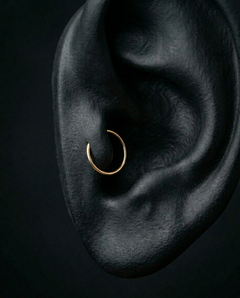
Changing jewellery on the tragus is harder than on any other common ear piercing, and there is a specific reason: you cannot see the piercing hole. The tragus points inward toward the ear canal. The front of the piercing faces away from any mirror angle you can achieve, and the back faces into the ear canal where visibility is essentially zero.
This means you work almost entirely by touch. You feel for the hole with your fingertip behind the tragus, guide the wire in by feel, and rely on the sensation of the ring sliding through the channel to confirm it is going in correctly. Once you have done it a few times, it becomes second nature — but the first attempt can be frustrating.
The good news: it is entirely doable at home with patience, good lighting, and the right technique. Thousands of people do it every week. The key is preparation and knowing the correct direction of insertion.
First time? See your piercer
If this is your very first stud-to-hoop switch, we strongly recommend having your piercer do it. They can confirm the piercing is fully healed, verify your hoop size is correct, and demonstrate the insertion technique on your actual ear. Once you have seen it done, doing it yourself next time is much easier.
Before you start
Confirm healing. Your tragus must be fully healed before switching to a hoop. This means 4–8 months since piercing, with zero tenderness when the jewellery is touched, zero discharge, and zero crusting. If any of these are present, the piercing is not ready. A hoop in an unhealed tragus will cause an irritation bump almost immediately.
Check your size. You need the correct inner diameter (typically 5–7mm for tragus) and gauge (18G or 16G). A ring that is too small will not fit around the tragus. A ring with the wrong gauge will not pass through the piercing hole. See our tragus hoop size guide if unsure.
What you need
Clean hands — wash thoroughly with soap and warm water.
Saline spray — to clean both the piercing and the new ring.
A magnifying mirror — ideally wall-mounted or on a stand so both your hands are free. A regular mirror works, but magnification helps enormously for seeing the front of the tragus.
Good lighting — position a bright lamp so it illuminates the ear from the side. Overhead lighting creates shadows on the tragus that make it harder to see.
Your seamless ring — rinsed with saline and dried with a paper towel.
Patience — allow 10–15 minutes for the first attempt. It gets faster with practice.
Removing the stud
Most tragus studs are flat-back labrets. To remove:
Hold the flat back steady
Reach behind the tragus with one hand and grip the flat disc between your thumb and fingertip. Hold it firmly so it does not rotate. This is the trickiest part — the disc is small and slippery. Dry fingers help.
Unscrew the front
With your other hand, grip the decorative top on the front of the tragus and twist counterclockwise (lefty-loosey). If it is a push-pin (threadless) style, pull the front straight outward while holding the back. It should slide out with a gentle tug.
Slide the post through
Once the top is detached, pull the post through from the back. The flat disc will come out behind the tragus. If the post does not slide easily, spray saline on both sides to lubricate the channel.
Do not leave the piercing empty for long
Cartilage piercings can begin to tighten within hours without jewellery. Once you remove the stud, insert the hoop promptly. If you need a break, slide the stud back in rather than leaving the hole empty. A channel that partially closes will make hoop insertion painful or impossible.
Opening the seamless ring
The same technique applies as for nose hoops, but the smaller size of tragus rings makes it slightly more delicate:
Grip both sides of the opening
Hold the ring with your thumb and index finger on each hand, positioned on either side of the join (where the two ends meet).
Twist, do not pull
Push one end toward you and the other end away. This separates the ends vertically while keeping the ring circular. You only need a 2mm gap — enough for the wire to enter the channel.
Be extra gentle with small gauges
A 20G or 18G seamless ring in 5–6mm is very small and the wire is thin. In 14K gold, which is softer than titanium, over-twisting can kink the wire. Use the minimum force necessary. If you cannot grip the ring with your fingers, ring-opening pliers with flat, smooth jaws help enormously.
Step-by-step insertion
Find the hole from behind
With one hand, reach behind the tragus (inside the ear, near the ear canal entrance). Use your fingertip to feel for the piercing hole on the back surface of the tragus. It will feel like a small dimple or indentation. This is your guide.
Insert the ring from behind
Take the open ring in your other hand and guide one end into the hole from behind the tragus, pushing outward. Your fingertip behind the tragus directs the wire into the channel. Push gently until you feel the wire tip emerge on the front surface of the tragus.
Guide the ring through
Once the tip appears on the front, continue feeding the ring through by rotating it downward, following the curve of the hoop. The ring should wrap around the bottom edge of the tragus as you feed more wire through the channel.
Position the ring
Continue rotating until the ring sits naturally around the tragus edge with the opening positioned behind the tragus (hidden from view). The ring should wrap snugly around the cartilage without pinching.
Close the ring
Reverse the twisting motion: push the ends back toward each other until they meet and the gap disappears. Run your fingertip over the join — it should feel smooth with no catch. If you feel a step or gap, adjust until the ends are perfectly flush.
Check in the mirror
Angle your mirror to see the front of the tragus. The ring should form a clean arc around the tragus edge. The join should be invisible. If the ring sits crookedly, it may be the wrong size — a ring that is too small will tilt at an angle because it cannot complete the curve around the cartilage.
The behind-to-front direction is key
Inserting from behind (inside the ear outward) is easier than from the front because you can feel the hole with your fingertip and guide the wire directly into it. Inserting from the front means pushing toward a hole you cannot see or feel, which is significantly harder. Almost everyone who struggles with tragus hoops is trying to go front-to-back. Switch direction and it becomes much simpler.
Seamless hoop
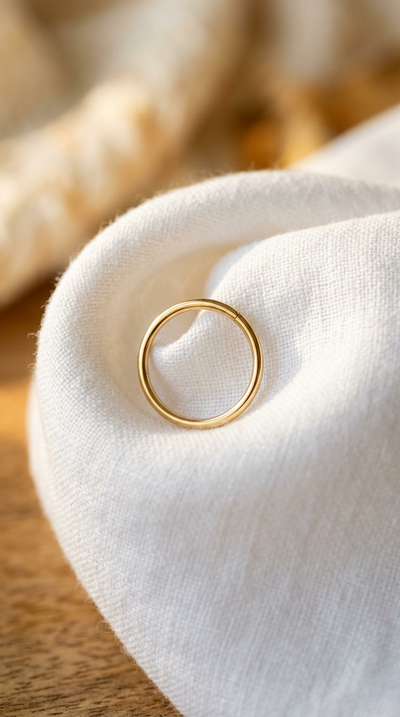
14K Gold Tragus Ring
Handmade seamless hoop. 5-8mm in 18G & 20G. Nickel-free 14K solid gold.
Shop tragus rings ->Troubleshooting problems
I cannot find the hole
The back of the tragus piercing can be hard to locate by feel. Try these: spray saline on the back of the tragus — the liquid will pool slightly in the dimple of the hole, making it easier to feel. Alternatively, hold a small torch (phone flashlight) behind your ear. The light may illuminate the channel from behind, making the hole visible from the front as a tiny bright spot.
The ring will not go through
Do not force it. The most common reasons: you are not aligned with the channel (try a slightly different angle), the gauge is wrong (too thick for your piercing), or the channel has partially tightened. Spray saline to lubricate, wait a minute, and try again gently. If it still meets resistance, insert your stud back in and visit your piercer — they have the tools and angle to guide the ring through properly.
The ring looks crooked
A ring that sits at an angle is almost always too small. It cannot complete the full curve around the tragus cartilage, so it tilts. Try the next size up (e.g. 7mm instead of 6mm). If the ring fits but still appears slightly crooked, the piercing angle itself may be slightly off-centre — this is cosmetic and not harmful. Rotating the ring gently may find a more flattering position.
I cannot close the ring flush
Small tragus rings (5–6mm in 20G or 18G) are fiddly to close by hand. The wire is thin, the ring is tiny, and your fingers may be too large to grip precisely at this scale. Ring-opening pliers with flat, smooth jaws are the solution. Grip the ring on both sides of the opening and gently twist until the ends meet. These pliers cost very little and make every future jewellery change easier.
It hurts to insert
Mild resistance is normal. Cartilage channels are firmer than soft tissue channels and may feel slightly tight, especially if this is the first hoop after months of wearing a stud. Apply gentle, steady pressure — not force. If you experience sharp pain, stop. The piercing may not be fully healed, or the channel may have developed scar tissue that a piercer can help navigate.
After insertion
Saline twice daily for 3–5 days. A jewellery change is a minor disruption to the piercing channel, even in a fully healed piercing. A few days of gentle saline care helps the channel settle around the new ring.
Do not touch or spin the ring. Let the channel adapt on its own. Rotating the ring creates micro-friction that can lead to irritation.
Avoid earbuds for 48 hours. Give the piercing a brief rest from earbud pressure after the jewellery change. After 48 hours, resume normal earbud use.
Sleep on the opposite side for a few nights. Pillow pressure on a newly inserted hoop can shift it out of position. Once the ring has settled (3–5 days), sleeping on either side is fine.
Watch for bumps. A small irritation bump in the first week after switching is not unusual, especially on cartilage. Continue saline care. If the bump persists beyond two weeks, the ring may be the wrong size, the piercing may not have been ready, or the ring may be pressing on the cartilage. Consult your piercer.
Frequently asked questions
Can I put a tragus hoop in by myself?
Yes, once you know the technique. The key insight is inserting from behind the tragus (inside the ear, pushing outward) rather than from the front. This gives you fingertip control over the hole location. Most people succeed on their first solo attempt with patience and good lighting.
Which direction do I insert?
From behind the tragus, pushing outward toward the front. Feel for the hole behind the tragus with your fingertip, guide the ring end into the hole, and push until it emerges on the front surface. Then rotate the ring around the tragus edge.
How long does it take?
First attempt: 10–15 minutes (including stud removal and ring opening). With practice: 2–3 minutes. Most of the time on the first attempt is spent finding the hole and getting comfortable with the angle. Once you have done it twice, it becomes routine.
Do I need pliers?
Not necessarily, but they help enormously. Small tragus rings (5–6mm) are difficult to open and close with fingers alone, especially in thinner gauges. Flat-jaw ring-opening pliers designed for body jewellery make the process faster and more precise. They cost very little and are worth owning if you plan to change your tragus ring regularly.
Can I switch back to a stud after wearing a hoop?
Yes, at any time. Remove the hoop using the reverse of the insertion process (twist open, slide out) and insert your stud. Many people alternate between a stud for daily earbud use and a hoop for evenings and weekends. Switching does not harm a fully healed piercing.
The ring keeps falling out — what is wrong?
A properly closed seamless ring should not fall out. If it opens on its own, the ends are not fully aligned (close them more precisely) or the ring may be too large for the tragus, causing it to catch and pull open on clothing or bedding. If the ring opens repeatedly, try a slightly snugger diameter or consider a clicker, which has a secure click-shut mechanism.
←
Tragus Hoop Size Guide: 5mm-8mm
Compare sizes and find your perfect tragus hoop
Ready to switch to a hoop?
14K solid gold seamless tragus rings. 5-8mm. Handmade, nickel-free.
Shop tragus rings ->S
Stepoy
Piercing Jewellery Specialists
We craft handmade 14K solid gold piercing jewellery and publish in-depth guides to help you make informed decisions about your piercings.