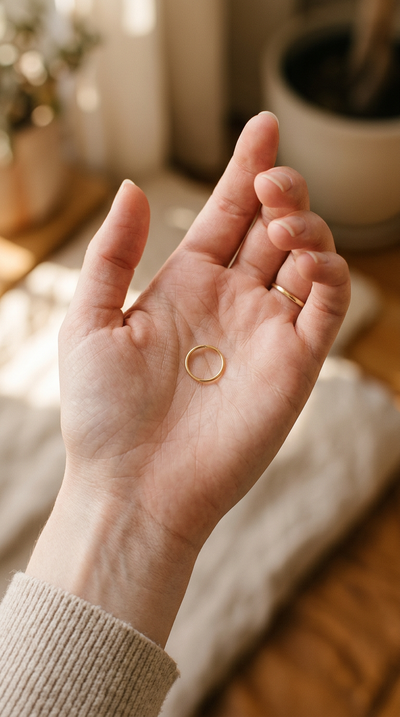
New 14ct Solid Gold Piercing Hoop
Tragus Piercing Jewellery: Hoops, Studs & 14K Gold
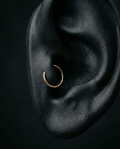
- The two primary tragus jewellery styles are flat-back labret studs (for healing and daily comfort) and seamless hoops (for the classic ring look)
- Flat-back studs are the best choice for people who wear earbuds regularly — the disc sits flush and does not interfere
- Seamless hoops create a small gold ring around the tragus edge — the most popular upgrade after healing
- The tragus is dense cartilage that heals slowly and reacts strongly to poor-quality metal — material choice is critical
- Only 14K solid gold and implant-grade titanium are recommended for tragus piercings
- Standard gauge is 18G or 16G — confirm yours before buying
Why tragus jewellery choice matters
The tragus is not like the earlobe. It is a small tab of thick, dense cartilage at the entrance to the ear canal. This location creates three challenges that make jewellery choice unusually important:
Slow healing. Cartilage piercings take 4–8 months to fully mature. During this time, the jewellery sits inside a developing channel that is easily disrupted by movement, pressure or reactive metals. The wrong jewellery during healing can double the timeline.
Constant contact. You touch your tragus when inserting earbuds, adjusting headphones, holding a phone to your ear, and sleeping on your side. Every contact point interacts with whatever jewellery is in the piercing. Poorly designed jewellery gets caught, pressed, or pulled.
High reactivity. Dense cartilage is less forgiving than soft tissue. Nickel, plating flakes, and corroding metals trigger irritation bumps on the tragus faster and more aggressively than on lobes or nostrils. Once a tragus bump forms, it can take weeks to resolve.
Tragus jewellery types
Flat-back labret stud
A straight post with a flat disc on the back and a decorative or plain top on the front. The flat disc sits inside the ear (behind the tragus), flush against the skin, distributing pressure evenly without poking or catching. The front sits on the outer surface of the tragus.
Why it is the tragus standard: The flat back eliminates the biggest problem with traditional butterfly-back or ball-back earrings on the tragus — the backing protrudes into the ear canal space, where it presses against earbuds, gets caught, and causes irritation. A flat disc solves all of this. It is virtually invisible from behind and does not interfere with anything.
Best for: healing period, earbud users, daily wear, work environments, sleeping.
Sizing: Post length of 6mm is standard for most tragus piercings once swelling subsides. 8mm may be used initially during healing to accommodate swelling. See our tragus size guide for details.
Seamless hoop
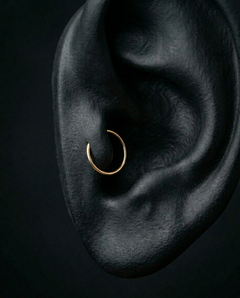
A continuous ring that wraps around the outer edge of the tragus. No clasp, no hinge — just a clean circle of wire. Opens by twisting the ends apart, closes by twisting them back. The join is positioned behind the tragus, invisible from the front.
The look: A small gold ring framing the entrance to the ear canal. This is the look that most people picture when they think of a tragus hoop — minimal, clean, and unmistakably intentional. In 14K gold, it becomes a fine jewellery accent that elevates the entire ear stack.
Best for: healed tragus piercings only. Not for healing — the ring rotates in the channel and disrupts the healing fistula. Wait 4–8 months before switching from a stud to a hoop.
Sizing: 5–8mm inner diameter. 6mm is the most popular for a snug fit. See our tragus hoop size guide.
Hinged segment ring / clicker
A ring with a small hinge that clicks open and shut. Easier to insert and remove than a seamless ring because you do not need to twist the ends — just click open, guide through the piercing, and click closed. The hinge sits behind the tragus, invisible from the front.
Best for: people who change tragus jewellery frequently. The click mechanism is especially useful on the tragus, where the angle is awkward and visibility is limited. If you find seamless rings fiddly, a clicker is the practical alternative.
Captive bead ring (CBR)
A ring with a removable bead held in place by tension. Less common on the tragus than on other piercings because the bead adds bulk in a small area. Can work aesthetically, but the bead may interfere with earbuds more than a seamless ring or stud.
Best for: decorative emphasis. If you want a visible bead or gemstone at the tragus, a CBR delivers that. Not the most practical daily option.
Style comparison
| Style | Healing? | Earbuds? | Look | Ease of use |
|---|---|---|---|---|
| Flat-back stud VERSATILE | Yes — ideal | Excellent — flat disc | Single point, subtle | Easy — push/screw in |
| Seamless hoop MINIMAL | No — healed only | OK if snug (5–6mm) | Ring around tragus, elegant | Moderate — twist open/close |
| Clicker | No — healed only | OK if snug | Ring, clean or decorative | Easiest ring style |
| CBR | No — healed only | May interfere — bead adds bulk | Ring with visible bead | Hardest — bead removal |
Materials: what is safe
The tragus is one of the most material-sensitive piercing locations. Dense cartilage heals slowly and reacts aggressively to irritants. Choosing the right metal is not a luxury — it is a necessity.
| Material | Safe? | Nickel-free? | Notes |
|---|---|---|---|
| 14K solid gold RECOMMENDED | Yes | Yes | Premium look, zero reactivity when properly alloyed. Lasts decades. |
| Implant-grade titanium | Yes | Yes | ASTM F-136. Best for initial healing. Lightweight. |
| Niobium | Yes | Yes | Excellent but uncommon. Can be anodised for colour. |
| Gold-plated | No | Base metal exposure | Plating chips inside the piercing channel. Common cause of bumps. |
| “Surgical steel” | No | Contains nickel | 10–14% nickel content. The most frequent trigger for tragus reactions. |
| Sterling silver | No | Oxidises | Tarnishes in contact with body fluids. Can permanently stain tissue. |
Why 14K gold for tragus
The tragus is a highly visible part of the ear. It sits at the front, at eye level, and catches attention when someone faces you. This makes material aesthetics matter more than on hidden piercings like the rook or conch inner.
Warm visibility. A small 14K gold hoop or stud on the tragus creates an immediately noticeable, premium accent. The warm gold tone reads as fine jewellery rather than body modification — subtle enough for professional settings, beautiful enough to be a genuine style feature.
Zero reaction on dense cartilage. 14K solid gold (nickel-free) is inert in the piercing channel. It does not corrode, does not shed particles, and does not trigger the inflammatory response that causes cartilage bumps. For a piercing location that is notoriously reactive, this matters enormously.
Durability at small scale. Tragus jewellery is tiny. A 6mm seamless hoop in 20G is one of the smallest pieces of body jewellery you can own. At this scale, the quality of the metal determines whether the ring holds its shape or bends the first time you handle it. 14K gold at 20G is strong enough to maintain its circular shape through daily wear while remaining easy to open and close when needed.
Stacking compatibility. If you are building a curated ear with multiple piercings (helix, conch, lobe, tragus), matching the metal across all positions creates cohesion. 14K yellow gold across the ear stack looks intentional and collected. Mixing gold with steel or titanium can look disjointed.
Choosing jewellery for earbud users
If you use AirPods, Galaxy Buds, or any in-ear headphones regularly, your tragus jewellery choice needs to account for this. Here is the practical breakdown:
Best for earbuds: flat-back labret stud. The flat disc sits flush behind the tragus and does not protrude into the ear canal entrance at all. Standard AirPods and most earbuds sit comfortably alongside a flat-back stud with zero interference. This is the ideal choice for daily earbud users.
Also works: snug seamless hoop (5–6mm). A tight-fitting ring that hugs the tragus does not extend significantly into the earbud zone. Standard AirPods typically coexist with a 6mm hoop, though you may feel the ring when inserting the bud. Silicone-tipped earbuds that create a seal may press against the ring slightly.
May cause issues: 7–8mm hoops, CBRs. Larger rings and rings with beads protrude further from the tragus and can physically block earbud insertion or get pressed painfully against the cartilage when the earbud is in place.
Quick sizing reference
For the full sizing breakdown, read our tragus hoop size guide. Here is the quick reference:
| Measurement | Standard | Range |
|---|---|---|
| Hoop inner diameter | 6mm (snug) | 5–8mm |
| Stud post length | 6mm (healed) | 6–8mm |
| Gauge | 18G (1.0mm) or 16G (1.2mm) | 20G–16G |
Initial vs healed jewellery
During healing (months 1–8): A flat-back labret stud in implant-grade titanium or 14K solid gold. The post should be slightly longer than needed (usually 8mm) to accommodate swelling. Once swelling subsides (typically 4–6 weeks), your piercer will downsize to a 6mm post. Do not skip the downsize — a long post catches, snags, and prolongs healing.
After healing (month 8+): You can now wear any style. Seamless hoop, clicker, CBR, or continue with a stud. This is when most people switch to 14K solid gold if they healed with titanium. The piercing is mature and stable, and the gold upgrade is immediately visible on this prominent piercing location.
Caring for tragus jewellery
During healing: Saline spray twice daily. Do not twist, rotate, or play with the jewellery. Keep earbuds out of the pierced ear for the first 3 months minimum. Clean around the stud gently — let the saline do the work.
After healing: Minimal care. Rinse the jewellery during your shower to remove buildup. If you switch between a stud and a hoop, clean both pieces before reinserting. Store spare jewellery in a small pouch to prevent bending or loss — tragus jewellery is tiny and easy to misplace.
14K gold care: No special cleaning needed beyond warm water. A soft cloth restores shine. The ring will develop a gentle patina over months of continuous wear — many people prefer this lived-in look. If you want the original polish, a very gentle buff with a jewellery cloth brings it back.