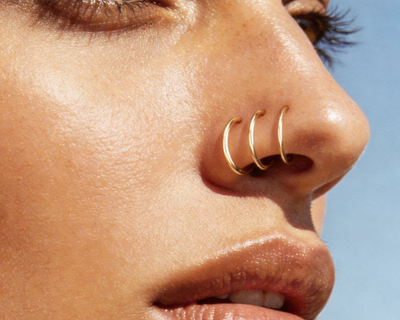
18G vs 20G vs 22G Nose Ring: Which Gauge Do You Need?

- Gauge measures wire thickness, not ring diameter — a lower number means thicker wire
- 20G (0.8mm) is the UK standard for nostril piercings — if you are unsure, start here
- 22G (0.6mm) is thinner than standard — popular for delicate, fine-jewellery looks and common in South Asian piercings
- 18G (1.0mm) is thicker — standard for septum piercings and used when a bolder wire is preferred
- You can wear a thinner gauge in a thicker piercing, but not the other way around without stretching
- Gauge and diameter are completely separate measurements — you need to know both when buying
What gauge actually means
Gauge is a measurement system for wire thickness. It originates from the American Wire Gauge (AWG) standard, and the numbering is counterintuitive: the lower the number, the thicker the wire. An 18G wire is thicker than a 20G wire, which is thicker than a 22G wire.
In nose ring terms, gauge determines the thickness of the metal that sits inside your piercing channel. It affects how the ring looks on your nose, how easily it opens and closes, and whether it fits through your piercing hole.
Gauge is not the same as diameter. Diameter measures how wide the ring is (6mm, 7mm, 8mm — see our nose ring size guide). You can have an 8mm ring in 18G, 20G or 22G — same circle size, different wire thickness.
The three gauges compared
| Gauge | Thickness | Visual comparison | Feel |
|---|---|---|---|
| 22G | 0.6mm | Thinner than a standard paperclip wire | Featherlight, barely noticeable in the piercing |
| 20G UK STANDARD | 0.8mm | Similar to a standard sewing pin | Comfortable, balanced presence without bulk |
| 18G | 1.0mm | Noticeably thicker, visible wire substance | Substantial, secure, you can feel it in the piercing |
The difference between each gauge step is only 0.2mm — but on a small piece of jewellery worn on your face, that 0.2mm is very visible. Side by side, an 18G ring looks distinctly chunkier than a 22G ring of the same diameter.
22G — the delicate one
Wire thickness: 0.6mm (also written as 0.55mm by some manufacturers).
The look: Ultra-fine, barely-there wire. In a small seamless hoop, the metal almost disappears against the skin. This is the gauge that gives the “is that real gold thread?” effect — minimal, refined, and unmistakably fine jewellery rather than body jewellery.
Who it suits: People who want a dainty, subtle nose ring. Very popular in Indian, Middle Eastern and South Asian piercing traditions where fine gold wire is the norm. Also increasingly popular in the UK and Europe for the minimal aesthetic.
Where it is standard: Piercings done in India, Pakistan, the Middle East and parts of Asia are commonly performed at 22G. Some UK piercers offer 22G as well, particularly for clients requesting a delicate look.
Things to know: 22G is softer and easier to bend, especially in 14K gold. Be gentle when opening and closing seamless rings at this gauge. The thin wire also means lower material weight, so 22G rings tend to cost less than 18G equivalents in solid gold.
20G — the standard
Wire thickness: 0.8mm.
The look: The classic balance. Visible enough to register as a nose ring from a conversational distance, but not so thick that it dominates the face. This is the gauge that most people picture when they think of a gold nose hoop.
Who it suits: Almost everyone. If you have a standard nostril piercing done at a UK studio, 20G is almost certainly what you were pierced with. It is the default gauge for nostril studs, L-shapes, screws, and hoops.
Where it is standard: The UK, most of Europe, the United States, Canada, and Australia. The vast majority of professional piercers in these regions use 20G or 18G needles for nostril piercings.
Things to know: 20G is the safe middle ground. If you do not know your gauge and are ordering online for the first time, 20G is the answer. It fits 20G piercings exactly and can be worn in 18G piercings (slightly loose, but functional). It is thick enough to hold its shape in a seamless ring and thin enough to insert and remove easily.
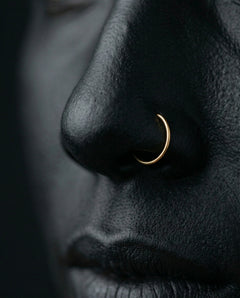
18G — the bold one
Wire thickness: 1.0mm.
The look: Noticeably chunkier. The wire has real visual weight, especially in a seamless hoop. An 18G gold ring reads as deliberate, substantial, and statement-making. It catches light differently than thinner gauges because there is more surface area reflecting.
Who it suits: People who prefer a bolder aesthetic. Also the standard choice for septum piercings, where a thicker wire is needed for structural stability and to match the larger diameter rings typically worn in the septum.
Where it is standard: Some UK and US piercers use 18G for nostril piercings, particularly if the client requests a thicker look or plans to wear hoops exclusively. 18G is the universal standard for septum piercings.
Things to know: 18G rings use more gold per ring, so they are the most expensive of the three gauges in solid 14K gold. They are also the sturdiest — harder to bend accidentally, harder to deform when opening and closing a seamless ring. If durability matters to you, 18G is the most robust option.
Which gauge for each piercing type
| Piercing | Typical gauge | Notes |
|---|---|---|
| Nostril | 20G or 18G | 20G is standard in the UK. Some studios use 18G. |
| Septum | 16G or 14G | Thicker than nostril piercings. 18G occasionally used for dainty septum rings. |
| Helix | 18G or 16G | Cartilage piercings are typically 18G. 20G also works for healed helix. |
| Tragus | 18G or 16G | Similar to helix. 18G is common for hoops. |
| Conch | 16G or 18G | Thicker cartilage often pierced at 16G. 18G hoops are popular for healed conch. |
| Daith | 16G or 18G | Deep cartilage. 16G is standard for initial piercing. |
| Rook | 16G or 18G | Thick cartilage fold. Usually pierced at 16G. |
| Lobe | 20G or 18G | Standard butterfly-back earrings are typically 20G. 22G also common. |
How to check your gauge
If you do not know what gauge your piercing is, here are three ways to find out:
1. Ask your piercer
The fastest and most reliable method. If you still have your piercing studio’s details, call or visit and ask what gauge they used. Most studios keep records, and any piercer can measure your current jewellery in seconds.
2. Measure your current jewellery
If you have digital callipers (available cheaply online), remove your current jewellery and measure the thickness of the post or wire. Match the measurement to the gauge chart: 0.6mm = 22G, 0.8mm = 20G, 1.0mm = 18G. A standard ruler is not precise enough for this — you need callipers or a gauge card.
3. Use the process of elimination
If you were pierced at a professional UK studio: almost certainly 20G or 18G. If you were pierced at a high-street shop with a piercing gun (lobes only): likely 20G. If your piercing was done in India, Pakistan, or the Middle East: likely 22G. If your piercing is a septum: likely 16G or 14G.
Can you mix gauges?
Thinner gauge in a thicker piercing — yes. You can wear a 22G ring in a 20G piercing, or a 20G ring in an 18G piercing. The ring simply has a little extra room in the channel. This is safe and common. Be aware that if you wear a thinner gauge for an extended period, the piercing may slowly shrink to match the smaller wire over months.
Thicker gauge in a thinner piercing — no, not without stretching. You cannot push a 20G wire through a 22G hole or an 18G wire through a 20G hole without enlarging the piercing. Stretching should be done intentionally, gradually, and ideally with your piercer’s guidance.
Mixing gauges across multiple piercings — absolutely. Many people wear 22G in their nostril for a delicate look and 18G in their helix or conch for a bolder statement. There is no rule that says all your piercings need the same gauge. In fact, varying the gauge across different ear and nose piercings creates visual interest and depth in a curated stack.
Gauge and 14K gold
The gauge you choose affects the feel and durability of a solid gold ring in ways that are worth understanding:
22G in 14K gold is exceptionally light and delicate. The thin wire opens and closes easily but also bends more easily if mishandled. This is the most affordable gauge in solid gold because it uses the least metal. Ideal for people who want gold but prefer a fine, minimal aesthetic.
20G in 14K gold is the sweet spot. Thick enough to hold its shape through daily wear, thin enough to feel comfortable and look elegant. This is our most popular gauge across all nose ring sizes.
18G in 14K gold is the most substantial. The extra metal gives the ring more weight (still very light overall), more durability, and a bolder visual presence. It is the hardest to accidentally deform and will maintain its shape the longest. Also the most expensive per ring because more gold is used.