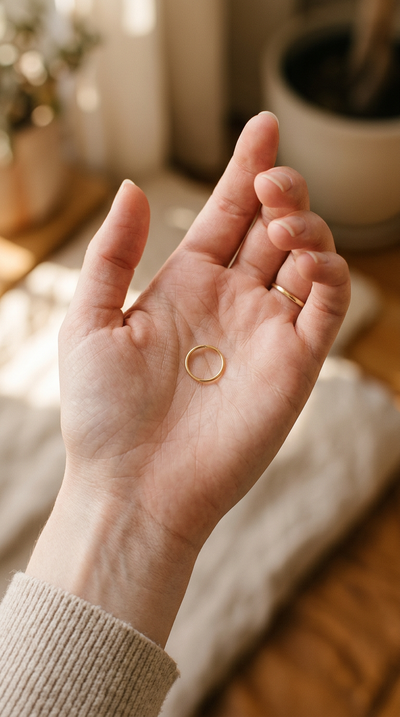
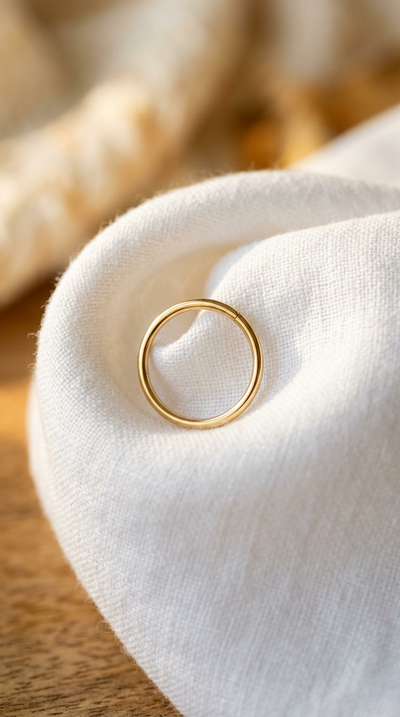
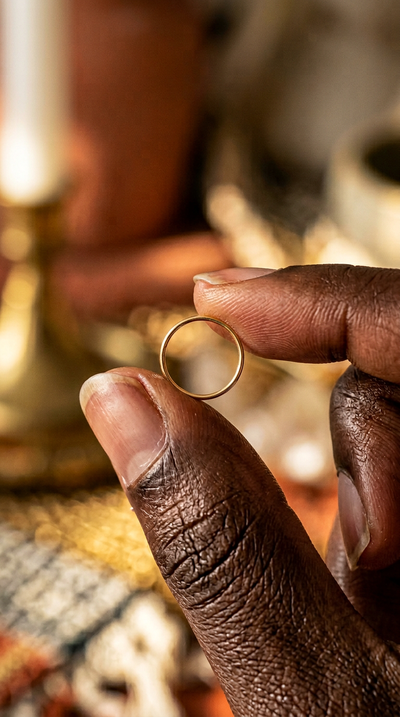
New 14ct Solid Gold Piercing Hoop


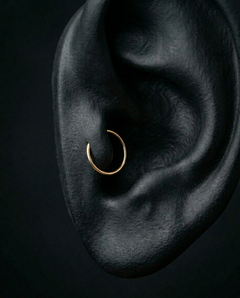
Personalised Double Digits 14ct Solid Gold Tragus Ring
Personalised Double Digits 14ct Solid Gold Tragus Ring


Tragus vs Anti-Tragus Piercing: Placement, Pain & Jewellery
- The tragus is the small flap at the front of the ear canal; the anti-tragus is the small ridge of cartilage directly opposite, just above the earlobe
- Tragus is more popular, more versatile for jewellery, and more earbud-compatible — the easier first choice for most people
- Anti-tragus is less common, sits lower on the ear, and requires specific anatomy — not everyone has enough cartilage for it
- Both are cartilage piercings with similar pain levels (4–5/10) and healing times (4–8 months)
- Both require 14K solid gold or implant-grade titanium — cartilage reacts aggressively to nickel
- You can have both on the same ear for a striking “frame the ear canal” pairing
Where each one sits
Think of the ear canal opening as a gap. The tragus guards the front of that gap; the anti-tragus guards the back. They face each other across the ear canal entrance, roughly 10–15mm apart. Together, they frame the opening — which is why some people get both for a symmetrical pairing.
Side-by-side comparison
| Tragus | Anti-tragus | |
|---|---|---|
| Location | Front of ear canal | Opposite tragus, above earlobe |
| Cartilage type | Thick, dense flap | Thin, curved ridge |
| Anatomy required | Most people have enough tragus | Not everyone — needs sufficient ridge |
| Pain (1–10) | 4–5 — crunch through thick cartilage | 4–6 — sharp pinch, smaller target |
| Healing time | 4–8 months | 6–12 months |
| Standard gauge | 18G or 16G | 18G or 16G |
| Hoop diameter | 5–8mm (6mm most popular) | 6–8mm (depends on anatomy) |
| Stud post length | 6mm standard | 6–8mm (varies more) |
| Earbuds | Fine once healed with stud | Minimal interference — sits away from canal |
| Visibility | High — front-facing | Moderate — visible from side/angle |
| Popularity | Very popular — one of the top ear piercings | Less common — a connoisseur choice |
| Bump risk | Moderate — sleeping/earbud pressure | Moderate — sleeping/hair snagging |
The anatomy question
Tragus: the vast majority of people have enough tragus cartilage to support a piercing. The tragus is a distinct, protruding flap that is easy for a piercer to work with. Only in rare cases — where the tragus is very flat or thin — will a piercer advise against it. If you can feel a definite tab of cartilage covering the front of your ear canal, you almost certainly have enough anatomy for a tragus piercing.
Anti-tragus: this is where anatomy becomes a genuine constraint. The anti-tragus ridge varies significantly between individuals. Some people have a prominent, well-defined bump of cartilage above the earlobe. Others have a barely perceptible ridge or a smooth transition from cartilage to lobe with no distinct anti-tragus at all. A piercer needs enough cartilage to place a needle through safely and enough tissue to hold the jewellery stable during healing.
Pain compared
Tragus pain: 4–5/10
The tragus is thick, dense cartilage. The needle produces a crunch or pop sensation as it passes through — a brief, sharp pressure that is more intense than a lobe piercing but over in 1–2 seconds. Your eyes may water from the proximity to the ear canal nerves. Most people describe it as uncomfortable but very manageable. Soreness fades within hours.
Anti-tragus pain: 4–6/10
The anti-tragus is thinner cartilage but the piercing area is smaller, giving the piercer less room to work. The sensation is a sharp pinch with a crunching pressure, similar to the tragus. Some people find it marginally more painful because the cartilage is under more tension — the anti-tragus ridge curves rather than lying flat. Swelling tends to be more noticeable with anti-tragus piercings because the ridge is compact and has less room to accommodate inflammation.
Verdict: pain is comparable. If you handled a tragus piercing, you will handle an anti-tragus. If you handled a helix or conch, either of these will feel familiar. The piercing itself takes 1–2 seconds regardless of which you choose.
Healing differences
Tragus: 4–8 months. The tragus has reasonable blood supply for cartilage, heals relatively predictably, and is well-established in the piercing community with a long track record of successful outcomes.
Anti-tragus: 6–12 months. The anti-tragus ridge is thinner and less vascularised, which means the healing tissue receives fewer nutrients and takes longer to mature. Swelling can be significant in the first 1–2 weeks because the small ridge has limited room to expand. Some piercers consider the anti-tragus one of the more challenging cartilage piercings to heal.
Aftercare is identical for both: sterile saline spray twice daily, no touching, no earbuds during healing, sleep on the opposite side, and no swimming for 8 weeks. See our full aftercare details in our tragus jewellery guide.
Jewellery for each piercing
Tragus jewellery
The tragus accommodates a wide range of jewellery styles. Flat-back labret studs are standard for healing and earbud compatibility. Seamless hoops (5–8mm) create the classic ring-around-the-tragus look. Clickers and segment rings offer easy insertion. The tragus is one of the most versatile cartilage piercings for jewellery choices.
Most popular: 6mm seamless hoop in 18G, 14K yellow gold. See our tragus size guide for diameter options and our gauge guide for wire thickness.
Anti-tragus jewellery
The anti-tragus is more limited. Flat-back labret studs work well and are the standard for healing. Small seamless hoops can be worn once healed, but the hoop wraps around the anti-tragus ridge rather than framing the ear canal entrance — creating a different visual effect. Curved barbells are also popular for anti-tragus piercings, with a ball visible on each side of the ridge.
Most popular: flat-back stud with a small ball or gem top, or a snug seamless hoop in 6–7mm once healed. The anti-tragus sits lower on the ear, so the jewellery creates an accent near the lobe rather than at the ear canal.
| Specification | Tragus | Anti-tragus |
|---|---|---|
| Healing jewellery | Flat-back labret stud, 6mm post | Flat-back labret stud, 8mm post (swelling room) |
| Hoop diameter | 5–8mm (6mm most popular) | 6–8mm (anatomy dependent) |
| Gauge | 18G or 16G | 18G or 16G |
| Other styles | Clicker, segment ring, CBR | Curved barbell, clicker |
| Best material | 14K solid gold / titanium | 14K solid gold / titanium |
Earbuds and headphones
Tragus + earbuds: the tragus is the piercing most affected by earbuds. During healing, earbuds are off-limits (they press the jewellery into the wound). Once healed, a flat-back stud works well with AirPods and most in-ear earbuds. A snug seamless hoop (5–6mm) also coexists with earbuds in most cases. See our full headphone guide for brand-by-brand compatibility.
Anti-tragus + earbuds: the anti-tragus sits below and behind the ear canal entrance, so it interferes with earbuds less than the tragus does. Standard AirPods and most earbuds sit inside the ear canal opening, above the anti-tragus. However, silicone-tipped earbuds with large wings or stabilisers may press against the anti-tragus. During healing, avoid earbuds as a precaution.
Verdict: if earbud compatibility is a priority, the anti-tragus is marginally more headphone-friendly. But the tragus with a flat-back stud is also fine once healed. Neither piercing permanently prevents you from using earbuds.
The look
Tragus: front-facing and immediately visible. When someone looks at you, they see the tragus jewellery head-on. A small gold hoop or stud on the tragus creates a focal point at the ear canal entrance. It reads as deliberate, refined, and clean. The tragus is one of the most popular piercings for men and women specifically because of this direct visibility.
Anti-tragus: more of a side-view accent. The anti-tragus sits lower on the ear and is most visible from the side or at an angle. It creates a point of interest near the transition between cartilage and earlobe — a less expected location that reads as curated rather than mainstream. People who notice it tend to ask about it because it is less common.
Both together: a tragus hoop and an anti-tragus stud (or vice versa) frame the ear canal opening from both sides. This is an uncommon but striking pairing that creates visual symmetry. In matching 14K gold, the two piercings echo each other across the ear canal, giving the ear a sculpted, intentional look that single piercings cannot achieve.
Why material matters for both
Both the tragus and the anti-tragus are dense cartilage. Both heal slowly. Both react aggressively to poor-quality metal. The material rules are identical:
Safe: 14K solid gold (nickel-free alloy) and implant-grade titanium (ASTM F-136). These are the only two materials recommended for cartilage piercings. Zero reactivity, zero degradation, zero risk of bump-triggering inflammation.
Unsafe: “surgical steel” (contains 10–14% nickel), gold-plated (base metal exposure as plating wears), sterling silver (oxidises inside the piercing channel). All of these cause irritation bumps on cartilage far more frequently than on soft tissue. For the full material comparison, see our gold-plated vs solid gold guide.
How to decide
Choose the tragus if: you want maximum visibility from the front, you want the widest jewellery options, you are building a popular ear stack, or this is your first cartilage piercing. The tragus is the more versatile, more forgiving, and more universally suitable choice. It works on virtually all ear anatomies and has a well-understood healing profile.
Choose the anti-tragus if: you already have several ear piercings and want something less common, your anatomy supports it (check with a piercer), you like the lower-ear accent position, or you specifically want a pairing with an existing tragus piercing. The anti-tragus is the more adventurous, less mainstream choice that rewards people who like curated details.
Choose both if: you want to frame the ear canal from both sides, you are patient enough to heal them sequentially (not simultaneously — heal one fully before getting the other), and you want a pairing that very few people have. Matching gold jewellery on both creates a look that is subtle but unmistakably deliberate.
Where they fit in an ear stack
Both piercings occupy unique positions on the ear that do not compete with other common piercings:
Tragus + helix + lobe: the most popular three-point ear stack. The tragus at the front, the helix at the top, the lobe at the bottom. Three positions forming a triangle that covers the entire ear. All in matching 14K gold creates a complete, balanced look.
Tragus + anti-tragus + conch: an advanced stack that fills the inner ear. The tragus and anti-tragus frame the ear canal; the conch sits in the bowl between them. Three piercings in the interior of the ear, with the outer ear left clean. Minimalist on the outside, detailed on the inside.
Full curated ear: tragus + anti-tragus + helix + conch + lobe. Five piercings, each in a distinct position, all in matching metal. This is the maximum curated ear for people who want every position filled with purpose. Space them 4–6 months apart and heal each fully before adding the next.