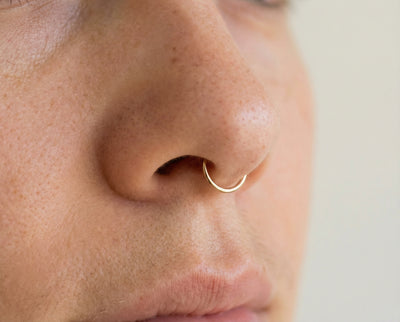
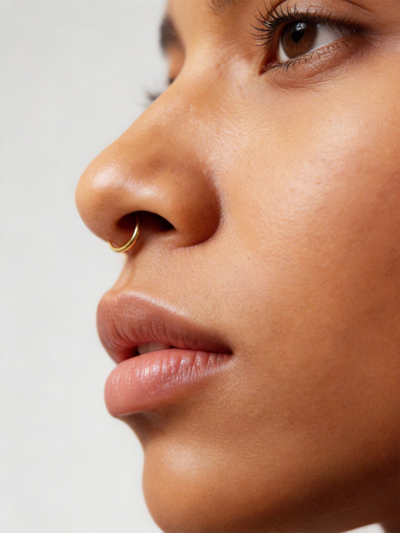
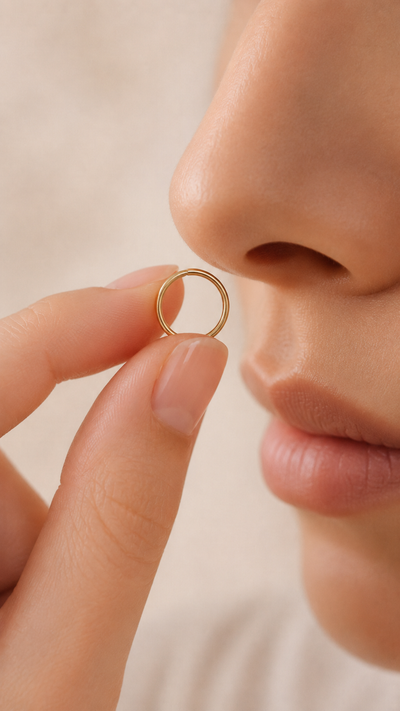
New 14ct Solid Gold Piercing Hoop


Infected Septum Piercing: Signs, Treatment & When to Worry

- Most “infected” septum piercings are actually irritated, not infected — true infections are relatively rare when aftercare is followed
- Normal healing involves crusting, occasional soreness and clear/pale yellow discharge — these are not signs of infection
- An actual infection shows spreading redness, heat, throbbing pain, and thick green/white/grey pus — possibly with fever
- Irritation is almost always caused by touching, wrong material (nickel), harsh cleaning products, or moving the jewellery too much
- Do not remove the jewellery from an infected piercing — the hole can close and trap the infection inside
- Switch to implant-grade titanium or 14K solid gold and use only sterile saline — this resolves 90% of septum problems
Irritation vs infection: the critical difference
The vast majority of people who search for “infected septum piercing” do not actually have an infection. They have irritation. These two conditions look similar on the surface but have completely different causes, completely different severity, and completely different treatments. Getting them confused leads to unnecessary panic, unnecessary antibiotics, and unnecessary jewellery removal.
Understanding the difference is the most important thing you can learn about piercing aftercare. Here is the distinction:
Signs of a real septum infection
A genuine infection occurs when bacteria enter the piercing wound and multiply faster than your immune system can control them. Here are the specific signs to watch for:
Discharge changes
Normal discharge is clear or pale yellow lymph fluid that dries into a whitish crust on the jewellery. This is your body’s natural healing fluid and is completely normal for the first 4–8 weeks. Infected discharge is thick, opaque, and green, grey, or dark yellow. It may have a foul or unusual smell. The shift from clear to coloured, thin to thick, and odourless to smelly is the key indicator.
Pain escalation
A healing septum piercing is tender when touched or bumped, but should not produce constant pain. Infection pain is different: it throbs even when the jewellery is not being touched. It may get worse over time rather than gradually improving. If pain is escalating day by day rather than fading, that is a warning sign.
Spreading redness and heat
Some redness directly around the piercing hole is normal during healing. Infection redness spreads outward — extending to the tip of the nose, the sides, or even the upper lip area. The affected area feels noticeably warm to the touch. If you draw an imaginary circle around the redness one day and it is larger the next, that is a sign of spreading infection.
Swelling that gets worse
Mild swelling inside the nose during the first week is normal. Infection swelling continues to increase after the first few days, may affect the outside of the nose, and can make it difficult to breathe through the nostrils. Swelling that appears suddenly after weeks of normal healing is particularly suspicious.
What causes septum infections
Infections do not happen spontaneously. Bacteria need to be introduced into the wound. Here are the most common causes:
Touching with dirty hands. This is the number one cause. Every time you touch your piercing with unwashed hands, you transfer bacteria directly into the wound channel. This includes fiddling with the jewellery, flipping a horseshoe, twisting the ring, or scratching an itch near the piercing.
Incorrect aftercare. Using anything other than sterile saline can introduce bacteria or destroy the beneficial bacteria that protect the wound. Cotton wool fibres left behind in the piercing, harsh antiseptics that damage tissue, or homemade saline that is not sterile are all common problems.
Swimming too soon. Pools, hot tubs, rivers, lakes, and the sea are all full of bacteria. Submerging a healing piercing in any of these exposes the open wound directly to contaminated water. Avoid all swimming for the first 8 weeks minimum.
Poor-quality jewellery. Cheap metal that corrodes inside the piercing creates micro-abrasions in the wound channel, giving bacteria more surface area to colonise. Nickel-containing metals also cause inflammatory reactions that weaken the tissue’s ability to fight bacteria. This is why material quality is not just an aesthetic choice — it is a health decision. See our septum jewellery guide for safe material options.
Unprofessional piercing. Piercings performed with unsterilised equipment, in non-clinical environments, or by untrained operators carry significantly higher infection risk. Always choose a reputable studio with autoclave sterilisation and single-use needles.
What is probably just irritation
Before you diagnose yourself with an infection, rule out these far more common causes of septum piercing problems:
Irritation bump
A small, raised bump next to the piercing hole. Usually flesh-coloured, sometimes slightly red. This is granulation tissue — the body’s response to physical irritation, not to bacteria. Causes include touching the jewellery, sleeping on it, wearing the wrong material, or a ring diameter that is too tight or too loose. An irritation bump is not a keloid (true keloids are rare and run in families) and it is not an infection.
Fix: stop touching the piercing entirely. Switch to implant-grade titanium or 14K solid gold if your current jewellery contains nickel. Use only sterile saline spray twice daily. Most irritation bumps flatten within 2–4 weeks once the cause is removed.
Material reaction (nickel allergy)
Persistent redness, itching, clear discharge and a bump that will not go away — despite good aftercare — often points to a metal reaction rather than an infection. “Surgical steel” contains 10–14% nickel. Gold-plated jewellery exposes the base metal as the plating wears off. Both cause reactions that mimic low-grade infections.
Fix: replace the jewellery with implant-grade titanium (ASTM F-136) or 14K solid gold (nickel-free alloy). Symptoms typically begin to improve within 48–72 hours of switching. For the full material comparison, see our gold-plated vs solid gold guide.
Over-cleaning
Cleaning a piercing too aggressively or too frequently damages the healing tissue and strips away the body’s natural protective layer. Alcohol, hydrogen peroxide, tea tree oil, Dettol, and TCP all destroy healthy cells and slow healing. Ironically, over-cleaning creates the same symptoms that make people clean even more — a destructive cycle.
Fix: sterile saline spray (0.9% sodium chloride, no additives), twice a day, no more. Let shower water run over the piercing. That is all.

How to treat an irritated septum
If your symptoms match irritation rather than infection, here is the treatment protocol that resolves the vast majority of septum problems:
If it is a real infection
If your symptoms genuinely match an infection (thick coloured pus, spreading redness, escalating pain, warmth, swelling, fever), take these steps:
Do not remove the jewellery. This is counterintuitive but critical. If you pull out the ring, the piercing hole can close over and trap the infection inside the tissue. A sealed pocket of infection can develop into an abscess, which requires medical drainage. Leave the jewellery in so the wound stays open and can drain.
See a doctor. Visit your GP, a walk-in clinic, or A&E if symptoms are severe. A medical professional will assess whether the infection requires antibiotics. Do not self-prescribe antibiotics — the wrong antibiotic or wrong course can make things worse. Tell the doctor it is a septum piercing and describe all your symptoms including timeline.
Continue saline aftercare. While waiting for your appointment and during antibiotic treatment, continue twice-daily saline sprays. Keep the area clean but do not apply topical antibiotic ointment unless prescribed — ointments can seal the piercing hole and prevent drainage.
See your piercer too. After or alongside medical treatment, visit your piercer. They can check the jewellery quality, ensure the sizing is appropriate, and assess whether the jewellery needs to be changed. In some cases, switching from a ring to a horseshoe or stud can help the infection drain more effectively.
Infection recovery timeline
How to prevent infection
Prevention is easier than treatment. These are the rules that keep septum piercings healthy:
Hands off. Do not touch the piercing unless you are cleaning it. Wash your hands thoroughly before any contact. This is the single most effective prevention measure.
Use quality jewellery from the start. Implant-grade titanium (ASTM F-136) or 14K solid gold (nickel-free alloy). Cheap metal creates micro-damage in the piercing channel that bacteria can exploit. It also causes inflammatory reactions that compromise the tissue’s defences. See our septum jewellery guide for material details.
Sterile saline only. No alcohol, no hydrogen peroxide, no tea tree oil, no essential oils, no Savlon, no Dettol, no TCP. These products damage healing tissue and increase infection risk. Sterile saline spray and clean running water are the only aftercare you need.
No swimming for 8 weeks. Pools, hot tubs, rivers, lakes and the sea are off-limits until the piercing has completed initial healing. The chlorine in pools is not strong enough to prevent infection in an open wound, and natural water contains bacteria that can cause serious piercing infections.
Choose a reputable piercer. A professional studio with autoclave sterilisation, single-use needles, and experienced piercers reduces infection risk to near zero. Avoid market stalls, beauty salons, and anyone who uses a piercing gun. For the piercing experience itself, see our septum piercing pain guide.