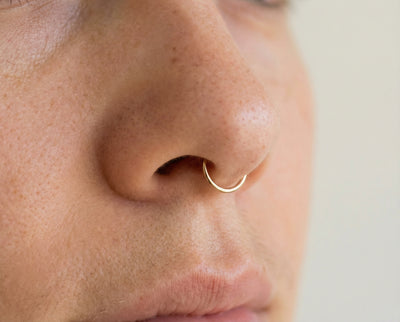
New 14ct Solid Gold Piercing Hoop


Septum Piercing Jewellery: Clickers, Hoops & 14K Gold Rings

- Four main septum jewellery styles: seamless rings, hinged clickers, circular barbells (horseshoes), and captive bead rings
- Seamless rings offer the cleanest, most minimal look — ideal for 14K gold
- Hinged clickers are the easiest to insert and remove — best for frequent jewellery changes
- Circular barbells (horseshoes) are the best for flipping up and hiding your piercing
- Only two materials are safe for long-term septum wear: 14K solid gold and implant-grade titanium
- Standard septum gauge is 16G (1.2mm) — thicker than nostril jewellery
Septum jewellery styles
The septum accommodates more jewellery styles than almost any other piercing. Each style has a different closure, a different look, and a different level of ease when inserting. Here is every type worth considering:
Seamless ring
A continuous circle of wire with no clasp, no hinge, and no visible join. You open it by twisting the ends apart (never pulling outward) and close it by twisting them back together. When closed properly, the ring looks like an unbroken circle hanging below the nose.
The look: Pure, minimal, clean. Nothing competes with the jewellery itself — no bead, no hinge, no decoration. In 14K gold, a seamless septum ring is the most refined option available. The warm gold colour against skin is the entire statement.
Best for: People who want the simplest, most understated septum ring. Those who do not change jewellery frequently (seamless rings require more effort to open and close than clickers).
Sizing: Available in 8–12mm diameters. See our septum size guide for help choosing.
Hinged clicker
A ring with a small hinge on one side and a clasp that clicks shut on the other. You open the clasp, swing the ring open on the hinge, pass it through the piercing, and click it closed. The hinge and clasp sit at the top of the ring, hidden inside the nose, so they are invisible when worn.
The look: Identical to a seamless ring from the outside when the ring is plain. Clickers also come in decorative styles with gems, filigree, and ornamental designs along the bottom arc — the visible portion of the ring. This makes clickers the most versatile style for decorative septum jewellery.
Best for: People who change septum jewellery frequently. The click-open mechanism is significantly easier than twisting a seamless ring, especially inside the nose where visibility is limited. Also ideal for anyone who finds seamless rings fiddly or frustrating.
Circular barbell (horseshoe)
A U-shaped bar with a threaded ball on each end. The balls sit at the bottom of the ring, visible below the nose. The open shape means the ring does not form a complete circle — it curves around the septum like a horseshoe.
The look: Two small balls (or spikes, cones, or flat discs) peeking below each nostril. More angular and edgy than a seamless ring. The balls can be matched in metal colour (gold balls on a gold bar) or mixed (gold bar with black balls) for contrast.
Best for: Hiding the piercing. The horseshoe flips up inside the nose better than any other style because the open U-shape does not press against the septum tissue when inverted. This is the standard initial jewellery for septum piercings at most studios, and the go-to choice for people who need to hide their piercing for work.
Captive bead ring (CBR)
A ring with a gap, bridged by a small bead that is held in place by the tension of the ring pressing inward on both sides. The bead sits at the bottom of the ring, visible below the nose. To insert or remove, you pop the bead out (which requires some force), pass the ring through the piercing, and snap the bead back in.
The look: A complete ring with a single bead at the bottom. Classic body piercing aesthetic. The bead can be the same metal as the ring or a contrasting material (opal, gemstone, black titanium).
Best for: People who want a traditional body piercing look. CBRs are very secure once the bead is in — they rarely come open accidentally. However, they are the hardest style to insert and remove at home. Ring-opening pliers are often needed.
Style comparison
| Style | Ease of use | Flipping up | Look | Security |
|---|---|---|---|---|
| Seamless ring MINIMAL | Moderate — twist open/close | OK — full circle takes more room | Cleanest, no visible hardware | Good when properly closed |
| Hinged clicker | Easiest — click open/close | OK — similar to seamless | Clean or decorative options | Very secure click mechanism |
| Horseshoe | Easy — unscrew a ball | Best — open U flips easily | Two balls below the nose | Balls can unscrew over time |
| CBR | Hardest — pop bead in/out | OK — full circle | Classic with centre bead | Very secure once bead is set |

Materials: what is safe
The septum sits inside the nose where the tissue is soft, moist, and more reactive than external skin. This makes material choice even more important for septum jewellery than for earlobe or nostril piercings.
| Material | Safe? | Tarnish? | Notes |
|---|---|---|---|
| 14K solid gold RECOMMENDED | Yes | No | Nickel-free when properly alloyed. Premium look, lasts decades. |
| Implant-grade titanium | Yes | No | ASTM F-136. Lightweight, hypoallergenic. Best for initial healing. |
| Niobium | Yes | No | Similar to titanium. Rare but excellent for sensitive skin. |
| Gold-plated | No | Plating chips | Base metal exposure inside the nose causes irritation. Avoid. |
| “Surgical steel” | No | Can corrode | Contains 10–14% nickel. The most common cause of septum reactions. |
| Sterling silver | No | Tarnishes black | Oxidises inside the nose. Can permanently stain the tissue. Never use. |
Why 14K solid gold for septum
A septum ring is one of the most visible pieces of jewellery on your face. The material is on display constantly — in every conversation, every photograph, every mirror check. 14K solid gold delivers in every way that matters:
Warmth against skin. Gold has a natural warmth that complements every skin tone. Against the philtrum and nostrils, a gold septum ring reads as intentional, premium, and refined. Titanium, by contrast, has a cooler, more clinical tone that some people find less flattering in septum placement.
Zero maintenance inside the nose. The inside of the nose is a challenging environment — moisture, mucus, temperature changes. Solid gold handles all of this without reacting. No tarnish, no discolouration, no coating to wear off. The ring looks the same after a year as it did on day one.
Lifetime durability. A solid 14K gold seamless ring, treated with basic care, will last indefinitely. The only risk is physical deformation — bending or kinking the wire. With gentle handling during opening and closing, this risk is minimal.
Colour options. Yellow gold is the most popular for septum rings, but rose gold creates a warm, blush-toned alternative that pairs beautifully with copper and bronze skin undertones. White gold offers the look of platinum or silver without the oxidation risks.
Quick sizing reference
If you need detailed sizing help, read our complete septum ring size guide. Here is the quick reference:
| Measurement | Standard | Range |
|---|---|---|
| Inner diameter | 8mm (snug) or 10mm (classic) | 8–12mm |
| Gauge | 16G (1.2mm) | 18G–14G |
Not sure what size? Start with 8mm in 16G. This is the most universally flattering combination, fits the majority of septum piercings, and is the easiest size to flip up and hide.
Initial vs healed jewellery
During healing (first 6–8 weeks): Your piercer will fit a circular barbell (horseshoe) or a simple seamless ring in implant-grade titanium. This jewellery is slightly larger than your eventual healed size to accommodate swelling. Do not change this jewellery until your piercer confirms the piercing is ready.
First downsize (6–8 weeks): Once the initial swelling subsides, your piercer may downsize to a smaller diameter. This is also when many people switch from titanium to 14K gold if they choose to upgrade the material.
Fully healed (3–6 months): The piercing is stable and can tolerate regular jewellery changes. You can now wear any style — seamless ring, clicker, horseshoe, or CBR — in your preferred material and diameter.
How to choose
Ask yourself three questions:
1. Do I need to hide my piercing regularly? If yes: start with a horseshoe in 8mm. It flips up invisibly. If no: choose any style you prefer.
2. How often will I change jewellery? If frequently: a hinged clicker is the most convenient. If rarely (set it and forget it): a seamless ring is the most elegant and lowest-profile option.
3. What look do I want? Minimal and refined: seamless ring or plain clicker in 14K gold. Edgy and bold: horseshoe with spike ends or a larger diameter. Decorative: clicker with ornamental design or gemstones.
Caring for septum jewellery
During healing: Saline spray twice daily, sprayed directly into both nostrils. Do not twist, spin, or play with the jewellery. Avoid submerging in pools or open water for the first 4 weeks.
After healing: Minimal maintenance. Rinse the ring under warm water during your shower to remove buildup. Septum jewellery can accumulate a smell over time due to dead skin cells and sebum collecting in the piercing channel — this is normal and harmless. Regular rinsing prevents it.
14K gold care: No special cleaning needed. If the ring loses its lustre after months of continuous wear, a gentle wipe with a soft cloth restores the shine. Do not use chemical jewellery cleaners on nose jewellery — the fumes are unpleasant inside the nose.