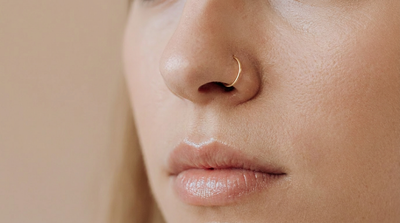
New 14ct Solid Gold Piercing Hoop


How to Hide a Septum Piercing: Retainers & Small Rings

- The easiest way to hide a septum piercing: flip a horseshoe barbell up inside your nostrils — completely invisible, takes two seconds
- A septum retainer (clear staple-shaped piece) makes the piercing virtually undetectable, even from close range
- A small 8mm seamless ring in 14K gold hugs tight inside the nose — barely visible from the front, looks like subtle jewellery rather than a piercing
- Never remove septum jewellery entirely to hide it — the piercing can narrow or close within hours, especially in the first year
- Plan ahead: if you know you will need to hide your piercing regularly, choose horseshoe or retainer as your everyday jewellery
Why you might need to hide it
Septum piercings are more accepted than ever in the UK, but “more accepted” does not mean universally accepted. There are still situations where hiding your piercing is practical, professional, or simply less hassle than explaining it.
Common reasons include conservative workplaces (certain NHS roles, uniformed services, client-facing corporate positions), family events where you would rather avoid the conversation, formal occasions (weddings, funerals), job interviews, or simply days when you prefer a completely clean look.
The good news: the septum is the single most concealable piercing on the body. Unlike a nostril, eyebrow or lip piercing, the septum sits between and inside the nostrils. With the right jewellery, it can be made invisible in seconds without removing anything or risking the piercing closing.
The four methods
There are four ways to hide a septum piercing, ranging from completely invisible to subtly visible. Each method has trade-offs in convenience, comfort and concealment level.
A horseshoe barbell (also called a circular barbell) is a U-shaped ring with a ball on each end. When worn normally, the U hangs below the septum with the balls visible. To hide it, you simply push the bottom of the U upward and rotate the ring so both balls tuck inside your nostrils.
How to flip: grip the bottom of the horseshoe with clean fingers. Push upward gently while rotating the ring 180° so the open end points up. The balls rest against the inside of each nostril. From the outside, nothing is visible — not even from close range.
Comfort: slightly noticeable at first. You may feel the balls pressing against the inside of your nostrils, especially if the diameter is large. Most people stop noticing within an hour. If the ring presses uncomfortably, you may need a slightly larger diameter.
A septum retainer is a small, clear (or flesh-toned) staple-shaped piece made from bioplast, glass or implant-grade PTFE. It sits flat against the inside of the septum with both arms tucked up into the nostrils. Because the material is transparent or skin-coloured, and the shape hugs tight inside the nose, a retainer is virtually invisible even to someone looking directly at your nose.
How it works: you insert the retainer through the piercing channel just like any other ring. The U-shape sits against the septum tissue with the arms pointing upward inside the nostrils. No portion of the retainer is visible below the nose.
Best for: situations where you need zero visibility for an extended period — multiple workdays, a week-long family visit, or anytime a horseshoe flip is not discreet enough. Many people keep a retainer specifically for these occasions.
This is not hiding in the traditional sense — it is minimising. A small-diameter seamless ring (8mm in 14K gold) hugs tight against the septum and sits barely below the nose. From the front, it is hard to see unless someone looks directly up at your nostrils. From a normal conversational angle, it reads as subtle jewellery rather than a piercing.
Why it works: most of the ring sits inside the nose. Only a thin sliver of gold is visible at the bottom of the septum. The thinner the wire gauge, the less visible it is. A 20G or 18G seamless ring in 8mm is one of the most discreet ways to wear a septum ring while still technically wearing one.
Best for: workplaces that allow “discreet” jewellery but frown on obvious piercings. The gold reads as refined rather than rebellious. Many people find that a small gold ring passes without comment in environments where a larger ring or horseshoe would attract attention.

We do not recommend this. Removing septum jewellery entirely is the most obvious way to hide a piercing, but it carries significant risk. Septum piercings can begin to shrink within hours of removing jewellery, especially in the first year. After 2–4 hours, the channel may narrow enough that reinserting your ring becomes difficult or painful. After 12–24 hours, a newer piercing may close completely.
Even well-established piercings (2+ years old) will gradually shrink when left empty. If you remove your ring for a full workday regularly, the channel narrows each time and reinsertion becomes increasingly difficult. Use one of the three methods above instead — they all keep the channel occupied while making the piercing invisible.
Methods compared
| Method | Visibility | Convenience | Comfort | Best for |
|---|---|---|---|---|
| Flip up horseshoe RECOMMENDED | 0% — completely hidden | Instant — 2 seconds | Good — slight pressure | Daily switching, job interviews, events |
| Retainer | 0% — invisible | Jewellery change needed | Excellent — lightweight | Extended hiding (days/weeks) |
| Small gold ring | 5–10% — subtle | Wear-and-forget | Excellent | Workplaces allowing “discreet” jewellery |
| Remove entirely | 0% | Quick but risky | N/A | Not recommended |
Step-by-step: flipping your horseshoe
If you have never flipped a horseshoe barbell before, here is the process:
To flip back down, simply reverse the process: push the bottom of the U downward and rotate 180° until the balls hang below the septum again.
Choosing jewellery for maximum concealment
If hiding your septum is a regular need, plan your jewellery choice around it from the start:
For complete concealment
Horseshoe barbell (circular barbell) is the best all-round choice. Wear it down when you want to show it, flip it up when you do not. Choose an 8mm or 9mm diameter for comfortable flipping. Standard gauge is 16G for most septum piercings. Material: 14K solid gold or implant-grade titanium for zero irritation, especially if you flip frequently. For gauge details, see our 14G vs 16G septum gauge guide.
For extended concealment
Glass retainer for healing piercings. Bioplast retainer for healed piercings. Keep one in your wallet or bag for situations that arise unexpectedly. Swapping from a ring to a retainer takes 30 seconds once you are practised.
For “barely there” visibility
8mm seamless ring in 14K gold, 18G or 20G. The smallest practical diameter for most septum anatomy. The thin gold wire and tight fit create a near-invisible ring that reads as refined jewellery. Many people wear this as their everyday ring because it works in every environment without needing to flip or switch. See our septum size guide for which diameter fits your anatomy.
Septum piercings and UK workplaces
UK employment law does not specifically protect body piercings. Employers can set dress code policies that restrict visible piercings, provided they apply consistently across genders and are not discriminatory on grounds of religion, race, disability, sex, or other protected characteristics.
In practice, attitudes have shifted significantly. Most private-sector employers in the UK have relaxed or eliminated piercing restrictions, particularly in tech, creative industries, retail, and hospitality. Public-facing corporate roles, financial services, and certain NHS/healthcare positions may still have stricter guidelines.
Strategy for restrictive workplaces: get pierced with a horseshoe barbell. Flip it up during work hours. Nobody will know. This is the most common approach and it works indefinitely. Some people wear a flipped horseshoe for years at work without anyone discovering the piercing.
Strategy for “discreet jewellery” workplaces: wear an 8mm 14K gold seamless ring. Most dress code policies distinguish between “extreme” piercings and subtle jewellery. A thin gold ring that barely shows is rarely flagged — it reads as jewellery, not body modification.
Why material matters for hidden rings
When your septum jewellery spends extended periods flipped up inside your nostrils, material quality becomes even more important. The inside of the nose is warm, moist, and chemically active — an environment that accelerates metal degradation.
Cheap metal flipped up = faster corrosion. A gold-plated horseshoe flipped inside the nose degrades faster than one worn hanging down, because the nasal environment is harsher than open air. The plating wears off, the base metal corrodes, and you end up with nickel and brass reacting inside your nose where you cannot see it. You may not notice the issue until the piercing becomes irritated or infected.
14K solid gold or implant-grade titanium are the only materials that survive the nasal environment indefinitely without degradation. Solid gold does not corrode in moisture, does not react with nasal mucus, and maintains its surface integrity whether worn down or flipped up for weeks at a time. For the full material breakdown, see our septum jewellery guide.