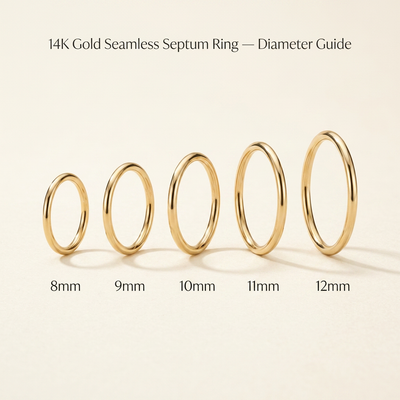
New 14ct Solid Gold Piercing Hoop


14G vs 16G Septum Ring: Which Gauge Is Right for You?

- 16G (1.2mm) is the global standard for septum piercings — if you do not know your gauge, start here
- 14G (1.6mm) is thicker — used by some piercers for initial piercings or by people who want a chunkier ring
- 18G (1.0mm) creates a dainty, delicate septum ring — thinner than standard but beautiful in gold
- You can wear thinner gauge jewellery in a thicker piercing, but not the other way around without stretching
- Gauge and diameter are separate measurements — you need both to order correctly
What gauge means for septum
Gauge measures the thickness of the wire or bar that passes through your septum piercing. The gauge system is counterintuitive: a lower number means thicker wire. So 14G is thicker than 16G, which is thicker than 18G.
For septum piercings specifically, gauge matters more than it does for most other piercings. The septum ring hangs below your nose in full view, and the wire thickness is visible at conversational distance. A thin 18G wire creates a delicate, barely-there look. A thick 14G wire creates a bold, substantial ring that commands attention.
Gauge is completely separate from diameter. A 10mm ring in 16G and a 10mm ring in 14G are the same size circle — but the wire making that circle is visibly different in thickness. You need to know both numbers when ordering septum jewellery.
The three gauges compared
| Gauge | Thickness | Look | Feel | Best for |
|---|---|---|---|---|
| 18G (1.0mm) | Thinnest | Delicate, fine, dainty | Lightweight, barely there | Subtle septum, minimal aesthetic |
| 16G (1.2mm) STANDARD | Standard | Balanced, classic, versatile | Comfortable, noticeable presence | Most septum piercings, everyday wear |
| 14G (1.6mm) | Thickest | Bold, chunky, substantial | You feel it, secure and solid | Statement look, stretched septums |
The difference between 16G and 14G is 0.4mm. On paper, that sounds insignificant. On your face, the difference is clearly visible. Side by side, a 14G ring looks noticeably chunkier than a 16G ring of the same diameter.
18G — the dainty option
Wire thickness: 1.0mm.
18G is thinner than the standard septum gauge and is not commonly used for initial septum piercings. However, once healed, an 18G septum ring creates a strikingly delicate look that many people prefer — especially in solid gold.
In a seamless hoop, 18G gold wire produces an almost jewellery-like quality that reads more “fine accessory” than “body piercing.” This is the gauge to choose if you want your septum ring to be subtle, refined and elegant rather than bold or edgy.
Compatibility: An 18G ring fits in any 16G or 14G septum piercing (thinner wire in a wider hole). The ring may move more freely in the channel than a perfectly matched gauge, but this is harmless. Over time, the piercing may slowly shrink toward 18G if you wear this gauge exclusively.
16G — the standard
Wire thickness: 1.2mm.
16G is the default gauge for septum piercings worldwide. The vast majority of professional piercers use a 16G needle for septum piercings, and the vast majority of septum jewellery is manufactured in 16G. If you were pierced at any professional studio and do not know your gauge, 16G is almost certainly what you have.
The look is balanced — thick enough to read as a proper septum ring, thin enough to remain elegant. In 14K gold, a 16G seamless hoop is the quintessential septum ring: visible, refined, and substantial without being heavy.
This is the gauge we recommend for most people. It fits the widest range of jewellery options (most clickers, horseshoes and seamless rings are made in 16G), and it sits in the comfortable middle ground between dainty and bold.
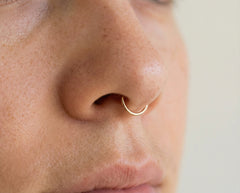
14G — the bold option
Wire thickness: 1.6mm.
14G is visibly thicker than 16G and creates a deliberately chunky look. The ring has real visual weight on the face. In a seamless hoop, the extra metal catches more light and creates a bolder arc below the nose. In a horseshoe, the thicker bar makes the balls look more proportionate.
Some piercers use 14G needles for initial septum piercings, particularly if the client has thicker septum tissue or plans to stretch later. If your piercing was done at 14G, wearing 14G jewellery is the natural match.
14G in gold: Because the wire is thicker, 14G rings use noticeably more gold than 16G equivalents. This makes them the most expensive gauge option in solid 14K gold, but also the most durable. A 14G gold seamless ring is extremely robust — it holds its circular shape better than thinner gauges and is harder to bend or kink accidentally.
How to check your gauge
Ask your piercer
The fastest and most reliable method. Call your studio or visit — they can check your piercing or look up your records in seconds. If you were pierced at a UK studio, the answer is almost certainly 16G.
Measure your current jewellery
Remove your current ring and measure the wire thickness with digital callipers. Match the measurement: 1.0mm = 18G, 1.2mm = 16G, 1.6mm = 14G. A standard ruler is not precise enough for these small measurements.
Process of elimination
If you were pierced at a professional studio in the UK, US, Europe or Australia: almost certainly 16G. If your piercer mentioned using a “thicker gauge” or you specifically requested it: possibly 14G. If you have been wearing earring-gauge jewellery in your septum and it fits: you may have an 18G piercing or a 16G piercing that has gradually shrunk.
Switching between gauges
Going thinner (16G → 18G)
This is safe and requires no special process. A thinner wire passes through a wider hole without resistance. The ring will sit a little looser in the channel, but this is harmless. Over several months, the piercing may gradually shrink to match the thinner gauge. If you later want to return to 16G, you may need a gentle re-stretch.
Going thicker (16G → 14G)
This requires stretching the piercing. The increase from 1.2mm to 1.6mm is manageable but should be done properly. Have your piercer insert a taper or the new jewellery for you. Expect mild soreness and slight swelling for a few days. Do not attempt to force thick jewellery through a smaller hole — this tears the tissue instead of stretching it gradually.
Going much thicker (16G → 12G or larger)
This enters the realm of septum stretching, which is a deliberate modification practice with its own techniques and timelines. It should be done in incremental steps (one gauge at a time), with adequate healing between each stretch. This is beyond the scope of standard septum jewellery changes and is best guided by an experienced piercer.
Gauge and 14K gold
The gauge you choose directly affects the amount of gold in each ring, which affects both cost and character:
| Gauge | Gold content | Character | Price |
|---|---|---|---|
| 18G | Least gold per ring | Light, delicate, fine jewellery aesthetic | Most affordable |
| 16G | Standard gold content | Balanced, classic, versatile | Mid-range |
| 14G | Most gold per ring | Substantial, bold, very durable | Highest |
All three gauges are available in yellow, white and rose 14K gold. The warm lustre of gold is visible in every gauge, but the visual impact scales with thickness. An 18G gold septum ring whispers. A 14G gold septum ring makes a statement.
Septum gauge vs nostril gauge
One of the most common mistakes is using nostril jewellery in a septum piercing, or vice versa. The gauges are different:
| Piercing | Standard gauge | Wire thickness |
|---|---|---|
| Nostril | 20G | 0.8mm |
| Septum | 16G | 1.2mm |
A 20G nostril ring in a 16G septum piercing will work physically — the thin wire fits through the larger hole. But the ring will look disproportionately thin for a septum placement, and it may move excessively in the wider channel. For the best look and fit, use jewellery specifically made for septum gauge.
Conversely, a 16G septum ring in a 20G nostril piercing will not fit without stretching the nostril piercing. Do not attempt this.