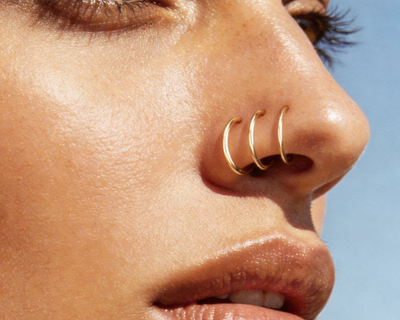
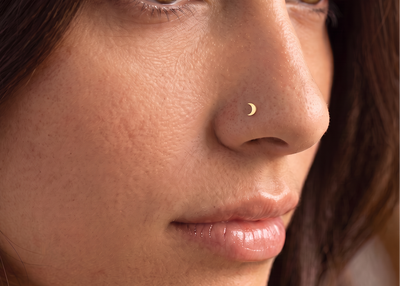
New 14ct Solid Gold Piercing Hoop


Nose Piercing for Men: Styles, Rings & Sizing
- Nose piercings on men are completely mainstream in the UK — common across all age groups, professions and styles
- The most popular men’s choice: a simple seamless gold hoop in 20G or 18G, 7mm or 8mm diameter
- Left or right nostril makes no difference — choose the side that suits your face
- 18G gives a bolder, more substantial look that many men prefer over thinner gauges
- 14K solid gold is the best material for long-term wear — no tarnishing, no nickel, no reactions
- Heal with a flat-back stud first (3–6 months), then switch to a seamless hoop
Men’s nose piercings in the UK
If you are a man considering a nose piercing, the first thing worth knowing is that you are not in the minority. Nose piercings have been one of the most popular piercings for men in the UK for over a decade. Walk through any city centre, any gym, any university campus, and you will see them everywhere. The stigma that existed twenty years ago has largely disappeared.
What has changed is the quality of jewellery that men are choosing. The trend has shifted away from cheap steel hoops and novelty studs towards cleaner, more refined pieces — particularly simple seamless hoops in solid gold. A single thin gold ring on the nostril reads as understated and intentional, not as a statement piece. It sits somewhere between a watch and a wedding ring in the hierarchy of men’s jewellery: quiet, personal, and permanent.
This guide covers everything you need to decide before getting pierced and everything you need to know when choosing your ring afterwards.
Which side and which piercing
Left or right nostril?
There is an old myth that one side means something specific for men. It does not. In the UK in 2025, there is no cultural code attached to which side your nose is pierced. Choose the side that looks better on your face.
How to decide: most people’s faces are slightly asymmetrical. One nostril may be marginally wider, higher, or more prominent than the other. A nose ring tends to look best on the side where the nostril has a clean curve and enough space for the hoop to sit without crowding the nose bridge or the crease of the nostril. Stand in front of a mirror and hold a small hoop (or a bent paperclip) against each side. The difference is usually subtle but noticeable.
If you have a strong hair parting, some people prefer the ring on the opposite side so it is more visible. Others prefer it on the same side for symmetry. There is no rule — it is purely aesthetic preference.
Nostril vs septum
These are the two most common nose piercings for men. They are different piercings with different jewellery, sizing and healing.
| Nostril | Septum | |
|---|---|---|
| Location | Through the curve of one nostril | Through the thin tissue between the nostrils |
| Typical jewellery | Seamless hoop or flat-back stud | Circular barbell, seamless ring, or clicker |
| Standard gauge | 20G or 18G | 16G, 14G or 18G |
| Standard diameter | 6–8mm | 8–10mm |
| Healing time | 3–6 months | 2–3 months |
| Pain level | Moderate — sharp pinch, over in seconds | Moderate — eyes may water, quick procedure |
| Visibility | Always visible | Can be hidden by flipping ring upward |
Many men start with a nostril piercing because it is the more subtle of the two. A septum piercing is more visible and has a different aesthetic impact. Some men get both — a nostril hoop and a septum ring. This guide focuses primarily on nostril piercings, but the material and sizing advice applies to both.
Jewellery styles for men
Men’s nose jewellery tends toward the minimal. The most popular choices among men in the UK are:
Seamless hoop
By far the most popular choice. A single continuous ring made from one piece of wire, bent into a circle with no visible clasp or hinge. It sits flush against the nostril and looks clean from every angle. In gold, it catches light without being flashy. This is the nose ring equivalent of a plain gold band — understated, classic, works with everything.
Why men prefer it: no moving parts, no decorative elements, no fuss. You open it, put it in, close it, and forget about it. It works equally well in 18G (bolder, more visible) and 20G (finer, more subtle). See our insertion guide for step-by-step instructions on how to put one in.
Flat-back labret stud
A straight post with a flat disc on the inside of the nostril and a small decorative top (or plain ball) on the outside. This is the jewellery your piercer will use for the initial piercing. Many men continue wearing a stud permanently if they prefer the single-point look over a ring.
Why some men prefer it: even more minimal than a hoop. A small titanium or gold ball on the nose is barely noticeable. It is also the most secure — threaded or push-pin flat-backs do not fall out or snag.
Which one?
Start with a flat-back stud for healing (3–6 months, non-negotiable). Then decide: if you want the classic ring look, switch to a seamless hoop. If you prefer something more discreet, keep the stud. Many men own both and swap depending on the occasion — stud for work, hoop for everything else.
Sizing for men
Two measurements determine how a nose ring fits: diameter and gauge. Men typically have slightly larger nostrils than women, which means the most flattering ring sizes can differ.
Diameter (ring size)
Diameter is the inner width of the hoop — the distance across the inside of the circle. It determines how closely the ring hugs your nostril.
| Diameter | Fit on men | Look |
|---|---|---|
| 6mm | Very snug — works for men with smaller or narrower nostrils | Tight to the nose, minimal protrusion, barely extends below the nostril |
| 7mm MOST POPULAR | The sweet spot for most men — snug without being too tight | Sits neatly against the nostril with a clean half-circle showing below |
| 8mm POPULAR | Comfortable fit for men with wider or fleshier nostrils | Slightly more visible ring, relaxed fit, clear circular shape |
| 9–10mm | Loose — only suits very large nostrils or intentionally oversized aesthetic | Hangs noticeably below the nostril, more bohemian or statement look |
The most common mistake men make is ordering a ring that is too large. An 8mm ring on a nose that needs 7mm will hang below the nostril and look loose rather than intentional. A snugger fit almost always looks cleaner on men. If you are between sizes, go smaller. See our complete size guide for how to measure at home.
Gauge (wire thickness)
Gauge determines the thickness of the wire that passes through your piercing. This is where men’s preferences often differ from women’s.
| Gauge | Wire thickness | Look on men | Notes |
|---|---|---|---|
| 22G | 0.64mm | Very fine, delicate wire — can look too thin on larger faces | Less common for men in the UK. Works if you want maximum subtlety. |
| 20G UK STANDARD | 0.81mm | Clean, balanced — visible without being heavy | Standard piercing gauge. Safe default if unsure. |
| 18G MEN’S FAVOURITE | 1.02mm | Bolder, more substantial wire — reads clearly as intentional jewellery | Many men prefer 18G for the slightly chunkier look. Standard for septum. |
Our recommendation for men: if your piercing was done at 20G (most UK studios), you have two options. Stay at 20G for a cleaner, more refined look. Or have your piercer stretch to 18G for a bolder presence. The 0.2mm difference is small but genuinely noticeable on the face, and many men find that 18G feels more proportionate against wider features and stronger jawlines. For a detailed comparison, see our 18G vs 20G vs 22G guide.
Recommended combinations
Based on the most common preferences among male customers, here are three proven combinations:
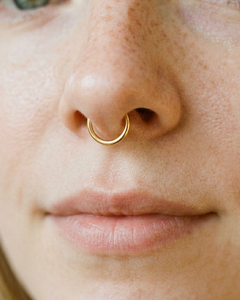
Why material matters
The ring in your nose sits inside an open channel in your body 24 hours a day. The metal it is made from is in constant contact with tissue, sweat and body chemistry. Cheap metal reacts. Good metal does not.
The short version: wear 14K solid gold or implant-grade titanium. Nothing else. “Surgical steel”, gold-plated, gold-filled, sterling silver, and unspecified alloys all contain metals that cause reactions — most commonly nickel. For the full breakdown of what each material is and why plated gold is not safe for piercings, see our gold-plated vs solid gold comparison.
| Material | Safe? | Looks | Lifespan |
|---|---|---|---|
| 14K solid gold BEST | Yes — hypoallergenic, nickel-free | Warm gold lustre, fine-jewellery finish | Decades |
| Implant-grade titanium | Yes — ASTM F-136 | Silver/grey, industrial feel | Decades |
| “Surgical steel” | No — contains 10–14% nickel | Silver, shiny when new | Variable — may corrode |
| Gold-plated | No — base metal exposed as plating wears | Gold initially, degrades quickly | Weeks to months |
| Sterling silver | No — oxidises, stains skin | Silver, tarnishes black | Tarnishes within weeks |
Getting pierced: what to expect
Choosing a studio. Find a reputable piercer through the UK’s UKAPP (UK Association of Professional Piercers) or by checking reviews. A good piercer will discuss placement with you, explain the jewellery options, and use single-use sterilised needles. Never get pierced with a gun — guns force blunt studs through tissue and cannot be properly sterilised.
The procedure. The piercer cleans the area, marks the placement with a dot (you approve the position), clamps the nostril (some piercers use freehand technique instead), and pushes a hollow needle through in one motion. The needle is immediately followed by the initial jewellery — usually a flat-back labret stud in titanium or gold. The entire procedure takes less than five seconds.
Pain level. A sharp, intense pinch that is over almost instantly. Your eyes will water — this is a nerve reflex, not a pain response. Most men describe it as less painful than expected. On a scale of 1–10, most put it at a 3–4.
Cost in the UK. Expect to pay £25–£45 for a professional nostril piercing including basic titanium jewellery. Some studios charge extra for gold initial jewellery. This is not a place to save money — a cheap piercing at a market stall or beauty salon is a false economy that frequently leads to infections, misplacement and scarring.
Healing and aftercare
Nostril piercings take 3–6 months to fully heal. During this period, the piercing channel is forming — your body is building a tube of healed skin around the jewellery. This is why you cannot swap to a hoop immediately.
What to do: spray the piercing with sterile saline solution (0.9% sodium chloride) twice a day. Let shower water run over it. Do not twist, turn, or touch the jewellery with dirty hands. Do not remove the stud during healing.
What not to do: do not use alcohol, hydrogen peroxide, tea tree oil, or any “piercing aftercare” solution that is not pure saline. Do not swim in pools, hot tubs or open water for the first 8 weeks. Do not sleep face-down on the piercing side if you can help it — use a travel pillow to keep pressure off the nose.
When and how to switch to a hoop
The earliest you should switch from a stud to a seamless hoop is when the piercing is fully healed: no tenderness when touched, no discharge, no redness, and the jewellery moves freely in the channel without catching. For most people, this is at the 4–6 month mark.
Signs you are not ready: any crustiness around the stud, pain when the jewellery is bumped, visible redness, or discharge of any colour. If any of these are present, wait longer. Switching too early is the most common cause of healing setbacks.
Your first hoop: we recommend starting with a 20G seamless hoop in your measured diameter (usually 7mm or 8mm for men). See our step-by-step insertion guide for how to open, insert and close a seamless ring properly without bending it.