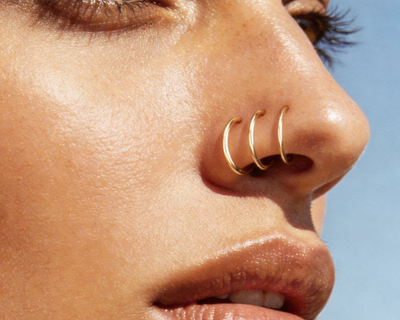
New 14ct Solid Gold Piercing Hoop


Nose Piercing Jewellery: Hoops, Studs & 14K Gold Options
- There are five main types of nostril jewellery: seamless hoops, L-shapes, nose screws, bone studs, and flat-back labrets
- Seamless hoops are the most popular choice for healed nostrils — minimal, clean, and available in every size
- Material matters more than style — 14K solid gold and implant-grade titanium are the only two materials worth wearing long-term
- Gold-plated, gold-filled, and “surgical steel” all contain nickel and are the leading cause of piercing reactions
- Always heal with a flat-back labret stud first, then switch to a hoop once fully healed (3–6 months)
Jewellery types explained
Not all nose jewellery is the same shape, and the shape affects comfort, security, and ease of insertion. Here is every type you will encounter:
Seamless hoop
A continuous ring made from a single piece of wire bent into a circle. No clasp, no hinge, no visible join. You open it by twisting the ends apart and close it by twisting them back together. This is the classic nose ring — the one most people picture when they think of a gold hoop on the nostril. It sits flush against the nose, looks minimal from every angle, and comes in every diameter from 6mm to 12mm.
Best for: healed nostril piercings. The go-to choice for everyday wear. See our step-by-step insertion guide for how to put one in.
L-shape stud
A straight post with a 90-degree bend at the end, forming an L. The decorative top sits on the outside of the nose, and the bent portion sits inside the nostril to hold it in place. Easy to insert and remove, but less secure than a flat-back — L-shapes can be accidentally pulled out during sleep or when catching on clothing.
Best for: people who change jewellery frequently and want quick access.
Nose screw
Similar to an L-shape but with a corkscrew-shaped curve instead of a single bend. The spiral sits inside the nostril and holds the stud more securely than an L-shape. Slightly trickier to insert — you need to twist it through the piercing following the curve. Once in, it stays put.
Best for: people who want a stud that will not fall out easily but do not want a flat-back.
Bone stud
A straight post with a small ball on the end that is slightly wider than the post. You push the ball through the piercing hole — it clicks past the tissue and holds the stud in place. Bone studs are the simplest to insert and remove, but they are the least secure. The small ball can slip through an established piercing during sleep.
Best for: very casual wear, temporary jewellery, or piercings that have been established for years.
Flat-back labret stud
A straight post with a flat disc on the back (inside the nostril) and a decorative or plain top on the front. The flat disc distributes pressure evenly, sits comfortably against the inner nostril wall, and does not poke or catch. This is the style most professional piercers use for initial nostril piercings because it minimises movement and irritation during healing.
Best for: initial piercings, healing period, and people who prefer studs over hoops permanently.
Hoop vs stud: which to choose
| Seamless hoop | Flat-back stud | |
|---|---|---|
| Look | Ring around the nostril, visible, classic | Single point on the nose, subtle |
| Comfort | Barely noticeable once in | Flat disc sits flush inside — very comfortable |
| Security | Stays in well when properly closed | Threaded or push-pin — very secure |
| Healing | Not for fresh piercings — healed only | Ideal for healing — minimal movement |
| Versatility | One style, many sizes | Many decorative top options (gems, shapes, plain) |
| Maintenance | Easy to clean in place, saline spray both sides | Can trap discharge behind the disc — clean carefully |
Many people own both and alternate. A flat-back stud for work or formal settings where subtlety matters. A seamless gold hoop for evenings, weekends, and when you want your piercing to be the feature. The two styles complement each other rather than compete.
Materials: what to wear and what to avoid
The metal your nose jewellery is made from is more important than the style. The wrong material causes reactions, bumps, discolouration, and chronic irritation. The right material sits quietly in your piercing for years with zero issues.
| Material | Safe for piercings? | Nickel-free? | Tarnish? | Price |
|---|---|---|---|---|
| 14K solid gold RECOMMENDED | Yes — excellent | Yes (when properly alloyed) | No | £££ |
| 18K solid gold | Yes | Yes | No | ££££ |
| Implant-grade titanium | Yes — excellent | Yes | No | ££ |
| Niobium | Yes | Yes | No | ££ |
| Gold-plated | No | Usually contains nickel base | Plating wears off | £ |
| Gold-filled | No | Often contains nickel base | Layer can wear through | ££ |
| “Surgical steel” | No | Contains nickel | Can corrode | £ |
| Sterling silver | No | Yes, but oxidises | Tarnishes and stains skin black | £ |
Why 14K solid gold
14K gold sits at the ideal intersection of purity, durability and biocompatibility for body jewellery:
58.3% pure gold. High enough purity to be genuinely hypoallergenic when alloyed without nickel. Low enough that the metal has the structural strength to hold its shape in thin gauges like 22G and 20G. Higher karat gold (18K, 24K) is softer and more prone to scratching and deformation.
Nickel-free when properly made. Quality 14K gold for body jewellery uses palladium, silver and copper as alloy metals — no nickel. This is critical. Not all 14K gold is created equal. Cheap 14K gold from unspecified sources may use nickel as a filler. Always confirm that the manufacturer explicitly states “nickel-free”.
Will not tarnish, corrode or discolour. Unlike plated or filled jewellery, solid gold does not have a coating that can wear off. The gold goes all the way through. You can shower with it, sleep in it, and wear it continuously for years without degradation.
Available in yellow, white and rose. Yellow gold is the classic choice for nose rings. White gold offers a silver-toned look without the risks of actual silver. Rose gold gives a warm, blush-pink tone that complements many skin tones beautifully.
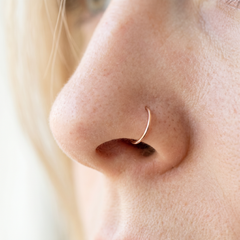
14K gold vs titanium
Both are excellent, safe choices. The decision comes down to aesthetics, budget and personal preference:
| 14K solid gold | Implant-grade titanium | |
|---|---|---|
| Biocompatibility | Excellent (nickel-free) | Excellent (ASTM F-136) |
| Weight | Slightly heavier — feels substantial | Very light — almost weightless |
| Look | Warm gold lustre, fine-jewellery finish | Silvery or anodised colours, industrial feel |
| Durability | Softer — can bend or scratch if mishandled | Very hard — scratch-resistant |
| Longevity | Lasts decades, retains value | Lasts decades, no resale value |
| Price | Higher — precious metal | Lower — industrial metal |
| Colours | Yellow, white, rose | Silver, anodised (blue, purple, etc.) |
Our recommendation: use titanium for the initial healing period if budget is a concern, then switch to 14K solid gold for long-term wear. If budget allows, 14K gold is safe from day one and gives your piercing the premium look and feel from the start.
How to choose
Selecting the right nose jewellery involves three decisions, in this order:
1. Material first. Decide between 14K solid gold and implant-grade titanium. This is non-negotiable — everything else (plated, filled, steel, silver) is a compromise that will likely cause problems. See the material comparison above.
2. Style second. Stud or hoop? If your piercing is new: flat-back labret stud. If your piercing is healed: seamless hoop for the classic ring look, or keep the stud if you prefer subtlety.
3. Size last. Once you know the material and style, choose your diameter (6mm, 7mm, 8mm for hoops) and gauge (18G, 20G, 22G). These two numbers ensure the ring fits your anatomy.
Caring for your jewellery
14K solid gold requires minimal care. Rinse under warm water occasionally to remove skin oils and product buildup. A soft cloth restores the lustre. Do not use harsh chemical cleaners or ultrasonic jewellery cleaners, which can weaken thin gauge wire over time.
Titanium is even easier. Virtually indestructible in daily wear. Wipe clean with saline or warm water.
For both materials: store spare rings in a small zip-lock bag or jewellery pouch. Thin nose rings (especially 22G) can bend if thrown loosely into a drawer. Keep them in their circular shape when not in use.