
22G vs 20G Nose Ring in the UK: Is 22G Smaller?

- Yes, 22G is smaller than 20G — 22G is 0.6mm, 20G is 0.8mm
- 20G is the more common gauge in UK nostril jewellery; 22G is rarer
- 22G wire is more delicate and easier to bend or deform if handled incorrectly
- Always match the gauge of your existing piercing — don't guess by eye
- Gauge and inner diameter are separate measurements — you need both right
What does gauge actually mean on a nose ring?
Gauge refers to the thickness of the metal wire that forms the ring. It's the number you'll see written as "20G", "22G" or "18G" on a product listing.
The gauge system is counter-intuitive: a smaller gauge number means a thicker wire, and a larger gauge number means a thinner wire. So a 22G ring is thinner than a 20G, which is thinner than an 18G.
Getting the gauge right matters because it affects three things at once:
Fit. The gauge has to match the size of your existing piercing channel. A ring that's too thick won't go in; one that's too thin will move around or let the channel shrink.
Comfort. A well-matched gauge sits stable in the piercing and barely registers during the day.
Durability. Thinner wire is more delicate and easier to bend if handled incorrectly. 22G needs more careful handling than 20G.
Is 22G smaller than 20G? Yes — here's the difference
22G is the smaller of the two. In metric terms:
| Gauge | Wire thickness | Relative size |
|---|---|---|
| 22G | 0.6mm | Thinner — the smaller option |
| 20G | 0.8mm | Thicker than 22G; thinner than 18G |
| 18G | 1.0mm | Thicker still — for reference |
The difference between 22G and 20G is just 0.2mm — small in the hand, but enough to noticeably change how the ring sits, feels, and how it holds up over time.
What's the difference between 22G and 20G in everyday wear?
Beyond the millimetres, the two gauges behave differently in everyday wear.
| Gauge | Look | Feel | Durability |
|---|---|---|---|
| 22G | Very fine, almost barely-there | Lightest possible, you may forget it's in | More delicate — bends more easily if mishandled |
| 20G | Delicate but with a bit more presence | Light but slightly more stable | Holds shape well in everyday wear |
Neither is universally "better" — they suit different piercings and preferences. The right one is the gauge that matches the piercing you already have.
Which gauge is more common in the UK?
20G is much more common than 22G in UK nostril jewellery. Most UK piercing studios pierce nostrils at 18G or 20G; 22G is rarely used as a piercing gauge and is mainly found as fine jewellery for already-healed piercings.
| Gauge | UK studio use |
|---|---|
| 20G (0.8mm) | Common for nostril jewellery, often the default for finer styles Common |
| 18G (1.0mm) | Common for a slightly more stable everyday fit Common |
| 22G (0.6mm) | Less common — mainly for fine fashion pieces on healed piercings Less common |
This matters when you're buying online. If you had your nostril pierced at a UK studio and don't know your gauge, it's more likely to be 20G or 18G than 22G — but you should still confirm before ordering.
Is 22G or 20G better for a healed nostril piercing?
20G suits most healed UK nostril piercings. 22G works only if your existing piercing was made for it — which is uncommon in the UK.
First, check your existing gauge
If you already wear a nose ring that fits comfortably, your safest move is to order the same gauge again. Wearing a thinner gauge (e.g. 22G in a 20G piercing) lets the channel shrink and the ring move around; wearing a thicker gauge can damage the channel if forced.
Choose 20G if your piercing fits 20G
20G gives a delicate, refined look while keeping enough wire strength for everyday wear. It's the most widely supported nostril gauge in the UK, so finding quality jewellery and replacement pieces is easier.
Choose 22G only if you know your piercing fits 22G
22G gives the thinnest, most minimal look. It suits people who specifically had their piercing made or stretched down for very fine jewellery, or who already wear 22G comfortably. It's not a good general-purpose substitute for 20G.
Does 22G feel different from 20G?
Yes, in two ways: weight and stability.
22G feels lighter. Because the wire is thinner, the ring is physically lighter and many wearers genuinely forget it's there. This can be the deciding factor if you find jewellery distracting or are sensitive to weight on the nose.
20G feels slightly more stable. The extra 0.2mm of wire means the ring sits with marginally more presence in the piercing. For everyday active wear, this stability is often preferred.
That said, comfort depends mainly on whether the gauge matches your piercing — not on the gauge in the abstract. A correctly-matched 22G feels comfortable; a mismatched 20G feels off.
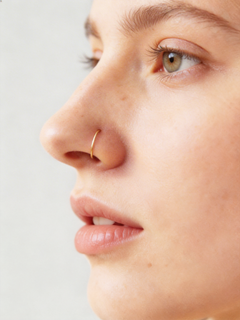
Does gauge change how a nose ring looks?
Both can look elegant in solid 14ct gold. The finish, style (seamless vs segment), and inner diameter all influence the final look as much as the gauge itself.
A note on handling 22G jewellery
Because 22G wire is only 0.6mm thick, it's more easily bent or deformed than 20G or 18G. If you choose 22G, a few habits will keep it looking right:
Do not pull a seamless hoop apart sideways. Twist it open gently to keep the circle shape. Pulling sideways is the most common way to permanently warp fine wire.
Avoid catching it on clothing or towels. Pat dry rather than rubbing; pull jumpers and scarves over slowly.
Take it out before contact sports or heavy gym sessions if possible. Direct knocks can deform 22G wire enough to feel uncomfortable.
What inner diameter should I choose with 22G or 20G?
Gauge and inner diameter are two separate measurements. Gauge tells you wire thickness; inner diameter tells you how wide the hoop is across the inside — usually 6mm, 7mm, 8mm, 9mm or 10mm for nostril piercings.
A ring can have the right gauge but the wrong diameter and still fit badly. Most UK buyers need a 7mm or 8mm inner diameter for healed nostrils, regardless of gauge.
| Gauge + Diameter | Best for |
|---|---|
| 20G + 7mm or 8mm | A common UK combination for healed nostrils Popular |
| 22G + 7mm or 8mm | Very fine, minimal look on a healed nostril (if your piercing fits 22G) |
| 20G + 6mm | Snug fit for low or close-to-edge placements |
| 22G + 6mm | The most delicate possible look — smallest fine hoop |
| 20G + 9–10mm | Higher placements or a deliberately looser look |
Can I switch between 22G and 20G?
This comes up a lot. The short answer is: match the gauge you already wear unless a piercer confirms you can safely change size. Use this table as a quick reference.
| Your situation | Recommendation |
|---|---|
| You currently wear 20G | Buy 20G again. 22G may fit, but it will move around and the channel may shrink over long-term wear. |
| You currently wear 22G | Buy 22G again unless a piercer confirms you can size up. Do not force 20G into a 22G piercing. |
| You do not know your gauge | Do not guess. Check your current jewellery, product receipt, or ask your piercer. In the UK, 20G or 18G is more likely than 22G. |
Which gauge does Stepoy recommend?
We make 14k solid gold seamless nose hoops for healed UK nostril piercings in 18G and 20G, the two gauges most UK nostrils are actually pierced at. We don't stock 22G as a default because it doesn't suit most UK buyers.
Why 14ct solid gold works well in fine gauges
If you're shopping for delicate jewellery, material matters as much as gauge. 14ct solid gold is a strong fit for fine nostril hoops because it holds its shape better than higher-carat alternatives at thin diameters.
Harder than 18ct or 22ct. Higher-carat gold is softer and bends more easily in 20G or 22G wire. 14ct is hard enough to keep its shape in a delicate hoop without feeling brittle.
Better than plated in fine gauges. Plated jewellery wears down faster on thin wire, especially inside a piercing channel. Solid 14ct gold doesn't have a coating to lose.
Clean polished finish. A seamless 14ct hoop sits flush against the skin without rough edges or visible joins — especially important on fine gauges where any seam would be visible.
Quick comparison: 22G vs 20G at a glance
| Feature | 22G | 20G |
|---|---|---|
| Wire thickness | 0.6mm | 0.8mm |
| Smaller / larger | Smaller (thinner) | Larger (thicker) |
| Look | Very fine, barely-there | Delicate but with presence |
| Feel | Lightest possible | Slightly more stable |
| UK studio use | Less common | Common |
| Durability | More delicate, bends more easily | Holds shape well |
| Best for | Maximally minimal styling on healed nostrils | Most healed UK nostrils |
| If unsure | Confirm your current gauge first | Confirm your current gauge first |
Final buying checklist
Before you check out, confirm all four:
Frequently asked questions
- What gauge means
- Is 22G smaller than 20G?
- 22G vs 20G difference
- Which is more common in UK
- Which is better for healed
- Does 22G feel different
- How gauge affects look
- Handling 22G jewellery
- Inner diameter with 22G/20G
- Can I switch between sizes
- Which Stepoy recommends
- Why 14ct gold works
- Quick comparison
- Final checklist
- FAQ