


New 14ct Solid Gold Hoop
How to Buy a 14ct Gold Helix Ring in the UK
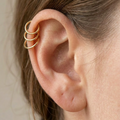
- 14ct solid gold is a strong choice for healed helix piercings — durable, nickel-free, and suited to long-term wear
- Many healed helix piercings use 16G or 18G — confirm yours before ordering, don't guess between gauges
- Common inner diameters: 7mm to 9mm, depending on ear shape and where the piercing sits
- Helix piercings take longer to heal than lobe — often 6 to 12 months or more before switching to gold
- Look for clear "14ct solid gold" wording, a nickel-free declaration, and a smooth polished finish
For a healed helix piercing in the UK, look for a nickel-free 14ct or 14K solid gold ring rather than plated jewellery. Many healed helix piercings use 16G or 18G — check your existing jewellery or ask your piercer to confirm. Inner diameter usually falls between 7mm and 9mm depending on ear shape and placement.
When buying, the four checks that matter most are: material, gauge, inner diameter, and what the seller tells you about delivery and pricing in GBP.
What is a helix ring?
The helix sits on the upper ear
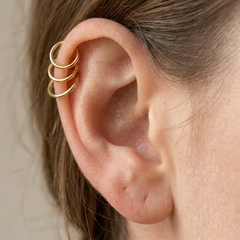
A helix piercing is placed along the upper cartilage rim of the ear — from the top of the ear curving down towards the back. It's one of the most popular ear piercings in the UK because it works with both subtle styling and statement jewellery, and it suits a wide range of face shapes.
Why people choose rings for helix piercings
Once fully healed, some people prefer a ring because it follows the natural curve of the ear and gives a cleaner side profile than a stud. The right choice depends on the look you want and the exact placement — comfort still varies with diameter, placement, and whether anything (sleep, headphones, hair styling) presses on the ring during the day.
Why choose 14ct gold for a helix ring?
Solid gold is better than plated for long-term wear
14ct solid gold is a stronger long-term choice than gold-plated, gold-filled, or vermeil jewellery. Plated and filled pieces wear down over time, especially in a piercing channel where the ring rotates against the skin. Once the surface layer wears through, you're exposing the piercing to the base metal underneath.
14ct sits in a useful middle ground
14ct (58.5% pure gold) balances purity and durability. Higher carat options like 18ct or 22ct are softer and can deform more easily in a small ring. Lower carat options like 9ct contain more alloy. 14ct, when nickel-free and well-alloyed, is suited to long-term wear in healed piercings while still holding its shape in a small cartilage ring.
Look for clear product information
If you're buying in the UK, make sure the seller clearly states the piece is solid 14ct gold. Avoid vague wording like "gold-tone", "gold-look", "gold-plated", "gold-filled", or "vermeil" if you want a proper long-term piece. Reputable sellers will also state the alloy is nickel-free.
- "Gold-tone", "gold-look", or "gold-colour" descriptions
- "Plated", "vermeil", or "gold-filled" sold as "14k gold"
- "Fashion jewellery" or "costume jewellery" labelling
- No clear material information at all
- Prices that seem too low for solid gold
What size helix ring should you buy?
Two measurements matter: gauge (how thick the wire is) and inner diameter (how big the ring is across). Both need to match your existing piercing.
Gauge is the thickness
Gauge refers to the thickness of the wire. The correct gauge matters because it must match your piercing channel — cartilage doesn't stretch like soft tissue, so a ring that's too thick won't fit, and one that's too thin will sit loose. Many healed helix piercings use 16G or 18G; 20G is less common because cartilage often needs a slightly thicker post to heal well.
| Gauge | Wire thickness | UK use for helix |
|---|---|---|
| 16G | 1.2mm | Common for UK helix piercings Popular |
| 18G | 1.0mm | Common for a finer, more delicate look Popular |
| 20G | 0.8mm | Less common — used in some studios for very fine jewellery |
| 14G | 1.6mm | Chunkier wire — occasional for stretched or bold styles |
Inner diameter is the width
Inner diameter is the inside size of the ring. This is what decides whether the ring hugs your ear closely or sits with a small gap below it. For helix, the right diameter depends on the curl and thickness of your ear cartilage at the piercing location — thicker ear rims need more room.
| Diameter | How it sits on a helix |
|---|---|
| 6mm | Snug, sits very close to the ear; suits thin rims or low placements |
| 7mm | Comfortable everyday fit for many UK helix piercings Popular |
| 8mm | Slightly looser, suits average ear shapes Popular |
| 9mm | More relaxed look; better for thicker rims or higher placements |
| 10mm | Statement size or for thicker cartilage areas |
The right size depends on your ear shape and where the piercing was placed. Many UK buyers find 16G or 18G + 7mm to 9mm is a comfortable range, but the exact fit always comes back to your specific anatomy and placement — not a one-size-fits-all default.
How do I know what size I need?
Check your current jewellery
If you already wear a helix ring or stud that fits well, this is the easiest route. Look for gauge and inner diameter on the original product listing, packaging, or receipt. If you bought it from a UK piercer, they may have your size on record — a quick message can save you a measurement.
Ask your piercer
If the piercing was done professionally, your piercer is the most reliable source for your exact gauge, diameter, and placement angle on your ear. This matters more for helix than other piercings because placement varies more than, say, a lobe — a slightly different placement can need a slightly different ring size.
Measure carefully if you have to
Gauge and diameter are different measurements, so confirm both before ordering. An inexpensive digital caliper will give you an accurate gauge reading in millimetres. For inner diameter, lay the ring flat and measure the empty space inside — not edge-to-edge across the outside, which is the most common mistake.
Which style of helix ring should you choose?
Once you know your size, the next decision is style. For healed helix piercings, four styles cover most of what UK buyers consider.
Seamless helix rings
Best for: healed helix piercings and minimal everyday wear.
Pros: a single bent wire with no closure mechanism, so the line is clean and uninterrupted. Sits neatly against the ear. The most popular long-term style for healed cartilage.
When to choose: once your piercing is fully healed and you want a low-profile, minimal look. Seamless rings should be opened and closed carefully to keep the ring round — if you're not confident inserting one yourself, ask your piercer to fit it the first time.
Clicker helix rings
Best for: people who change jewellery often or prefer a secure closure.
Pros: a hinged segment opens cleanly and clicks shut. Easier to insert by feel, which can help for helix — you can't always see the piercing clearly in a mirror.
When to choose: if you swap jewellery regularly, or want a closure mechanism for added security.
Plain gold helix rings
Best for: understated, versatile daily style.
Pros: works with any outfit, pairs cleanly with other ear jewellery, and lets the gold itself be the focal point. Often the most flexible choice if you wear multiple ear piercings together.
When to choose: if you want a piece that disappears into your everyday wardrobe rather than drawing attention on its own.
Stone-set helix rings
Best for: more decorative or statement looks.
Pros: a small stone adds detail without being heavy. Suits people who already have other ear piercings and want this one to catch the eye.
When to choose: if you want a clearly decorative piece rather than a minimal one, or you're building a more layered ear stack.
Why UK buyers should consider a UK-focused brand
Buying body jewellery from a UK-focused brand can give you a clearer, more predictable shopping experience — particularly when fit, sizing language, and pricing transparency matter.
Pricing in GBP, visible before checkout
Prices are shown in pounds, with delivery costs and any applicable taxes visible before you commit. You see what you're paying before placing the order — no late conversion or unclear total.
UK-friendly sizing language
UK piercing studios use gauge numbers (16G, 18G, 20G) and millimetre inner diameters. UK-focused sellers list jewellery in the same formats — easier to match what your piercer told you, without converting from US fractional sizes or other regional systems.
Made to order, with delivery times shown clearly
Many UK-focused jewellery brands operate on a made-to-order basis, which means estimated delivery time will vary. Always check the timeline on the product page before buying — that's more honest than assumptions about shipping origin or speed.
Is a 14ct gold helix ring good for daily wear?
Yes — once the piercing is fully healed
A healed helix is the right stage for a 14ct gold ring. Once the piercing is fully settled, gold becomes a comfortable, durable long-term option. The key phrase is fully healed — helix piercings often take 6 to 12 months and sometimes longer to settle completely, so ask your piercer to confirm before switching from healing jewellery to gold.
For a fresh or still-healing helix
For a fresh or still-healing helix, follow your piercer's advice. Many piercers prefer implant-grade titanium (ASTM F136) for healing cartilage, while properly made solid 14K/14ct gold can also be suitable when it is nickel-free, cadmium-free, biocompatible, and polished to body-jewellery standards. Stepoy rings are intended for healed piercings, so confirm with your piercer that yours is fully settled before switching.
It suits a refined daily look
14ct gold gives helix jewellery a polished finish that reads as quality without being flashy. It pairs well with other gold ear jewellery (lobe studs, conch rings) and ages gracefully — solid gold won't tarnish or lose colour the way plated jewellery does.
Fit still matters
Even the best material won't feel right if the ring is the wrong size. Helix piercings sit against cartilage that doesn't have the give of soft tissue — a slightly wrong gauge or diameter is noticeable in a way it might not be in a lobe piercing. Get the size right first, then choose the gold.
What should you buy from Stepoy?
Solid 14K gold seamless helix rings
Stepoy focuses on 14K solid gold seamless helix rings for healed cartilage piercings — clean, minimal, nickel-free, and made to order in carefully chosen helix sizes.
Sizes that match real UK piercings
Available in 16G and 18G, with inner diameters of 6mm, 7mm, 8mm, 9mm, and 10mm. That lets you match what your piercer specified rather than rounding to whatever a generic seller stocks.
UK-focused buying experience
Stepoy is a UK-focused brand for buyers who want clear GBP pricing, UK-friendly sizing language, and transparent delivery information before checkout. Each piece is made to order, so always check the estimated delivery time on the product page before buying.
Quick checklist before you order
Frequently asked questions
Final recommendation
If you want a long-lasting, elegant ring for a healed helix piercing, a properly sized 14ct solid gold ring is a strong choice. For most UK buyers, the best result comes from matching three things carefully: material (solid 14ct, not plated), gauge (usually 16G or 18G), and inner diameter (typically 7mm to 9mm).
Confirm your size with your piercer or existing jewellery first, then choose the gold. That order matters — the right material in the wrong size still won't fit.