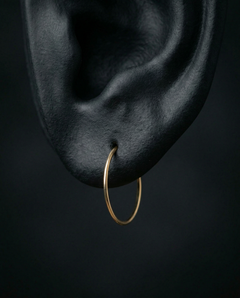
New 14ct Solid Gold Piercing Hoop


Infected Lobe Piercing: Signs & Treatment
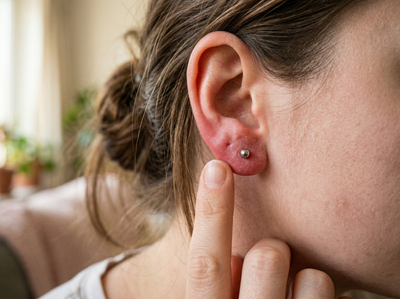
- Most "infected" lobes are actually irritated — caused by cheap metal, butterfly-back compression or dirty hands, not bacteria
- A real infection has spreading redness, thick coloured discharge, heat, throbbing pain and sometimes fever
- Irritation has localised redness, clear or white discharge, mild soreness — and resolves by removing the cause
- Do not remove the earring from a genuinely infected lobe — the hole closes and traps the infection inside
- Gun-pierced lobes are significantly more likely to become infected than needle-pierced lobes
- An old, healed lobe that suddenly gets sore is almost always a metal reaction, not an infection
Infection vs irritation — how to tell
This is the most important distinction in this entire article. Getting it right determines whether you need a doctor or just better earrings. Getting it wrong leads to either unnecessary antibiotics (for irritation misdiagnosed as infection) or delayed medical care (for infection dismissed as irritation).
| Symptom | Irritation | Infection |
|---|---|---|
| Redness | Localised — only around the piercing hole | Spreading — extends beyond the hole across the lobe |
| Discharge | Clear, white or pale yellow. Thin. No strong smell. | Thick yellow, green or brown. Opaque. Often smells. |
| Pain | Mild soreness when touched or bumped | Throbbing pain that does not ease, even at rest |
| Heat | Not noticeably warm | The lobe feels hot compared to the other ear |
| Swelling | Slight puffiness around the hole | Whole lobe swollen, visibly larger than the other |
| Fever | Never | Possible — sign of systemic infection |
| Timeline | Appears gradually over days | Escalates noticeably over 24–48 hours |
| Response to | Removing the irritant (metal, pressure) → improves in 48 hrs | Needs medical treatment → does not self-resolve |
Why lobe piercings get infected
Lobe infections happen when bacteria enter the piercing channel and multiply faster than the body can clear them. On a healthy healed lobe with quality jewellery, this is rare. On a fresh gun piercing with a butterfly-back stud and unwashed hands, it is much more likely. Here are the specific causes, in order of frequency.
1. Gun piercing with non-sterile equipment
Piercing guns cannot be autoclaved (steam-sterilised) because they contain plastic components that melt at autoclave temperatures. They are wiped down with antiseptic between clients, which does not eliminate all bacteria. The gun also forces a blunt stud through the tissue by brute force, creating a jagged channel with bruised edges — an ideal environment for bacteria. Gun-pierced lobes are significantly more likely to become infected than needle-pierced lobes.
2. Touching the piercing with dirty hands
Every time you touch the earring, adjust it, twist it or fiddle with it, bacteria from your hands transfer directly into the piercing channel. This is the single most common cause of fresh lobe infections. The "twist your earring" advice given by gun-piercing shops is directly responsible for a large number of lobe infections.
3. Butterfly-back studs trapping bacteria
Butterfly backs (the folded-metal clips used in gun piercings) have crevices that trap dead skin, discharge, shampoo residue and bacteria. The clip sits tight against the back of the lobe, compressing the tissue and creating a warm, moist pocket where bacteria thrive. Flat-back studs have a smooth, flush disc that does not trap debris.
4. Changing earrings too early
Swapping earrings before the lobe is healed (before 6–8 weeks) introduces bacteria from your fingers and from the new earring. Every earring change on a fresh lobe is a potential infection event. See our lobe healing guide for the correct timeline.
5. Swimming in contaminated water
Pools, hot tubs, lakes and the sea contain bacteria that a healing lobe channel cannot defend against. A single swim session in week 2 of healing can introduce enough bacteria to cause an infection within 48 hours.
6. Cheap or reactive metal
Fashion earrings with unknown alloys, nickel-containing studs, and gold-plated jewellery with worn-through plating do not cause infection directly, but they cause irritation that compromises the skin barrier inside the channel. Once the barrier is broken, bacteria that would normally be harmless can enter and multiply. Cheap metal is the leading cause of the "old piercing suddenly infected" scenario.
If it is irritation — what to do
Most people searching "infected lobe piercing" actually have an irritated lobe. Here is the treatment:
If it is a real infection — what to do
If your lobe has spreading redness, thick coloured discharge, heat, throbbing pain at rest, or fever, it needs medical treatment. Here is the process:
The embedded earring emergency
An embedded earring is the most serious lobe complication and requires medical attention. It happens almost exclusively with gun piercings using butterfly-back studs.
What happens: The initial gun-pierced stud is too short for the swelling that develops in week 1. The butterfly back presses into the swollen lobe. The front disc begins to sink into the tissue. Within days, the skin can grow over the front of the earring, partially or fully trapping it inside the lobe.
What to do: If the front of the earring is sinking below the skin surface, see a piercer within 24 hours to swap to a longer stud. If the skin has already grown over the earring and you cannot see it, go to a GP or minor injuries unit — the earring will need to be removed under local anaesthetic. Do not attempt to push it out or dig it out yourself.
Prevention: Get pierced with a needle by a professional piercer who uses flat-back studs with enough post length for swelling. If you were gun-pierced and the earring feels tight within the first week, see a piercer immediately to swap to a longer post before embedding occurs.
What not to do
Do not remove the earring from an infected lobe. The channel closes and traps the infection. Leave it in for drainage.
Do not apply hydrogen peroxide, rubbing alcohol, TCP or Dettol. These are too harsh and damage the tissue that is trying to heal. Saline only.
Do not squeeze pus out of the piercing. Squeezing pushes bacteria deeper into the tissue and can spread the infection. Let the saline soak draw discharge out naturally.
Do not apply antibiotic ointment without a GP prescription. Over-the-counter antibiotic creams (Neosporin, Savlon) are petroleum-based and seal the piercing channel, trapping bacteria inside. They are not designed for puncture wounds. If you need antibiotics, a GP will prescribe oral ones that work systemically.
Do not ignore an infection hoping it will resolve. Irritation self-resolves when the cause is removed. Infection escalates without treatment. If symptoms are worsening day over day, see a doctor.
Do not self-diagnose with internet photos. Photos of infected piercings online are often extreme cases chosen for shock value. Mild infections look very similar to irritation in photographs. The diagnostic table above is more reliable than photo comparison.
How to prevent lobe infections
Most lobe infections are entirely preventable. These steps eliminate the vast majority of risk:
Get pierced with a needle. Professional piercers use single-use sterile needles and implant-grade jewellery. The infection rate for needle-pierced lobes is a fraction of the rate for gun-pierced lobes. See our lobe healing guide for the full needle-vs-gun comparison.
Wear 14K solid gold or implant-grade titanium. These materials do not irritate, do not corrode, and do not compromise the skin barrier inside the channel. The majority of "suddenly infected" old piercings are caused by cheap metal, not bacteria.
Do not touch, twist or rotate the earring. The single most effective infection prevention behaviour is simply not touching the piercing.
Complete the full healing period. 6–8 weeks for needle, 8–12 weeks for gun. Do not change earrings, swim, or stop aftercare before the piercing is confirmed healed.
Replace butterfly backs with flat backs. If you were gun-pierced with butterfly-back studs, visit a professional piercer to swap them for flat-back studs in titanium or 14K gold. This single change eliminates the compression and bacteria-trapping that causes most gun-related complications.
When to see a piercer vs GP vs A&E
| Symptom | Go to | Timing |
|---|---|---|
| Mild redness and soreness, clear discharge | Self-treat (switch metal, saline, stop touching) | Monitor for 7 days |
| Earring feeling tight, front disc pressing into skin | Piercer (swap to longer stud) | Within 24 hours |
| Not improving after 7 days of self-treatment | Piercer (check fit, material, placement) | This week |
| Thick coloured discharge (yellow, green) | GP | Within 24 hours |
| Spreading redness beyond the piercing hole | GP | Within 24 hours |
| Throbbing pain at rest, lobe hot to touch | GP | Within 24 hours |
| Earring fully embedded (skin grown over) | GP or minor injuries | Same day |
| Fever, spreading redness towards neck/jaw, severe swelling | A&E | Immediately |