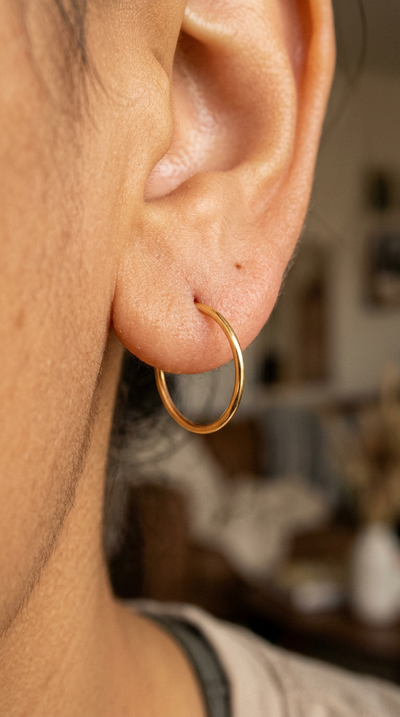
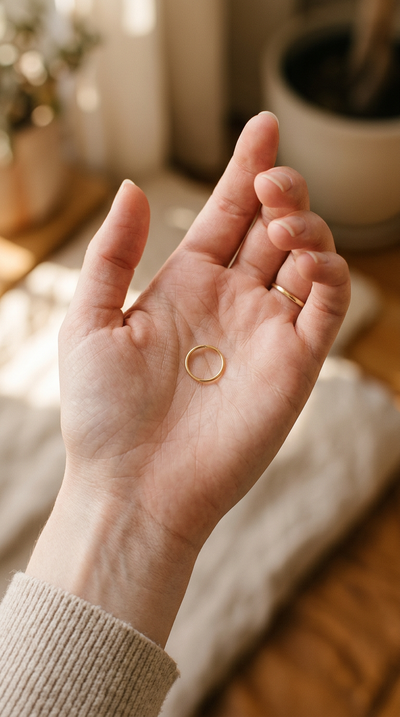
New 14ct Solid Gold Piercing Hoop


Lobe Hoop Size Guide: 6mm, 7mm, 8mm & 10mm
- Lobe hoops typically range from 6mm to 10mm — wider than rook but the lobe is soft tissue so the hoop hangs down rather than wrapping a ridge
- 8mm is the most popular lobe hoop size — hugs the lobe closely on average ear anatomy
- Huggie hoops are the most popular style for lobes — they click shut and sit flat against the lobe
- Lobe thickness determines your size more than anything else — thin lobes need 6–7mm, average 8mm, thick 9–10mm
- Second and third lobe positions need smaller hoops than the first because the lobe narrows higher up
- Lobe hoops can be heavier than cartilage hoops without risk — but heavy hoops stretch the hole over time
Why lobe hoops are sized differently from cartilage
On a helix, rook or tragus, a hoop wraps around a ridge of cartilage and the diameter needs to match the fold precisely — too tight and it pinches, too loose and it catches. Lobe hoops work differently. The lobe is a flat, soft, hanging piece of tissue. A hoop does not wrap around anything — it passes through the piercing hole and hangs below the lobe by gravity.
This means lobe hoop sizing is about how much the ring extends below the lobe, not how tightly it fits. A 6mm hoop on a thin lobe barely peeks below the edge. A 10mm hoop creates a visible dangling circle. The difference is purely aesthetic, not structural — unlike cartilage, where a wrong size causes bumps and irritation.
The consequence: lobe hoop sizing is more forgiving than cartilage sizing. A 1mm error on a rook hoop causes pressure problems. A 1mm error on a lobe hoop is simply a slightly different look. This does not mean sizing does not matter — it does, for aesthetics — but it means you have more room to experiment.
6mm vs 7mm vs 8mm vs 10mm
| Diameter | Look on the lobe | Best for |
|---|---|---|
| 6mm | Very small — sits tight against the lobe, barely visible below the edge | Second or third lobe, thin earlobes, ultra-minimal aesthetic |
| 7mm | Small — a thin crescent just below the lobe edge | Second lobe, thin to average earlobes, understated daily wear |
| 8mm MOST POPULAR | Classic — a neat circle that hugs the lobe closely with a small visible drop | First lobe on average anatomy — the default starting point |
| 10mm | Medium — a clearly visible hoop with space between the ring and the lobe | First lobe on thick lobes, statement mini-hoop, relaxed fit preference |
| 12mm+ | Large — a full dangling hoop well below the lobe | Statement look, fashion hoops, stretched lobes |
6mm — barely there
6mm is the smallest lobe hoop commonly sold. On an average first lobe, a 6mm ring is almost entirely hidden by the lobe itself — only a sliver of metal is visible below the ear. It works best on a second or third lobe where the tissue is thinner, or on people with naturally thin, small earlobes who want a huggie-style ring that sits tight.
7mm — subtle but visible
7mm shows a thin crescent of metal below the lobe. This is the sweet spot for people who want a hoop that reads as "I have a hoop" without the ring dominating the ear. Popular for second lobes and for people who wear their first lobe hoop alongside studs in other positions.
8mm — the default
8mm is the most commonly purchased lobe hoop size. On an average earlobe (approximately 6–7mm thick at the piercing), an 8mm ring creates a neat, close-fitting circle with a small visible arc below the lobe. This is the size most people picture when they think "small gold hoop." If you are buying your first lobe hoop and have not measured, 8mm is the safest starting point.
10mm — visible and relaxed
10mm creates a clearly visible hoop with a noticeable gap between the ring and the lower edge of the lobe. It is a more relaxed, casual look compared to the tight hug of 8mm. 10mm is the right choice for people with thicker earlobes (where 8mm would be too tight) or those who prefer a slightly more dramatic ring.
Huggie vs seamless vs sleeper
Lobe hoops come in three main styles. Each closes differently, sits differently on the ear, and has a different aesthetic. Understanding the distinction matters because "lobe hoop" can mean any of these, and they are not interchangeable in terms of look or fit.
Huggie hoops
The most popular lobe hoop style. A huggie is a small, thick hoop with a hinged closure that snaps shut. The metal is wider than a wire — typically 1.5–3mm wide — which gives it a substantial, polished look without being heavy. Huggies sit flush against the lobe and do not dangle or swing. They are measured by inner diameter, with 8mm being the standard lobe huggie. The name "huggie" comes from how closely they hug the ear.
Seamless rings
A seamless ring is a single continuous circle of thin wire (usually 18G or 20G) with a small gap that opens by twisting. The wire is much thinner than a huggie — just 0.8–1.0mm — which creates a delicate, thread-like appearance. Seamless rings are the same style used on helix, rook and nostril piercings, just in larger diameters for the lobe. They dangle and swing slightly because the wire is light and there is no click-closure to hold them rigid against the lobe.
Sleeper earrings
A sleeper is a small, lightweight hoop designed to be worn 24/7 — including while sleeping. Sleepers are thin wire (like seamless rings) but with a latch or clasp closure that locks the ring shut securely. They are smooth, rounded, and have no protruding mechanisms that could dig into the ear during sleep. Sleepers are the go-to choice for people who want a permanent lobe hoop they never take out.
| Huggie | Seamless | Sleeper | |
|---|---|---|---|
| Wire width | 1.5–3mm (wide band) | 0.8–1.0mm (thin wire) | 0.8–1.0mm (thin wire) |
| Closure | Hinge + click | Twist gap open/shut | Latch or wire clasp |
| Look | Polished, substantial, flat against lobe | Delicate, thread-like, slight dangle | Simple, smooth, no-fuss |
| Sleep-friendly | Good — flat profile | Fair — gap can snag on pillow | Best — designed for 24/7 wear |
| Common sizes | 8–12mm | 6–10mm | 8–10mm |
| Best for | Daily wear, polished look, lobe stacks | Minimal aesthetic, layering with studs | Never-remove, permanent hoop |
Sizing by lobe position
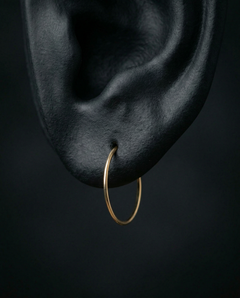
If you have multiple lobe piercings, each position may need a different hoop size because the lobe narrows as it rises.
| Position | Typical hoop size | Why |
|---|---|---|
| 1st lobe (bottom centre) | 8mm MOST COMMON | Widest, thickest part of the lobe. 8mm fits most anatomy. |
| 2nd lobe (above first) | 6–7mm | Lobe is thinner here. 8mm may look oversized. |
| 3rd lobe (top of lobe) | 6mm | Thinnest soft tissue area before cartilage. Small hoops only. |
For a lobe stack with hoops at all three positions, graduating the size (8mm at bottom, 7mm in the middle, 6mm at the top) creates a clean cascading effect. All three hoops in the same size can work if your lobe is even in thickness, but graduated sizes usually look more intentional because they follow the natural taper of the ear.
How to measure
Measuring for a lobe hoop is simpler than for cartilage because there is no ridge to wrap around. You are measuring lobe thickness — how far the hoop post must travel through the lobe — and then adding the amount of visible ring you want below the lobe.
Lobe hoop gauge
Lobe piercings are typically pierced at 20G (0.8mm) or 18G (1.0mm). This is thinner than cartilage piercings (16G). Most lobe hoops and huggie hoops are made in 20G or 18G — check your gauge before ordering.
| Gauge | Thickness | Notes |
|---|---|---|
| 20G (0.8mm) COMMON | Thin, delicate | Most common for lobe piercings. Standard for seamless rings and many huggies. Dainty look. |
| 18G (1.0mm) COMMON | Standard | Common for professionally-pierced lobes. Slightly more substantial wire. Good for huggies and sleepers. |
| 16G (1.2mm) | Thick | Uncommon for lobes unless the piercing was originally done at 16G. Creates a bold, noticeable ring. |
If you do not know your gauge, 20G is the safest assumption for fashion-pierced lobes (gun piercings from shops). 18G is standard for professionally needle-pierced lobes. A 20G hoop fits in an 18G hole (it is thinner), but the reverse does not work without stretching.
The weight question
Lobe piercings have a unique concern that cartilage piercings do not: earring weight can stretch the hole over time. This matters for hoops because some lobe hoops — especially wide huggies with gemstone settings — are heavier than plain studs.
Lightweight hoops (seamless rings, thin huggies): No stretching concern even with daily wear. A 14K gold seamless ring in 8mm weighs under 0.5g. You can wear these indefinitely without the hole changing shape.
Medium hoops (standard huggies, sleepers): Fine for daily wear. A standard 14K gold huggie in 8–10mm weighs 1–2g. No stretching over months or years of normal wear.
Heavy hoops (wide huggies with stones, large hoops, thick gold): These can gradually elongate the piercing hole if worn daily for years. The weight creates downward pull on the bottom of the hole, and over time the hole becomes a slight slot rather than a circle. This is a cosmetic concern, not a medical one, but it is not easily reversible. Rotate heavy hoops with lightweight pieces to give the lobe rest days.
Common mistakes
Buying a helix-sized hoop for a lobe. A 6mm hoop that is perfect for a helix is often too small for a first lobe, where 8mm is standard. Lobe tissue is thicker than the helix rim. Always size specifically for the lobe position.
Same size for all three lobe positions. The lobe narrows as it rises. An 8mm hoop at the third position usually looks oversized because the tissue is thinner there. Graduate: 8mm first, 7mm second, 6mm third.
Ignoring gauge mismatch. A 16G hoop in a 20G hole will not pass through without stretching. A 20G hoop in a 16G hole wobbles and may irritate. Check your gauge before ordering.
Wearing heavy hoops 24/7 for years. Heavy huggies with gemstones are beautiful for a night out. Wearing them to sleep every night for five years elongates the hole. Rotate with lightweight hoops or studs for sleep.
Switching to a hoop before the lobe is healed. Hoops move more than studs and can irritate a fresh channel. Wait until week 6–8 (needle) or week 10–12 (gun) before inserting any hoop. See our lobe healing guide for the full timeline.