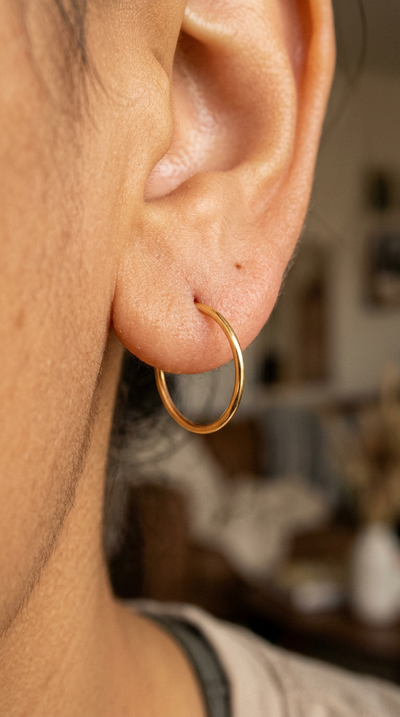
New 14ct Solid Gold Piercing Hoop


Lobe Piercing Jewellery: Hoops, Huggies & 14K Gold
- The lobe accepts more jewellery styles than any other ear piercing — studs, hoops, huggies, dangles, drops, threaders and crawlers
- 14K solid gold is the ideal lobe material — biocompatible, durable, tarnish-resistant and safe for long-term wear
- Healing jewellery (flat-back stud) is different from everyday jewellery — do not skip the healing stage
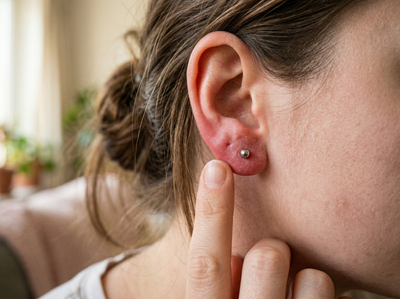
- Gold-plated jewellery wears through within months and is the leading cause of lobe irritation in established piercings
- Huggie hoops are the most popular lobe earring type in the UK — easy to wear, secure, and available in every size
- Match the metal across your entire ear for a curated look — mixing gold and silver within the ear reads as accidental
Every lobe jewellery type explained
Flat-back studs
A post with a decorative front and a flat disc on the back. The disc sits flush against the back of the lobe, making it the most comfortable style for sleeping and the standard for healing. Flat-back studs are the foundation of every lobe collection — they work in every hole, every situation and every outfit. Available in every size from 2mm micro dots to 8mm gemstone settings.
Best for: Healing piercings, sleeping, daily wear, second and third lobes, stacking.
Huggie hoops
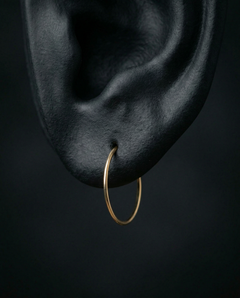
A small hinged hoop that clicks closed and hugs the lobe. Wider profile than a seamless ring (2–3mm), with a polished or pavé front surface. Huggies are the single most popular lobe earring type in the UK — they combine the visual impact of a hoop with the security of a locking mechanism. Available from 6mm to 14mm. See our lobe hoop size guide for detailed sizing.
Best for: First lobe daily wear, lobe stacks, people who want a hoop that will not fall out.
Seamless rings
A thin wire circle with a twist-open gap. Minimal, delicate and wire-thin. Creates a fine, thread-like ring on the lobe. More subtle than a huggie but less secure — the gap can catch on hair and open. Best for second and third lobes where a tiny, barely-there ring is the aesthetic goal.
Best for: Second and third lobes, minimalist stacks, permanent wear.
Drop earrings
A stud or hook with a single element hanging below the lobe. Drops range from a 5mm pendant on a short chain to a 30mm gemstone dangle. They add length and movement to the ear. The lobe is the only piercing strong enough to support the weight of most drop designs — cartilage piercings cannot safely hold heavy drops.
Best for: First lobe, evening and occasion wear, statement pieces.
Dangle earrings
Longer than drops, with multiple moving elements. Chandelier earrings, chain earrings and multi-stone designs all fall into this category. Dangles are statement pieces that transform the ear. Heavy dangles (above 5g per earring) can stretch the lobe over time if worn daily — save them for occasions rather than every day.
Best for: First lobe only, events, photographs, short-term wear.
Threader earrings
A thin chain that passes through the piercing hole with a decorative element hanging from one end. Threaders create a unique look — the chain drapes through the lobe and hangs at different lengths depending on how far you pull it. They are not secure for active wear (the chain slides out easily) but create a striking visual for evening.
Best for: First lobe, evening styling, people who like adjustable length.
Ear crawlers (climbers)
A curved bar that passes through the first lobe and extends upward along the ear, creating the illusion of multiple piercings with a single piece. Crawlers are design-forward and eye-catching. They work best on ears with only one lobe piercing, since a second hole would interrupt the crawler’s visual line.
Best for: Single first lobe, fashion-forward styling, people who want impact without multiple piercings.
| Type | Profile | Security | Sleep-friendly | Best position |
|---|---|---|---|---|
| Flat-back stud | Flush | Very high | Yes BEST | Any lobe |
| Huggie hoop MOST POPULAR | Low hoop | High (hinge lock) | Mostly | Any lobe |
| Seamless ring | Wire-thin hoop | Medium (twist gap) | Mostly | 2nd / 3rd lobe |
| Drop | Hanging | Medium | No | 1st lobe |
| Dangle | Long hanging | Medium | No | 1st lobe only |
| Threader | Chain-through | Low | No | 1st lobe |
| Crawler | Climbing bar | Medium | No | 1st lobe (single) |
Why 14K solid gold is the standard
Not all gold is the same, and the differences matter more for piercing jewellery than for fashion accessories. Here is why 14K solid gold is the material we recommend for every lobe earring.
Biocompatible. 14K gold (58.3% pure gold alloyed with silver, copper and zinc) does not react with skin or body fluids. It can sit inside a piercing channel for years without causing irritation, discolouration or allergic response. This is the single most important property of piercing jewellery.
Nickel-free. Quality 14K gold is alloyed without nickel. Nickel is the most common metal allergen in the UK, and it is present in surgical steel, many silver alloys and all cheap plated jewellery. If you have ever had a green mark, an itchy lobe or a reaction to earrings, nickel was almost certainly the cause.
Durable. 14K is harder than 18K or 24K because the alloy metals add structural strength. A 14K huggie hoop holds its shape through daily wear, withstands the hinge mechanism opening and closing hundreds of times, and resists bending even at 20G wire thickness.
Tarnish-resistant. 14K gold does not tarnish, blacken or corrode. Sterling silver tarnishes inside the piercing channel and deposits dark residue. Gold-plated jewellery flakes. 14K remains the same colour from day one to year ten.
| Material | Safe for lobes? | Longevity | Price (per earring) |
|---|---|---|---|
| 14K solid gold RECOMMENDED | Yes — biocompatible, nickel-free | Lifetime | £30–£120 |
| 18K solid gold | Yes — softer, more pure | Lifetime (bends more easily) | £50–£180 |
| Implant-grade titanium | Yes — hypoallergenic | Lifetime | £15–£50 |
| Gold-plated / vermeil | Short-term only — plating wears | 3–12 months before base metal shows | £10–£40 |
| Gold-filled | Acceptable — thicker gold layer | 2–5 years with care | £15–£50 |
| Sterling silver | Not ideal — tarnishes in channel | Indefinite but requires polishing | £10–£40 |
| Surgical steel | Caution — contains nickel | Indefinite | £5–£20 |
| Fashion / costume | No — unknown alloys, often nickel-heavy | Weeks to months | £2–£15 |
What to wear when
The jewellery that suits a healing lobe is different from what suits a healed lobe, which is different from what suits a night out. Here is the framework:
During healing (weeks 0–8)
Flat-back stud only. Titanium or 14K gold. No hoops, no dangles, no huggies. The stud must be long enough for swelling, with a flat disc back that does not dig into the lobe. This is not the time for aesthetics — heal first, decorate later. See our lobe healing guide.
First change (week 8–12)
Lightweight studs or small huggie hoops. The channel is healed but still new. Choose pieces under 3g per earring. Avoid heavy dangles for at least 3 months — the channel needs time to fully mature before supporting weight. This is when you start assembling your lobe stack. See our lobe stacking guide.
Everyday wear (month 3+)
Anything. Studs, hoops, huggies, drops — all are safe on a fully mature lobe. For daily wear, prioritise pieces that are comfortable for sleeping (flat-backs and huggies), secure enough for activity (hinge-lock huggies over seamless rings), and made of implant-safe material (14K gold or titanium).
Evening and occasions
Statement pieces. Heavy dangles, chandelier earrings, oversized hoops, threaders. These are short-term wear pieces — beautiful for an evening but not designed for 24/7. Swap back to a stud or huggie for sleeping. Wearing heavy earrings to bed stretches the lobe over time.
14K yellow vs white vs rose gold
All three are 14K gold (58.3% pure gold) — the difference is the alloy metals mixed with the gold, which change the colour.
Yellow gold is alloyed with silver and copper. It is the classic, warm gold tone and the most popular choice for lobe jewellery in the UK. It pairs with warm skin tones and coordinates with most other body jewellery.
White gold is alloyed with palladium or nickel (choose nickel-free) and rhodium-plated for brightness. It has a cool, silvery-white tone that resembles platinum. The rhodium plating will wear over years and can be re-plated by a jeweller. White gold pairs with cool skin tones and silver-toned watches.
Rose gold is alloyed with a higher copper ratio, giving a warm pink tone. It sits between yellow and white in visual temperature. Rose gold has surged in popularity and creates a distinctive, slightly vintage aesthetic. It pairs well with both warm and neutral skin tones.
Caring for lobe jewellery
14K gold is low-maintenance, but a small amount of care keeps it looking its best.
Clean once a month. Soak earrings in warm water with a drop of mild dish soap for 10 minutes. Gently brush with a soft toothbrush, rinse and pat dry. This removes skin oil, moisturiser and product buildup that dulls the surface over time.
Store separately. Gold scratches when pieces rub together. Keep earrings in individual compartments or a soft pouch. Never throw gold jewellery into a communal jewellery box with other metals.
Remove for chemicals. Chlorine (pools), bleach (cleaning products) and some skincare acids can discolour gold over time. Remove earrings before swimming in treated pools and before applying strong chemical products near the ears.
Re-plate white gold every 2–3 years. The rhodium plating on white gold wears gradually, revealing a slightly yellowish tone underneath. A jeweller can re-plate for £15–£25 per piece, restoring the bright white finish.