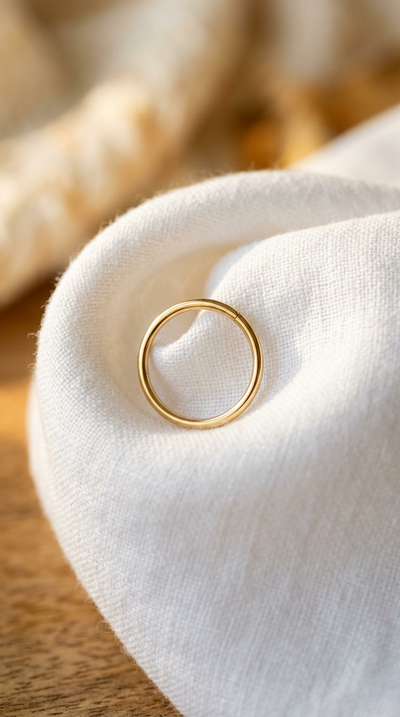
New 14ct Solid Gold Hoop
Forward Helix Piercing: Types, Pain & Jewellery
- Forward helix piercings go through the small cartilage fold where the helix meets the face
- Pain is moderate: 5-6 out of 10, slightly more than a standard helix
- Healing takes 6-12 months — longer than a standard helix due to thicker cartilage
- Best jewellery: small hoops (4-6mm) or flat-back studs in 18G or 20G
- Can be done as single, double, or triple for a stacked effect
What is a forward helix piercing?
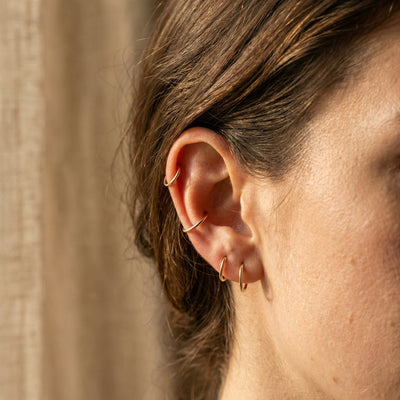
The forward helix is a piercing through the small fold of cartilage at the very front of your ear — where the upper rim curves down to meet your face. Unlike a standard helix (which sits on the outer edge of the ear), the forward helix is tucked into the front, creating a subtle, almost hidden look that catches the light when you turn your head.
It requires some of the smallest jewellery of any ear piercing. The anatomy is tight and the fold is narrow, so oversized jewellery looks awkward and is uncomfortable. Sizes typically range from 4mm to 6mm — much smaller than a standard helix ring.
Single, double & triple forward helix
Single forward helix
One piercing through the forward helix fold. The simplest and most common option. A single small hoop or flat-back stud creates a clean, understated look. Best starting point if you are not sure about committing to multiples.
Double forward helix
Two piercings stacked vertically in the forward helix area. Creates more visual interest while still looking refined. Your piercer needs enough space between the two piercings — typically 3-4mm apart.
Triple forward helix
Three stacked piercings creating a beautiful cascade of small rings or studs down the front of the ear. Requires generous anatomy and an experienced piercer — not every ear can accommodate three piercings in this area.
How much does a forward helix hurt?
Most people rate a forward helix at 5-6 out of 10 — slightly more painful than a standard helix (4-5/10) because the cartilage at the front of the ear tends to be thicker and denser. The piercing itself takes only a few seconds.
If you are getting a double or triple, the second and third may feel more intense because adrenaline has worn off and your body is already in a heightened state. Breathing techniques and an experienced piercer make a noticeable difference.
Healing timeline
Forward helix piercings take 6-12 months to fully heal — notably longer than a standard helix because the cartilage is thicker and receives less blood flow.
Best jewellery for forward helix piercings
During healing: a flat-back labret stud in 18G or 20G. The flat back sits flush inside the ear, minimising irritation.
Once healed: a small seamless hoop in 4mm, 4.5mm, or 5mm. These tiny hoops create the classic forward helix look.
Aftercare essentials
Clean twice daily with sterile saline solution. Spray, let it sit, pat dry with clean kitchen roll.
Do not touch it. Do not twist, rotate, or fiddle with it. Your hands are the biggest source of bacteria.
Be careful with hair. The forward helix sits right where hair falls around the face. Tie hair back during healing.
Sleep carefully. Avoid sleeping on the pierced ear. A travel pillow with a hole works brilliantly.