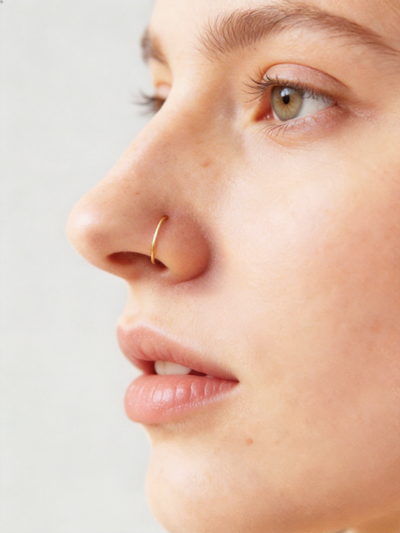
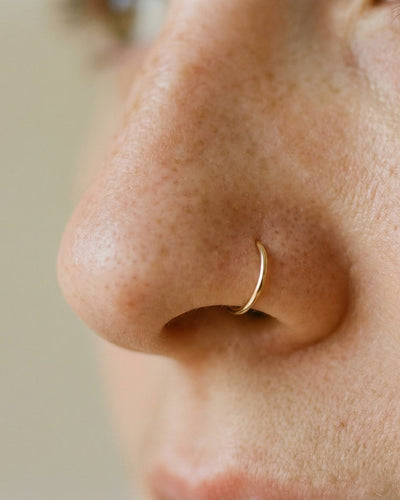
New 14ct Solid Gold Piercing Hoop


Nose Piercing Bump: Causes, Treatment & Prevention
- Nose piercing bumps are extremely common and almost always irritation bumps, not keloids
- Top causes: switching to a hoop too early, touching, poor jewellery quality, sleeping on it
- Treatment: identify and remove the irritant, strict saline care, patience (2-4 weeks)
- Keloids are rare and genetic — if you have never had one before, your bump is likely irritation
- Switching to 14K solid gold resolves many bumps caused by material sensitivity
What is a nose piercing bump?
A nose piercing bump is a raised area of tissue that forms near the piercing hole. It is one of the most common issues nostril piercing owners face — and one of the most misunderstood. The vast majority of nose piercing bumps are irritation bumps, caused by physical or chemical trauma to the healing channel. They are not infections and they are not keloids.
Irritation bumps are your body's response to ongoing disruption of the healing tissue. Remove the disruption, and the bump resolves. This is the single most important thing to understand about nose piercing bumps.
Common causes
1. Switching to a hoop too early. The number one cause. Hoops move more than studs, creating constant friction in an immature channel. If your bump appeared shortly after switching to a hoop, switch back to a stud.
2. Touching and fiddling. Hands carry bacteria. Every touch introduces irritants into the healing wound. The nose is especially tempting to touch.
3. Poor jewellery quality. Surgical steel (contains nickel), gold-plated (flakes), and fashion metals (unknown composition) all cause material-related irritation. Switching to 14K solid gold or titanium often resolves persistent bumps.
4. Sleeping on it. Pillow pressure against the nostril pushes jewellery into the channel at an angle.
5. Harsh cleaning products. Tea tree oil, alcohol, hydrogen peroxide, and antibacterial soap all damage healing tissue and trigger bumps.
6. Makeup and skincare products. Foundation, moisturiser, and sunscreen can enter the piercing channel and cause irritation.
Bump vs keloid vs infection
| Irritation Bump | Keloid | Infection | |
|---|---|---|---|
| Appearance | Small, fluid-filled, skin-coloured or pink | Firm, grows beyond wound, rubbery | Swollen, red, warm |
| Pain | Mild or none | Mild or none | Painful, worsening |
| Discharge | Clear or none | None | Green/yellow pus |
| Responds to care | Yes — shrinks when cause removed | No — continues growing | Needs antibiotics |
| Commonality | Very common | Rare (genetic) | Uncommon with good care |
Treatment protocol
Step 1: Identify the cause. What changed before the bump appeared? Did you switch jewellery? Start a new skincare product? Sleep on it? Use earbuds? Find the trigger.
Step 2: Remove the cause. Switch back to a stud if you changed to a hoop. Stop touching. Upgrade to 14K gold if using cheap metal. Eliminate harsh products.
Step 3: Strict saline care. Sterile saline spray twice daily. Nothing else. No tea tree oil, no aspirin paste, no crushed paracetamol.
Step 4: Wait 2-4 weeks. Most irritation bumps flatten and disappear within this window once the cause is eliminated.
Step 5: If it persists beyond 4 weeks, visit your piercer. They can assess whether it is a material reaction, placement issue, or (rarely) a keloid requiring medical treatment.
Prevention protocol
Quality jewellery from day one. 14K solid gold or implant-grade titanium. This prevents material-related bumps entirely.
Do not rush the hoop switch. Wait 3-6 months before changing from stud to hoop.
Saline only. No tea tree oil. No essential oils. No harsh products of any kind.
Do not touch. The nose is easy to accidentally touch while adjusting glasses, wiping your face, or blowing your nose. Be conscious of this.
Keep makeup away from the piercing. Apply foundation and skincare products around the piercing, not over it.