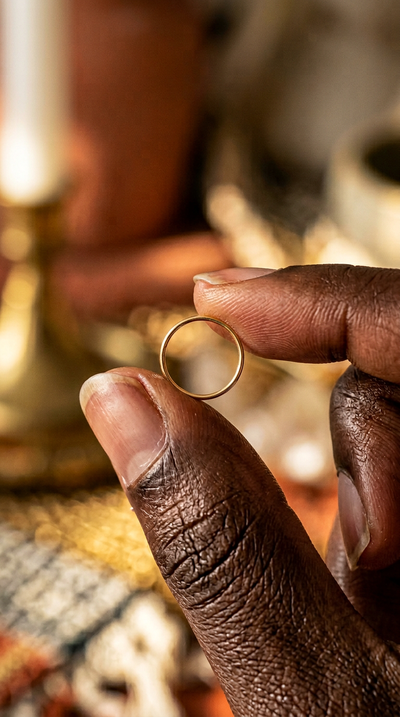
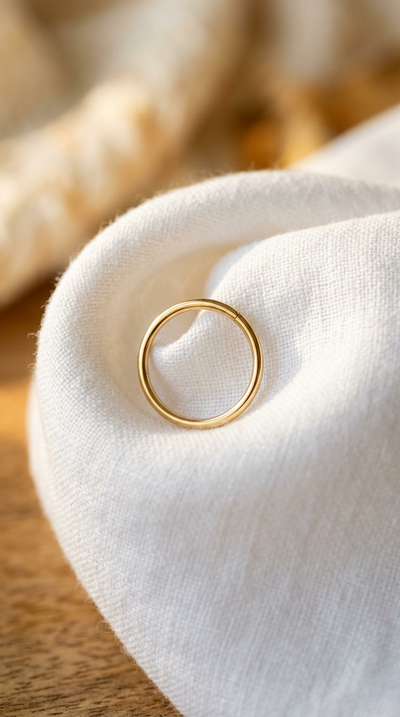
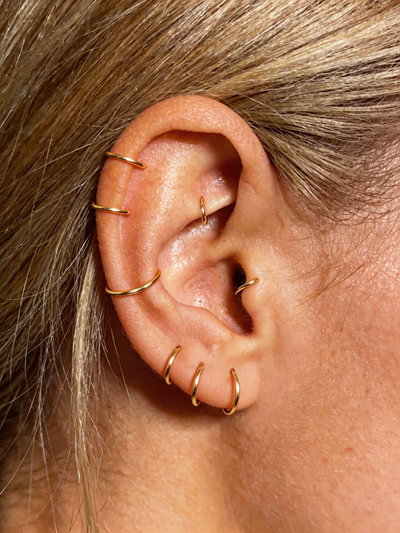
New 14ct Solid Gold Hoop
18G vs 20G Helix Ring: Which Gauge for Your Ear?

- Helix piercings are typically pierced at 18G (1.0mm) or 16G (1.2mm) in the UK — both are standard
- 20G (0.8mm) is thinner than the piercing gauge but popular for healed helix hoops — gives a dainty, fine-jewellery look
- 18G is the sweet spot for most helix hoops — visible enough to read as a ring, thin enough to feel delicate
- 16G creates a bolder ring — only use if your piercing was done at 16G
- You can wear thinner gauge jewellery in a thicker piercing, but not the reverse without stretching
- For stacked helix hoops, matching the gauge across all piercings creates the cleanest look
Helix gauge explained
The helix sits in an unusual position in the gauge spectrum. Most UK piercers use either 18G or 16G needles for helix piercings — thicker than a nostril (20G) but thinner than a septum (16G). Some piercers default to 16G for all cartilage, while others use 18G for the helix because the rim is thinner cartilage than the conch or rook.
This means helix jewellery comes in three practical gauges: 20G for a dainty downsize, 18G as the middle standard, and 16G for those pierced at the thicker gauge. Choosing correctly ensures the ring fits your piercing hole, looks proportionate on the thin ear rim, and holds its shape during daily wear.
The three gauges compared
| Gauge | Thickness | Look on the helix | Best for |
|---|---|---|---|
| 20G (0.8mm) | Thinnest | Ultra-delicate, fine wire, barely-there aesthetic | Dainty style, matching nostril gauge, stacking multiple thin hoops |
| 18G (1.0mm) MOST POPULAR | Standard | Classic balance — visible wire, elegant proportion | Most helix piercings, everyday wear, single or stacked hoops |
| 16G (1.2mm) | Thickest | Bold, substantial, visible wire thickness | Piercings done at 16G, bolder aesthetic, matching conch/septum gauge |
20G — the dainty option
Wire thickness: 0.8mm — the same gauge as a standard nostril piercing.
20G on the helix creates an extremely fine, delicate ring. The wire is thin enough that from a distance, the hoop reads more as a golden thread than a traditional ring. This is the gauge to choose if you want your helix jewellery to whisper rather than speak.
The stacking advantage: If you have a double or triple helix and want to wear hoops in all positions, 20G is the gauge that prevents the stack from looking heavy. Three thin gold hoops along the helix rim in 20G create a refined, layered effect. In 16G, the same three hoops would look significantly chunkier.
Cross-piercing matching: If you wear 20G in your nostril, wearing 20G on your helix creates visual consistency across your ear and nose jewellery. The matching wire thickness ties the look together.
Practical note: 20G is thinner than most helix piercing gauges (18G or 16G). The ring will fit through the wider hole, but it sits loosely in the channel. This is harmless, though the piercing may gradually shrink toward 20G over months of continuous wear.
18G — the sweet spot
Wire thickness: 1.0mm.
18G is the most popular gauge for helix hoops because it strikes the ideal balance for the ear rim. The wire is thick enough to be clearly visible as a ring — it catches light, holds a clean circular shape, and reads as intentional jewellery. But it is thin enough that it does not overpower the delicate helix anatomy.
If your piercing was done at 18G: this is a direct match. The ring fits the channel precisely. No looseness, no stretching required. This is the simplest, safest choice.
If your piercing was done at 16G: 18G will fit (thinner wire in a wider hole). The ring may move slightly more freely in the channel, but this is harmless and most people do not notice the difference.
In 14K gold: 18G is the gauge where gold hoops truly shine on the helix. The wire has enough substance to reflect light along its full circumference, creating a warm golden arc around the ear rim. This is the most photographed, most pinned, and most requested helix hoop configuration.
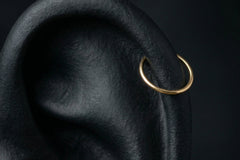
16G — the bold option
Wire thickness: 1.2mm — the same gauge as a standard septum piercing.
16G creates a noticeably thicker ring on the helix. The wire has real visual weight, and on the thin ear rim, it stands out as a deliberate, bold choice. This is not the dainty approach — 16G says “I want this ring to be seen.”
When to choose 16G: If your piercing was done at 16G (common at many UK studios for all cartilage piercings), wearing 16G jewellery is the direct match. The ring fills the channel precisely and sits securely.
Cross-piercing matching: If you wear 16G in your conch or septum, matching your helix to 16G creates uniform wire thickness across the ear. This looks particularly strong in a curated stack where the helix hoop sits alongside a conch hoop — identical gauge in both positions creates visual cohesion.
How to check your gauge
Ask your piercer
The fastest method. Call your studio or check your aftercare card. Most piercers record the gauge used. In the UK, the answer is typically 18G or 16G for helix piercings.
Measure your jewellery
Remove your current stud or ring. Measure the wire or post thickness with digital callipers. Match: 0.8mm = 20G, 1.0mm = 18G, 1.2mm = 16G.
Process of elimination
Pierced at a professional UK studio using a needle: 18G or 16G. Pierced with a gun at a high-street shop (lobes only, but some shops gun cartilage — which they should not): likely 20G equivalent. If you have been wearing standard butterfly-back earrings: those are typically 20G.
Gauge for stacked helix
If you have multiple helix piercings, the gauge you choose for your hoops affects the entire visual impression of the stack:
All 20G: Ultra-dainty stack. Three thin gold hoops create a refined, almost thread-like cascade along the ear rim. Minimal, elegant, and increasingly popular for the “curated ear” aesthetic. Works best on smaller ears where thicker hoops might look heavy.
All 18G: The classic stack. Three 18G gold hoops are the most photographed and requested helix configuration. Each ring is clearly visible as a distinct hoop, with enough visual weight to hold its own while remaining elegant. This is the default recommendation.
All 16G: Bold stack. Three 16G hoops create a chunky, statement effect. Each ring has real presence. This works well on larger ears and for people who want their piercings to be a dominant style feature rather than a subtle accent.
Mixed gauges: Not recommended. Wearing different gauges in adjacent helix piercings creates an inconsistent look — one ring appears thicker than its neighbours, which reads as mismatched rather than intentional. Match the gauge across the entire stack.
Gauge and 14K gold
| Gauge | Gold per ring | Character in gold | Price impact |
|---|---|---|---|
| 20G | Least | Delicate gold thread, fine jewellery feel | Most affordable |
| 18G | Standard | Classic gold hoop, warm visible arc | Mid-range |
| 16G | Most | Substantial gold ring, bold warmth | Highest |
Because helix rings are small (6–8mm), the gold content difference between gauges is modest in absolute terms. But the visual difference is significant. A 7mm hoop in 20G gold looks like a fine golden wire. The same 7mm hoop in 16G gold looks like a proper, solid ring. Both are beautiful — the choice depends entirely on the aesthetic you want.
Where helix gauge fits in your ear
If you are building a curated ear with multiple piercings, gauge consistency (or intentional variation) across different positions creates the overall look. Here is how helix gauge relates to other ear piercings:
| Piercing | Typical gauge | Matching the helix |
|---|---|---|
| Lobe | 20G | 20G helix matches lobe for a uniform dainty ear |
| Helix | 18G or 16G | — |
| Forward helix | 18G or 16G | Match to standard helix for consistency |
| Tragus | 18G or 16G | Same gauge as helix creates cohesion |
| Conch | 16G | 16G helix matches conch for a bold, uniform ear |
| Daith | 16G | 16G helix matches daith |
| Rook | 16G | 16G helix matches rook |
| Nostril | 20G | 20G helix matches nostril across ear and nose |
There is no single “correct” approach. Some people match everything to 18G as a middle ground. Others match the helix to their dominant visible piercing (nostril or conch). The key is intentionality — choose a gauge for a reason, not by accident.
Switching between gauges
Going thinner (18G → 20G)
Safe and simple. The thinner wire fits through the wider hole. The ring may feel slightly loose. Over months, the piercing may gradually shrink to match 20G. If you later want to return to 18G, you may need a gentle re-stretch.
Going thicker (18G → 16G)
Requires stretching. The difference is 0.2mm, which is manageable but should not be forced. Visit your piercer for a controlled stretch or taper insertion. Expect mild soreness for a day or two.
Going thinner then back (18G → 20G → 18G)
If you wore 20G for several months and the piercing has shrunk, returning to 18G may feel snug. A drop of water-based lubricant and gentle, steady pressure usually does the trick. If it meets firm resistance, see your piercer.