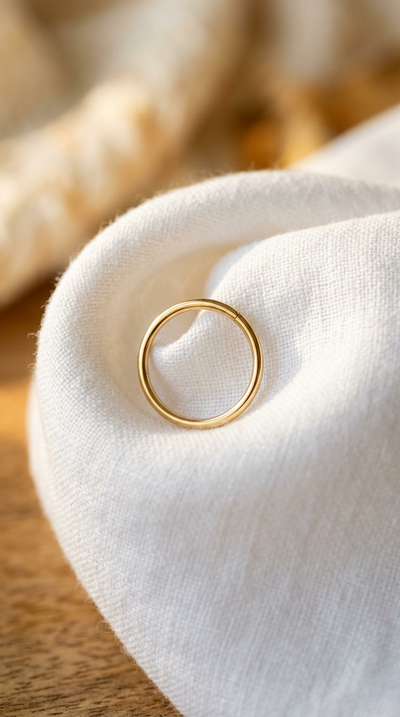
New 14ct Solid Gold Hoop
Forward Helix Jewellery: Hoops, Studs & Sizing Guide
- The forward helix sits on the front fold of the ear, above the tragus — one of the smallest and tightest cartilage piercing locations
- Flat-back labret studs are the standard jewellery for forward helix — small, flush, and compatible with glasses
- Seamless hoops work beautifully once healed, but require very small diameters (5–6mm) to fit the tight anatomy
- Standard gauge is 18G or 16G — the same as standard helix piercings
- Forward helix piercings heal in 6–9 months — do not switch to a hoop before full maturity
- Glasses wearers need special consideration — temple arms can press directly on forward helix jewellery
- 14K solid gold or implant-grade titanium only — this tight fold is extremely reactive to nickel
Where the forward helix sits
The forward helix is the small fold of cartilage at the very front of the ear, where the upper ear rim curves inward toward the head. It sits above the tragus and in front of the main helix rim. If you trace the outer edge of your ear from the top downward, the forward helix is the point where the rim turns and tucks forward, creating a tight fold or ridge.
This location is distinctly different from a standard helix piercing (which goes through the flat upper outer rim) and from the tragus (which covers the ear canal entrance). The forward helix occupies the narrow space between the two — a small, precise position that creates a front-facing accent visible when someone looks at you directly.
Many people get two or three forward helix piercings stacked vertically in this fold — a double or triple forward helix. The fold typically has enough room for 2–3 piercings spaced 3–4mm apart, creating a cascading line of small gold studs or hoops.
Jewellery types
Flat-back labret stud
The most common and most practical forward helix jewellery. A straight post with a flat disc on the back (behind the fold) and a small decorative or plain ball top on the front (visible side). The flat back sits flush against the inner fold, distributing pressure evenly without poking or catching.
Why it is the forward helix standard: the forward helix fold is tight. There is limited space between the fold and the side of the head. A flat-back stud occupies minimal depth, does not protrude behind the ear, and does not interfere with glasses temple arms (which pass directly over this area). For double and triple forward helix piercings, a row of small flat-back studs with matching ball tops creates a clean, deliberate line.
Best for: healing period, daily wear, glasses wearers, sleeping, double/triple stacks.
Seamless hoop
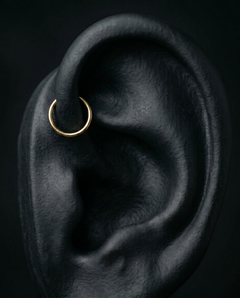
A small continuous ring that wraps around the forward helix fold. The hoop exits the front of the piercing, curves around the fold, and re-enters from behind. In 14K gold, a 5mm seamless hoop on the forward helix creates one of the most refined, delicate accents on the entire ear — a tiny gold ring nestled in the front fold that catches light beautifully.
Sizing is critical: the forward helix fold is the tightest space for a hoop on the ear. Standard helix hoops (6–8mm) are too large. Forward helix hoops are typically 5mm or 6mm — among the smallest seamless rings available. A ring even 1mm too large will gap away from the fold and look disproportionate.
Best for: healed piercings only. The ring look is the aesthetic payoff for the patience of a 6–9 month stud healing period.
Clicker / hinged segment ring
A small ring with a hinged segment that clicks open and closed. Easier to insert than a seamless ring in the tight forward helix space because you do not need to twist the ends — just click open, thread through, and click shut. Available in small diameters (5–6mm) that suit the forward helix.
Best for: people who find seamless rings difficult to open and close in the tight forward helix fold.
Style comparison
| Style | Healing? | Glasses? | Look | Stacking? |
|---|---|---|---|---|
| Flat-back stud VERSATILE | Yes — ideal | Best — flat, low profile | Single point, subtle | Excellent — 2-3 in a row |
| Seamless hoop ELEGANT | No — healed only | May press on glasses arm | Tiny ring in fold, refined | Possible but crowded |
| Clicker | No — healed only | Similar to hoop | Ring with clean close | Works for single piercing |
Sizing for forward helix
Forward helix sizing is smaller than standard helix. The fold is tighter, the cartilage is closer to the head, and there is less room for jewellery to sit.
Hoop diameter
| Diameter | Fit | Look |
|---|---|---|
| 5mm MOST POPULAR | Very snug — hugs the fold tightly | Barely-there ring, ultra-delicate, maximum refinement |
| 6mm | Snug — small gap between ring and fold | Clean ring visible in the fold, slightly more presence |
| 7mm | Relaxed — only if fold is deep or placement is far back | More visible, may look slightly large on most anatomy |
Recommendation: start with 5mm. The forward helix fold is one of the tightest positions on the ear, and a 5mm ring creates the most aesthetically proportionate fit for the majority of anatomies. If 5mm feels too tight or pinches the fold, try 6mm. Avoid 7mm+ unless your piercer specifically recommends it based on your anatomy.
Stud post length
Healing: 8mm post to accommodate swelling (the forward helix fold swells noticeably in the first 1–2 weeks). After healing: downsize to 6mm for a snug, secure fit that does not protrude behind the fold. A post that is too long sticks out behind the ear and catches on hair, pillowcases and glasses arms.
Gauge
| Gauge | Thickness | Forward helix notes |
|---|---|---|
| 18G STANDARD | 1.02mm | Standard for forward helix at most UK studios. Visible, balanced wire. |
| 16G | 1.27mm | Also common. Slightly bolder. Confirm with your piercer. |
| 20G | 0.81mm | Finer. Uncommon for forward helix but works if pierced at this gauge. |
Forward helix and glasses
This is the single most important practical consideration for forward helix piercings. The temple arms of glasses and sunglasses pass directly over the forward helix fold on their way from the frame to the ear. Depending on frame style and arm thickness, the temple arm may rest against, press on, or rub over the forward helix jewellery every time you wear them.
During healing (first 6–9 months): this is a genuine problem. Glasses arm pressure on a healing forward helix is one of the leading causes of bumps, delayed healing and chronic irritation at this position. Solutions include switching to contact lenses during healing (the most effective fix), asking an optician to adjust the temple arm angle so it passes above or below the piercing, or using glasses with thin, flexible arms that create less pressure.
After healing: most flat-back studs coexist with glasses without issue — the flat disc sits flush and the glasses arm passes over it. Hoops are more affected — the ring protrudes slightly from the fold and may catch or press against the arm. If you wear glasses daily and plan a forward helix hoop, test the compatibility by holding a small ring in position before committing to the switch.
Why material matters here
The forward helix fold is one of the most reactive piercing locations on the ear. The tight fold traps moisture, hair products and sweat around the jewellery, creating an environment where low-quality metal degrades faster and causes reactions sooner than on more exposed positions.
| Material | Safe? | Forward helix notes |
|---|---|---|
| 14K solid gold BEST | Yes — nickel-free | Zero reaction. Warm gold tone visible from the front. Lasts decades. |
| Implant-grade titanium | Yes — ASTM F-136 | Best for healing. Lightweight. Silver-grey only. |
| “Surgical steel” | No — 10-14% nickel | Leading bump trigger in this fold. Avoid entirely. |
| Gold-plated | No — base metal | Plating degrades faster in the moist fold. Quick bump risk. |
For double/triple forward helix stacks: matching 14K yellow gold across all 2–3 piercings creates a cohesive line of warm gold points. Mixing metals (gold + titanium) breaks the visual unity. If you plan a stack, commit to one material across all positions from the start.
Double and triple forward helix
Multiple forward helix piercings stacked vertically in the fold is one of the most curated looks in ear piercing. Two or three small gold studs cascading down the fold create a deliberate, architectural detail that reads as intentional design.
Spacing: 3–4mm between each piercing. Closer spacing creates a tighter, more clustered look. Wider spacing gives each stud room to breathe. Your piercer will assess your fold depth and advise on maximum number of piercings your anatomy supports.
Healing: do not get all 2–3 piercings simultaneously. Each cartilage piercing takes 6–9 months to heal, and healing multiple piercings in the same fold at the same time dramatically increases complication risk. Get one, wait until fully healed, then add the next. A triple forward helix is a 12–18 month project — plan accordingly.
Jewellery for stacks: flat-back studs with matching small ball tops are the standard for stacks. Hoops can work for a single forward helix within a stack, but multiple hoops in a tight fold tend to overlap and catch on each other. Most people use studs for the stack and optionally switch one position to a hoop as a focal point.
Healing considerations
The forward helix heals in 6–9 months. This is slightly longer than a standard helix (4–6 months) because the tight fold has less airflow and traps more moisture, creating a slower healing environment.
Do: sterile saline spray twice daily. Let shower water rinse the area. Keep hair tied back to prevent snagging. Sleep on the opposite side or use a travel pillow.
Do not: touch or twist the jewellery. Use earbuds or over-ear headphones that press on the area. Clean with anything other than saline. Wear tight hats, headbands or swimming goggles that compress the fold.
Downsize the post: after initial swelling subsides (2–4 weeks), visit your piercer to downsize from the longer healing post (8mm) to a shorter fitted post (6mm). A post that remains too long catches on everything and is a primary cause of forward helix bumps. See our helix bump guide if you develop a bump.
Forward helix in an ear stack
The forward helix occupies a unique front-facing position that complements every other ear piercing without competing:
Forward helix + tragus: a vertical column at the front of the ear. The forward helix above, the tragus below, with the ear canal entrance between them. In matching gold, this pairing frames the front of the ear with two precise accents.
Forward helix + standard helix: front fold and outer rim. The two piercings bookend the ear rim from opposite sides, creating a sense of completion along the upper ear.
Forward helix + conch + lobe: three piercings at three different depths — surface fold, inner bowl, and soft lobe. Each position has a different visual weight and angle, creating a layered, three-dimensional ear.
Triple forward helix + tragus + conch + lobe: a fully curated ear with six or more piercings, each in a distinct position, all in matching 14K gold. This is the maximum curated ear for the front-facing observer — every position filled with purpose.