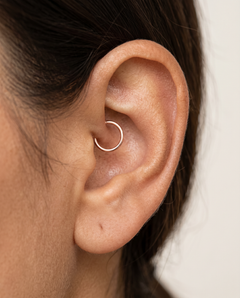
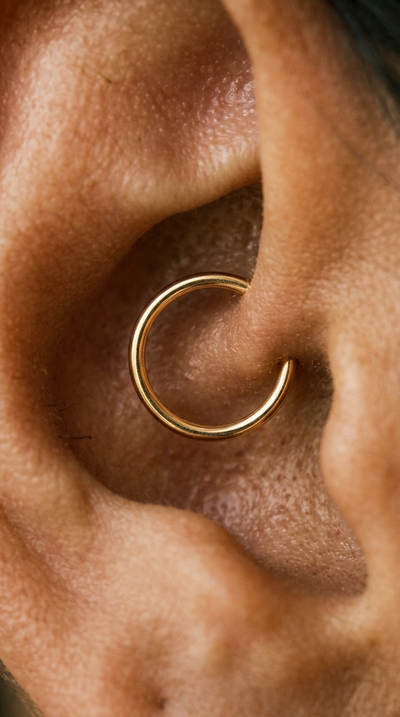
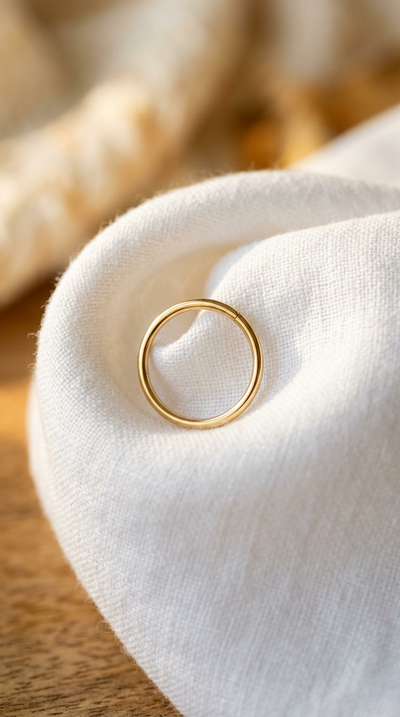
New 14ct solid gold hoop


Daith Piercing for Anxiety: Benefits & Evidence
- Some people report reduced anxiety after daith piercing, but no clinical evidence supports this
- The theory connects to vagus nerve stimulation, which has established links to anxiety regulation
- Vagus nerve stimulation (VNS) is a medically recognised treatment, but piercing is not the same as clinical VNS
- Placebo effect and the positive experience of getting a piercing may contribute to reported benefits
- A daith piercing should never replace professional anxiety treatment or medication
The anxiety claim
Following the popularity of daith piercings for migraines, a secondary claim has emerged: that daith piercings can also help with anxiety. The idea gained traction through social media, with users sharing personal stories of feeling calmer or less anxious after getting the piercing.
This claim is even less supported by evidence than the migraine connection. While migraine relief has at least some case reports in medical literature, anxiety relief from daith piercing has virtually no published research behind it.
The vagus nerve theory
The theoretical basis is vagus nerve stimulation (VNS). The vagus nerve is a major cranial nerve that plays a key role in the parasympathetic nervous system — the "rest and digest" system that counteracts the "fight or flight" stress response. Stimulating the vagus nerve has been shown to reduce anxiety in clinical settings.
The auricular branch of the vagus nerve passes through the ear, and some acupuncture traditions target ear points for stress and anxiety relief. The theory suggests that a daith piercing might provide continuous low-level stimulation to this nerve.
The problem: clinical vagus nerve stimulation uses precisely calibrated electrical impulses delivered through implanted or external devices. A piercing provides static pressure at a single point — this is fundamentally different from clinical VNS.
Current evidence
No clinical studies have examined daith piercing specifically for anxiety. Zero. The evidence base is entirely anecdotal.
Auricular acupuncture for anxiety has some limited evidence, but results are mixed and study quality is generally low. Even if ear acupuncture works for anxiety, a permanent piercing at one point is different from targeted needle therapy at multiple points.
Placebo response is particularly relevant for anxiety. The act of doing something proactive about your anxiety — making a decision, going through the experience, having a physical symbol of that decision — can itself reduce anxiety through a sense of control and agency.
What people report
Anecdotal reports online describe: a general sense of calm after getting the piercing; reduced frequency of anxiety episodes; better ability to manage stress; and improved sleep. Some people describe the effect as subtle but noticeable, while others report dramatic improvement.
Important context: anxiety is influenced by countless factors — sleep, exercise, relationships, medication, therapy, work stress, diet. Attributing changes to a single intervention (a piercing) is very difficult without controlled conditions.
Honest assessment
If you want a beautiful piercing and you also have anxiety: get the piercing. It is a lovely piece of ear art. If you experience any anxiety benefit, that is a welcome bonus.
If you are considering this solely as an anxiety treatment: please also pursue evidence-based approaches. Cognitive behavioural therapy (CBT), medication, exercise, and mindfulness all have strong clinical evidence. A piercing should complement these, never replace them.
If your anxiety is severe: please speak with your GP. A daith piercing is not a substitute for professional mental health support.