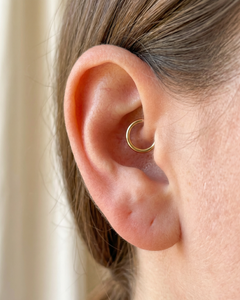
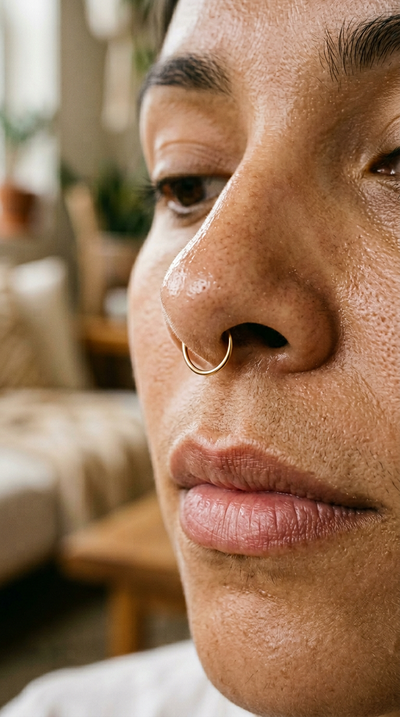
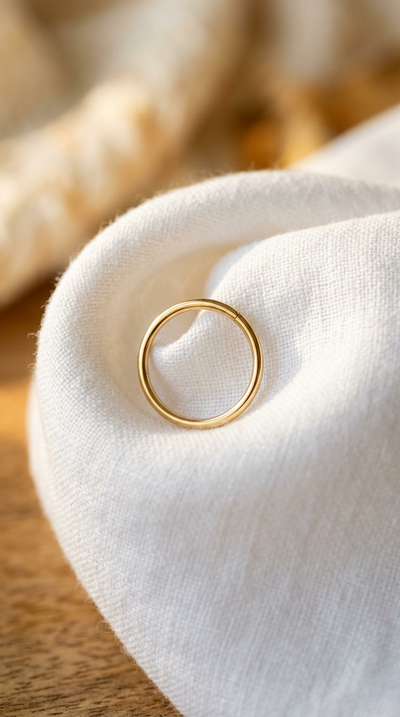
New 14ct solid gold hoop


Daith Piercing Pain: What to Expect (1–10 Scale)
- Most people rate daith piercing pain at 5–6 out of 10 — one of the more intense ear piercings, but over within seconds
- The daith passes through a thick, tight cartilage fold — expect strong pressure, a deep crunch, and a dull ache during the needle
- The procedure is slower than other ear piercings (3–5 seconds) because the piercer must navigate the curved fold carefully
- Your eyes will water and you may feel a brief wave of heat across the ear — both are nerve reflexes, not indicators of damage
- Soreness fades to mild tenderness within hours. Most people feel normal by the next day.
- A skilled piercer who navigates the fold correctly makes the single biggest difference in pain level
Pain rating: 5–6 out of 10
The daith is generally considered the most intense of the common ear piercings. Not because the tissue is especially painful, but because of three factors working together: the cartilage is thick and dense (comparable to the conch), the fold is tight and the piercer must work at an awkward angle, and the procedure takes slightly longer than other ear piercings because the needle must navigate a curve.
The actual pain sensation is a deep, grinding pressure with a crunch as the needle passes through the thick cartilage fold. It is more “intense pressure” than “sharp sting.” Most people describe it as uncomfortable but bearable — the kind of sensation you can breathe through because you know it will be over in seconds.
What happens during the piercing
Before the needle: the piercer examines the inner fold of your ear, identifies the daith ridge (the innermost cartilage fold directly above the ear canal), cleans the area, and marks the entry and exit points. You approve the placement in a mirror. They may use a curved receiving tube or freehand technique, depending on their preference and your anatomy.
The needle (3–5 seconds): this is where the daith differs from other ear piercings. Most cartilage piercings (helix, tragus) use a straight needle that passes through in 1–2 seconds. The daith requires a curved needle that follows the curve of the inner fold. The piercer guides the needle through the thick cartilage in a controlled, deliberate motion. You feel strong pressure building, then a deep crunch or pop as the needle exits the other side. The slower pace means you are aware of the pressure for longer than a helix or lobe piercing.
Jewellery insertion (3–5 seconds): the piercer follows the needle with a curved barbell or seamless ring, threading it through the fresh channel. The daith’s tight fold makes this more fiddly than other piercings. You may feel pulling and pressure as the jewellery is manoeuvred into position. This can be almost as intense as the needle itself — some people say the jewellery insertion is the worst part.
Immediately after: a wave of heat across the ear. Your eyes will almost certainly water — this is a nerve reflex triggered by the deep cartilage nerves in the inner ear fold. A dull, throbbing ache sets in immediately. The ear feels warm, full and tender. Most people describe a sense of “my ear feels heavy” for the first 30–60 minutes.
Pain timeline after piercing
How it compares to other piercings
| Piercing | Pain (1–10) | Sensation | Duration |
|---|---|---|---|
| Lobe | 2–3 | Quick pinch, minimal | 1 second |
| Helix | 4–5 | Sharp crunch, brief | 1–2 seconds |
| Tragus | 4–5 | Crunch with pressure | 1–2 seconds |
| Septum | 3–5 | Sharp pinch, eyes water | 1–2 seconds |
| Conch | 5–6 | Deep pressure, thick crunch | 2–3 seconds |
| Daith ← | 5–6 | Deep grinding pressure, slow | 3–5 seconds |
| Rook | 6–7 | Intense pressure, thick fold | 2–3 seconds |
| Industrial | 6–8 | Two piercings in sequence | 4–6 seconds total |
The daith sits in the same pain tier as the conch — both involve thick cartilage and deep pressure. It is more intense than the helix, tragus and septum because of the slower procedure and the thickness of the fold. It is generally considered less painful than the rook (which passes through an even thicker, tighter fold) and significantly less than an industrial (which is two piercings through the same ear).
What affects daith pain
Piercer skill
The daith is technically one of the most demanding ear piercings. The curved fold requires a curved needle navigated at a precise angle through thick cartilage in a confined space. An experienced piercer who has done hundreds of daiths will navigate this smoothly and efficiently. An inexperienced piercer may hesitate, readjust, or take multiple passes — all of which increase pain and tissue damage. Choose a piercer with specific daith experience.
Your anatomy
Daith folds vary significantly between individuals. Some people have a prominent, well-defined ridge with ample room for the needle. Others have a shallow or tight fold that gives the piercer less space to work. A shallower fold may require more pressure to navigate, which can feel more intense. Your piercer will assess your anatomy before proceeding and will tell you if your fold is straightforward or challenging.
Anxiety and tension
Muscle tension amplifies pain perception. If you are clenching your jaw, holding your breath, or gripping the chair, the piercing will feel worse than it needs to. Deliberate deep breathing, relaxing your shoulders, and unclenching your hands genuinely reduce the perceived intensity. This is not platitude — it is neuroscience. Relaxed muscles transmit fewer pain signals.
Jewellery type
The daith is typically pierced with a curved barbell or a captive bead ring, both of which require threading or snapping into place inside the tight fold. Seamless rings can also be used. The jewellery insertion takes 3–5 seconds and can be as uncomfortable as the needle because the piercer is manipulating metal inside a fresh wound in a tight space. The jewellery type does not change the needle pain, but it affects the post-needle insertion discomfort.
How to reduce the pain
Choose an experienced piercer. This is the single most impactful factor. A smooth, confident technique through the daith fold takes 3–5 seconds. A hesitant technique can take longer and hurt more. Ask how many daiths they have done.
Eat beforehand. Do not get pierced on an empty stomach. Low blood sugar increases pain sensitivity and raises the chance of feeling lightheaded. Eat a proper meal 1–2 hours before your appointment.
Stay hydrated. Dehydration makes tissue tougher and less pliable, which means the needle meets more resistance. Drink plenty of water in the hours before.
Breathe deliberately. Slow, deep breaths during the procedure. Many piercers will talk you through the breathing: inhale, exhale, and they pierce on the exhale when your body is naturally relaxed.
Do not take blood thinners. Avoid aspirin, ibuprofen, alcohol and excessive caffeine in the 24 hours before piercing. These thin the blood and increase bleeding, which makes the procedure messier and can increase swelling.
Book in the morning. Pain tolerance is generally higher earlier in the day when stress hormones (cortisol) are at their natural peak. If you have a choice of appointment time, morning is marginally better than evening.
The migraine question
The daith piercing has gained widespread attention online as a potential treatment for migraines. The theory is that the daith fold sits on an acupressure point associated with headache relief, and a permanent piercing at this point may provide ongoing pressure that reduces migraine frequency.
The evidence: there is currently no scientific evidence that daith piercings treat or prevent migraines. No clinical trials have demonstrated effectiveness. The anecdotal reports online are real — some people do report improvement — but anecdotal evidence cannot distinguish between the piercing’s effect and placebo, natural migraine fluctuation, or lifestyle changes made around the same time.
Our position: get a daith piercing because you want a daith piercing. If it happens to improve your migraines, that is a welcome bonus. Do not get a daith piercing as a medical treatment — the evidence does not support that decision, and an ear piercing is not a substitute for medical care. If you suffer from migraines, consult your GP or a neurologist.
First jewellery and material
The daith is typically pierced with a curved barbell or a captive bead ring in 16G or 18G. Once healed (6–12 months), you can switch to a seamless hoop, a clicker, or a decorative ring.
Material during healing: implant-grade titanium (ASTM F-136) is the standard for initial daith jewellery. It is lightweight, zero-reactivity, and the safest option during the long healing period. 14K solid gold (nickel-free) is also safe from day one if you prefer the gold aesthetic immediately.
Material for healed daith: 14K solid gold creates a striking ring in the inner ear fold. A small gold hoop in the daith is one of the most distinctive and refined ear accents — partially hidden, catching light from certain angles, and revealing itself when someone looks closely. It is the perfect complement to a helix stack or tragus ring in matching gold.