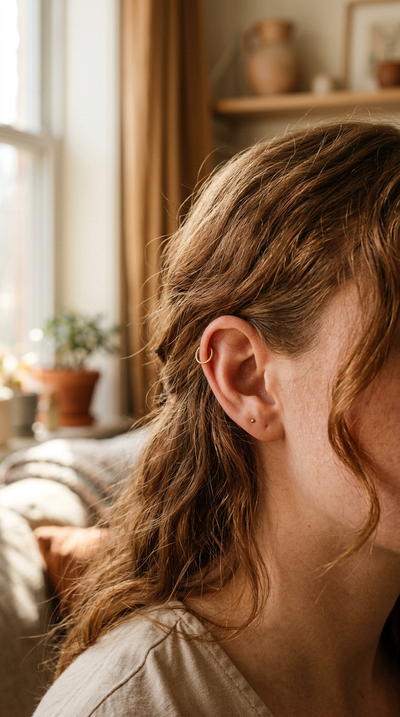
New 14ct solid gold hoop


Sleeping with a New Cartilage Piercing: Tips & Travel Pillow Guide

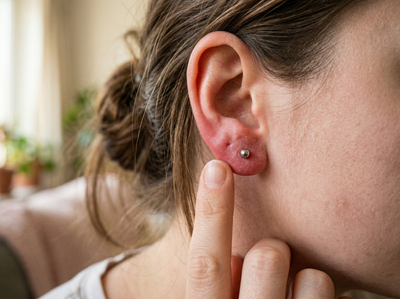
- Side-sleeping on a fresh cartilage piercing is the leading cause of bumps — the pillow presses the jewellery against the healing channel all night
- A u-shaped travel pillow with an ear cut-out is the most effective solution — the ear hangs through the hole and makes zero contact with the pillow surface
- Double and triple helix piercings make sleep management harder — more healing wounds closer together, more pressure points
- If you have piercings on both ears, do them one ear at a time so you always have a comfortable sleeping side
- Most cartilage piercings need 3–6 months of careful sleeping position before you can cautiously return to side-sleeping
- A morning-after sore piercing that was fine the night before almost always means you rolled onto it during sleep
Why sleep is the biggest healing risk
During waking hours, you can control what touches your cartilage piercing. During sleep, you cannot. You roll, shift, press your face into the pillow, and spend up to a third of your life with your ear compressed against a surface that puts sustained pressure on the healing channel for hours at a time.
The mechanism of damage is straightforward: the pillow pushes the ear inward, which pushes the jewellery post against the side wall of the channel. Hold that pressure for six hours and the channel wall responds with inflammation. Repeat nightly and the inflammation becomes persistent. Persistent inflammation becomes a bump. A bump that keeps getting pressed every night takes 6–8 weeks to resolve, during which sleep continues to be the primary obstacle.
This is why sleep position advice appears in almost every piercing aftercare guide. It is not precaution for the sake of it — it is the single most consistent mechanical factor in whether cartilage piercings heal smoothly or develop complications.
How different sleeping positions affect cartilage
Back sleeping — the ideal
Sleeping on your back means neither ear contacts the pillow. There is zero mechanical pressure on any cartilage piercing. This is the recommended position for the first 3 months of healing any cartilage piercing. The practical problem: most people are not natural back sleepers, and changing a habitual sleeping position takes deliberate effort.
To train yourself to stay on your back: use a firm pillow with a high edge on each side to create a valley that discourages rolling. Some people place rolled-up towels against their shoulders. It takes 1–2 weeks of consistent effort to form the habit, and most people find they naturally roll back to their preferred side during deep sleep regardless. This is why the travel pillow solution below is more reliable than back-sleeping training for most people.
Side-sleeping on the pierced ear — the problem
Direct side-sleeping on the pierced ear compresses the entire cartilage structure into the pillow. The outer helix rim, the inner ear bowl, and any piercing jewellery all experience this compression simultaneously. For a healing piercing, this is six hours of continuous pressure and micro-movement per night. The healing channel cannot maintain stability under these conditions.
Side-sleeping on the opposite ear
Sleeping on the ear without the cartilage piercing is safe and comfortable. This is the backup plan when back-sleeping is not achievable. The challenge: people with piercings on both ears have no comfortable opposite side. This is the core reason professional piercers recommend doing ears one at a time when planning multiple cartilage piercings — always keep a comfortable side available.
The travel pillow solution — how and why it works
A u-shaped travel pillow (also called a donut pillow or neck pillow) is the single most effective sleep solution for cartilage piercings. The concept is simple: position the pillow so the ear hangs in the gap of the u-shape rather than resting on any surface. The ear floats free while the head is fully supported. Zero ear contact. Zero pillow pressure on the piercing.
How to set it up correctly
Most people use the travel pillow incorrectly the first time. Do not wear it around your neck like you would on a plane. Instead, lay it flat on the bed with the opening of the U facing outward toward your shoulder. Lay your head sideways into the curve of the U so the two arms of the pillow support your skull above and below, and the ear with the piercing hangs in the gap between. Your head should feel fully supported, not tilted or strained.
The gap must be large enough for your ear to hang through without the sides pressing inward on the cartilage. Most standard travel pillows work, but if yours has a narrow opening, a donut-shaped orthopedic ear pillow (sold specifically for ear piercings) has a wider, cleaner hole.
Travel pillow types that work
U-shaped memory foam travel pillow. The most widely available option. Memory foam conforms to the skull shape and supports the head well on either side of the ear. Works for most ear piercings including helix, tragus and conch. May not have a large enough gap for a rook or daith if the pillow is narrow.
Donut / ear pillow (specialist). Sold specifically for post-surgical ear use and piercing aftercare. Has a larger central hole and is designed to be slept on directly. Sits flat under the head rather than being held around the neck. More comfortable for extended use but harder to find in shops.
Rolled towel alternative. A firm towel rolled into a U-shape and placed under the head creates the same gap principle for free. Less comfortable for the full night but adequate for naps or as a temporary measure before buying a dedicated pillow.
Sleeping impact by piercing location
| Piercing | Sleep risk | Pillow contact? | Notes |
|---|---|---|---|
| Helix (upper) | High | Direct — sits on outer rim | First point of contact when side-sleeping. Travel pillow essential. |
| Forward helix | Moderate | Indirect — faces forward | Pillow presses against the side of the ear bowl. Less direct than outer helix. |
| Tragus | Moderate | Indirect | Sits inside ear canal entrance. Protected by ear bowl slightly. |
| Rook | Moderate | Indirect — inside bowl | Less exposed than helix but ear compression still reaches it. See rook-specific guide. |
| Daith | Moderate | Indirect — inside bowl | Similar to rook. Ear bowl provides some protection. |
| Conch | High | Direct if large flat area | Sits on the flat cartilage bowl. Pressure distributes broadly. |
| Industrial | Very high | Direct — bar spans entire upper ear | Barbell protrudes significantly. Any side-sleeping presses the whole bar. Travel pillow non-negotiable. |
Double and triple helix piercings — the stacked challenge
A double helix piercing means two healing piercings on the same ear rim. A triple helix means three. Each adds another point of pressure against the pillow and another wound site that can develop a bump. The management principles are the same, but the margin for error is smaller — one careless night can disturb all three piercings simultaneously.
Sequencing matters more than anything
The most important decision for anyone planning a double or triple helix is whether to get all piercings in one session or spread them out. From a sleep management perspective, staggering the sessions is significantly better. If you pierce all three helixes in one session, you have three simultaneous healing wounds on the same ear rim — the entire rim becomes off-limits for sleeping for 6+ months.
If you get the first helix, heal it (6–9 months), then add the second, and later the third, you maintain a controlled healing environment at each stage. The trade-off is time: a full triple helix stack done sequentially takes 18–24 months to complete. Done simultaneously, it takes 6–9 months but with significantly higher complication risk and more complex sleep management throughout.
Sleep management for simultaneous multiple piercings
If you have had double or triple helix piercings done together, or have multiple cartilage piercings on the same ear at different healing stages, the travel pillow becomes even more critical. The entire ear rim must be suspended free of any surface for the duration of healing. A standard u-shaped pillow works, but position it carefully so neither arm of the pillow contacts the outer rim where the helix piercings sit.
The other essential rule with multiple simultaneous piercings: do the other ear next time. If your right ear has a double helix healing, your next cartilage piercing should go on the left ear. This gives you a safe sleeping side on the right while healing the left, and vice versa.
Pillowcase hygiene — the overlooked factor
Even with the travel pillow, your ear will occasionally contact the pillow surface. Pillowcases accumulate bacteria, dead skin cells, hair product residue and body oils over the week between washes. A fresh cartilage piercing is particularly vulnerable to bacteria introduced during sleep because the pillow contact happens repeatedly, every night, for hours.
Change the pillowcase every 2–3 days during the first 6 months of healing. This is significantly more frequently than most people wash their bedding. The simplest system: put 3–4 fresh pillowcases on one pillow simultaneously, and peel off the outer one every 2–3 nights. Fresh case every few days, no extra laundry hassle.
Use cotton or bamboo pillowcases. Satin pillowcases reduce friction but also retain products differently from cotton. Microfibre can harbour bacteria at the surface. 100% cotton or bamboo is the standard recommendation for healing piercings — breathable, washable at high temperature, and widely available.

The morning aftercare routine
Even with a travel pillow and good pillowcase hygiene, sleeping near a healing cartilage piercing creates conditions that benefit from a short morning clean:
Check for overnight crust. Lymph fluid discharge from a healing piercing dries overnight and forms crust around the jewellery. This is normal. Do not pick it off with your fingers. Spray with sterile saline and let it soften and fall away in the shower, or gently rinse in the morning.
Morning saline spray. A short spray on the front and back of the piercing in the morning is the first half of the twice-daily aftercare routine. Do it before breakfast, after the overnight crust has been softened by washing, and let it air dry. See our full cartilage piercing aftercare guide for the complete routine.
Check for new soreness. If the piercing is noticeably more tender than the day before with no obvious daytime cause, you almost certainly rolled onto it during the night. Take a photo to document the current state and resume strict travel pillow use. If a bump appears at the hole, see our cartilage bump guide for treatment.
When can you sleep normally again?
The answer depends on both the piercing location and the individual healing rate. Here is the general framework:
| Piercing | Strict no-contact period | Cautious return to side-sleeping | Normal sleeping |
|---|---|---|---|
| Helix | Months 0–3 | Month 3–6 (cautiously, with pillow) | Month 6+ once symptom-free |
| Forward helix | Months 0–3 | Month 3–6 (relatively protected) | Month 6–12 |
| Tragus | Months 0–3 | Month 3–6 (ear bowl provides some cover) | Month 6–12 |
| Rook / daith | Months 0–6 | Month 6–9 (indirect pressure only) | Month 9–12 |
| Conch | Months 0–3 | Month 3–6 | Month 6–12 |
| Industrial | Months 0–6 | Not recommended until healed | Month 12+ |
| Double/triple helix | Months 0–6 | Month 6 only with pillow | Month 9+ once all holes healed |
"Cautious return to side-sleeping" means sleeping on the pierced side with the travel pillow still in use, but tolerating it if you roll off the pillow during deep sleep — as long as no soreness or bump develops. If any soreness appears after a night of side-sleeping, go back to strict pillow use for another month.