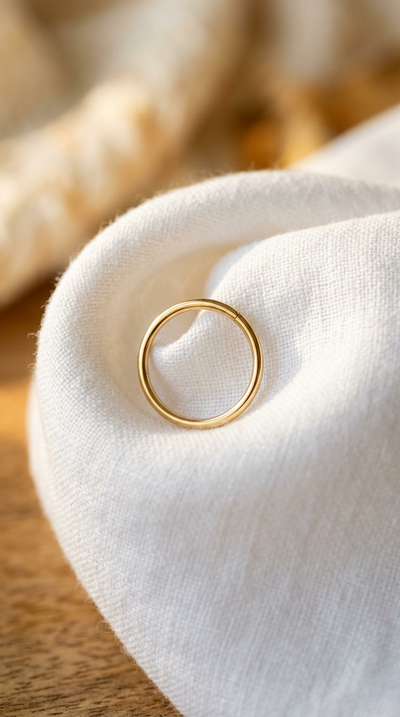
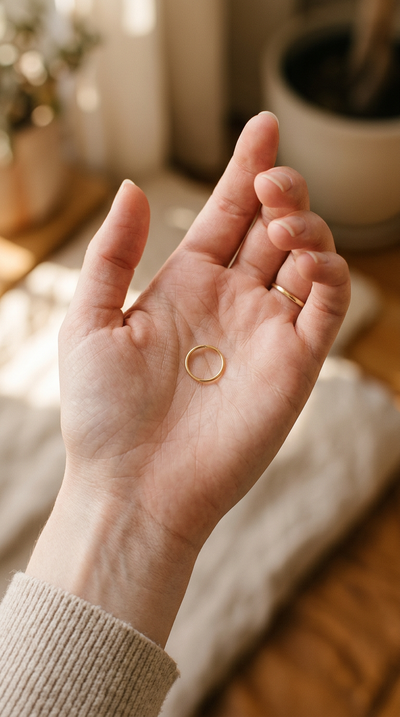
New 14ct Solid Gold Piercing Hoop
Rook Piercing for Men: Styles & Jewellery
- The rook sits in the upper inner ear fold — a subtle, masculine position that reads as intentional rather than ornamental
- Best jewellery for men: curved barbells (most popular), small captive bead rings, and minimal clicker hoops in 16G
- Black titanium, brushed steel, and 14K white or yellow gold are the most masculine material choices
- Recommended bead/end size: 3mm for a subtle look, 4mm for a balanced masculine finish, 5mm only for bold statements
- Pairs well with a helix or tragus for a curated masculine ear stack — avoid over-clustering
- The rook heals in 6–12 months — keep the initial curved barbell in for at least 4 months before changing
What the rook actually is
The rook is the piercing that passes through the anti-helix ridge — the raised fold of cartilage that sits just above the tragus, inside the upper ear. It is a vertical piercing through a thick, sculpted piece of cartilage, and it is one of the few ear piercings whose visual effect comes from the shape of the ear itself rather than the jewellery alone.
For men, this position matters. The rook reads as understated. It is tucked inside the ear fold, not hanging off the rim. It does not catch the light aggressively, does not draw the eye immediately, and does not signal “look at my jewellery.” It signals “I have a piercing, if you happen to notice it.” That is a very different register to a lobe stud or helix hoop.
Why the rook works for men
Most cartilage piercings have a style identity that has historically skewed one way or the other. Helix hoops read as feminine-default in the UK and US mainstream. Industrial barbells read as masculine-default. The rook sits in a genuinely neutral position — it has no strong pre-existing gender coding, which means men can wear it without the piercing itself performing any stylistic work. It is just a piercing.
It hides when you need it to. The rook sits in a fold of cartilage above the tragus. In most lighting conditions and from most angles, the jewellery is partially obscured. This is useful for professional contexts, conservative family situations, or simply for men who want the piercing but not the visibility. Turn your head slightly and it disappears. Turn the other way and it catches a glint of metal.
The curved barbell is a masculine-friendly shape. Unlike a ring, which reads as jewellery-forward, a curved barbell reads more like hardware — two small beads visible, with the bar itself hidden inside the cartilage. The aesthetic is closer to a mechanical detail than an ornament, which many men prefer.
It pairs cleanly with other masculine piercings. A single lobe stud, a helix hoop, a tragus stud, or a septum — the rook sits comfortably alongside any of these without looking crowded, because its inward position does not compete with piercings on the rim or lobe.
It suits both short and long hair. With short hair, the rook is visible at a glance but subtle. With longer hair, it peeks out only occasionally, creating a discovered-detail effect. Either works.
Jewellery styles for men
Which metal to choose
| Metal | Look on men | Best for |
|---|---|---|
| Black titanium MOST MASCULINE | Dark, hardware-like, understated | Minimalist men, dark-haired men, industrial aesthetic |
| Implant-grade titanium (natural) | Matte grey-silver, technical, clean | All skin tones, all ages, safest for initial healing |
| 14K white gold | Bright silver-tone, understated luxury | Men who wear silver-tone watches or rings, cooler skin tones |
| 14K yellow gold | Warm, classic, more visible | Men who wear yellow gold watches, warmer skin tones, bolder statements |
| Surgical steel | Bright silver, industrial-feel | Avoid if nickel-sensitive — many men are without knowing |
Black titanium has become the default masculine choice for cartilage piercings over the last five years. It reads as hardware rather than jewellery, disappears against dark hair, and carries no traditional jewellery coding. On the rook specifically — which is already a subtle position — black titanium compounds the understated effect.
Natural (grey) titanium is the safest initial jewellery and the most versatile long-term. It is nickel-free, hypoallergenic, and reads as clean and technical rather than decorative. Most professional UK piercers use titanium as the default starter metal.
14K gold (yellow or white) elevates the rook without feminising it, provided the jewellery shape is masculine (plain beads, discs, or spikes — not gemstones). 14K white gold is particularly versatile for men who want a luxurious piece that still reads as understated. Yellow gold has more presence and looks particularly strong on darker skin tones.
Avoid sterling silver entirely — it tarnishes inside piercings and can stain the surrounding tissue black. Avoid gold-plated jewellery for healed wear as the plating wears off within months, exposing the nickel-containing base metal underneath.
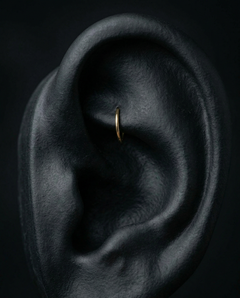
Gauge, bar length & bead size
Getting the dimensions right is what separates a rook that looks considered from one that looks accidental. Men’s rooks are typically pierced at the same gauge as women’s — anatomy, not gender, determines the specs — but the finish choices differ.
Gauge
16G (1.2mm) is the UK standard and the only gauge most professional piercers will use for the rook. The cartilage is thick enough that thinner gauges are unstable and more prone to migration. There is no “masculine thicker gauge” for the rook — 16G is the correct spec regardless of who is wearing it.
Bar length
Initial healing bar: 8mm or 10mm, longer than final length to accommodate swelling. Once healed (typically 2–4 months post-piercing), downsize to 6mm or 8mm for a cleaner finished look. A too-long bar post-healing leaves the beads sitting away from the cartilage — the rook looks more refined with a bar that keeps the beads close to the skin.
Bead size
| Bead size | Look | Best for men who want… |
|---|---|---|
| 3mm | Barely visible, refined | Minimalist style, professional contexts, discretion |
| 4mm BALANCED | Clearly visible, proportionate | A noticeable but understated piercing — the default choice |
| 5mm | Bold, prominent | A statement piece, bolder aesthetic, larger ears |
Pairing with other piercings
Most men who get a rook already have one or two other piercings — typically a lobe and/or a helix. The rook slots into this context well. Here are the combinations that work, and one that does not.
Rook + single lobe
Clean, balanced, and the most common masculine configuration. The rook adds an upper-ear piercing to a lobe setup without committing to a full stacked ear. Use the same metal across both — black titanium stud in the lobe, black titanium barbell in the rook. Matching metal creates intentional cohesion.
Rook + helix
A strong masculine pair. The rook (inside fold) and helix (outer rim) sit on different planes of the ear, so they do not compete visually. A classic configuration: small hoop or stud on the helix, small curved barbell on the rook. Keep both pieces understated — one prominent piercing, one subtle, is harder to pull off than two subtle ones.
Rook + tragus
Both are inner-ear piercings and sit close together — the tragus is a few millimetres below and outside the rook. This pair looks particularly strong on men because both positions are recessed into the ear rather than hanging off it. Use matching small beads (3mm or 4mm) in both for a curated masculine cluster.
Rook + industrial
Strong aesthetic pairing. The industrial is bold hardware; the rook is subtle hardware. Together they create a deliberate “hardware ear” look that avoids feeling decorative. Keep everything in the same metal and finish — mixing brushed titanium with polished gold in this configuration looks accidental.
What to avoid: the cluster
Adding a rook on top of an already-busy ear (double helix + conch + tragus, for example) is the one configuration that rarely works for men. The rook’s subtlety is wasted in a crowded ear — it disappears, and the ear starts to read as over-pierced rather than curated. If you already have four or more piercings, consider whether adding another is the right move before committing.
Rook in professional contexts
One of the rook’s practical strengths for men is that it remains viable in most professional environments. Unlike a visible lobe stretcher or a septum, the rook is small, tucked into the ear, and rarely attracts attention in meetings, interviews or conservative workplaces.
Interviews: a 3mm or 4mm bead in natural titanium or black titanium reads as a minor style choice rather than a statement. It is extremely unlikely to affect how you are perceived. If you are concerned, grow your hair slightly over the ear or turn your head so the unpierced side faces the interviewer.
Client-facing roles: most client-facing roles in the UK now accept small, discreet cartilage piercings on men without issue. The rook is one of the least controversial choices. Flat disc ends make the piercing effectively invisible except at close range.
Uniformed or hyper-conservative roles: military, legal, medical surgical, or conservative financial roles may still have jewellery restrictions. Check your dress code before getting pierced. The rook cannot be easily “removed for the day” — cartilage piercings should not be taken in and out, and the channel can close quickly when empty.
Pain & the healing commitment
Worth being honest about: the rook is one of the more painful ear piercings to get. The anti-helix fold is dense cartilage, and the needle has to pass through the full thickness — typically 5–7mm of tissue. On a pain scale of 1 to 10, most men rate it 6–7 during the piercing and 3–4 for the next 24 hours. The pain is sharp but brief. The pressure sensation lasts longer than the pain itself.
Recovery realities for men:
- Full healing: 6–12 months. Longer than a lobe (6–8 weeks) but similar to other cartilage piercings.
- Tenderness to side-sleeping pressure for the first 2–3 months. Use a travel pillow or sleep on the other side.
- Avoid headphones with over-ear cups for at least 3 months. Earbuds are fine immediately.
- Gym training is fine from day two; avoid any exercise where your ear touches contact surfaces (combat sports, wrestling, rugby scrums) for 3–6 months.
- Shaving around the ear: take care on day one with electric clippers — the jewellery is a snag risk until you know where it sits.
Getting the piercing: practical steps
What not to do
No gun piercings. Piercing guns cannot pierce the rook safely. If a shop offers to do it with a gun, leave immediately. Needle only.
No rings during healing. The rook is a curved piercing and a ring applies rotational pressure to the channel. Stay in a curved barbell for the first 6–12 months. Rings are an option only after full healing and only if your anatomy supports them.
No changing jewellery too early. The rook channel is deep and fragile. Changing the bar in the first two months disrupts healing and frequently causes bumps. Wait for your piercer’s green light.
No sterling silver. Silver tarnishes inside piercings and can permanently stain the surrounding tissue. Never appropriate for a rook, healed or otherwise.
No sleeping on the pierced side during healing. This is the single biggest cause of rook bumps. A travel pillow with the ear in the hole is the practical solution.