New 14ct Solid Gold Piercing Hoop
Infected Rook Piercing: Signs, Treatment & Prevention
- True infection is less common than irritation — most “infections” are actually irritation bumps
- Key infection signs: green/yellow pus, increasing pain after week 2, spreading redness, fever
- Normal healing signs: clear/pale discharge, occasional swelling, mild redness around holes
- Do not remove the jewellery from an infected piercing — this can trap the infection inside
- See a doctor if you suspect true infection; visit your piercer for irritation issues
Infection vs irritation: know the difference
This is the most important distinction in piercing aftercare. The vast majority of people who believe their rook is “infected” are actually experiencing irritation — a far less serious condition with a completely different treatment approach. Getting this wrong can lead to unnecessary antibiotics, unnecessary removal, or unnecessary panic.
| Symptom | Irritation | Infection |
|---|---|---|
| Discharge | Clear or pale yellow (lymph) | Green, dark yellow, or grey (pus) |
| Smell | None or mild | Foul, unpleasant odour |
| Pain | Mild, comes and goes | Persistent, getting worse |
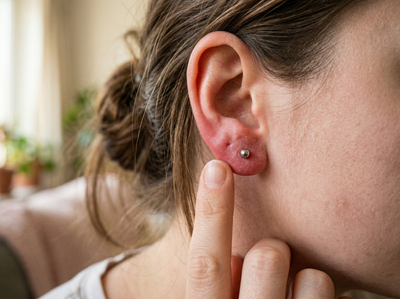
| Redness | Localised around holes | Spreading outward from piercing |
| Swelling | Mild, intermittent | Significant, increasing |
| Bump | Irritation bump (fluid-filled) | Abscess (painful, warm) |
| Fever | No | Possible |
Detailed infection signs
Green or dark discharge: healthy piercings produce clear lymph fluid. When that fluid turns green, opaque yellow, or grey, it often indicates bacterial activity. This is the most reliable visual indicator of infection.
Escalating pain: piercing pain should gradually decrease after the first week. If it’s getting worse — especially a deep, throbbing pain — that’s a red flag. Infection pain typically intensifies over days rather than hours.
Spreading redness: some redness immediately around the piercing holes is normal for months. But if the redness is expanding outward like a starburst pattern, or if red streaks are visible running away from the piercing, seek medical attention.
Heat: an infected piercing often feels notably warmer than the surrounding skin. Touch the pierced area and then touch the same spot on the other ear — if there’s a significant temperature difference, infection may be present.
Abscess formation: a painful, swollen lump near the piercing that feels warm and firm. This is different from an irritation bump, which is typically a small, fluid-filled bump that isn’t particularly warm or painful.
How to treat an infected rook
Step 1: Do NOT remove the jewellery. This is counterintuitive, but removing the jewellery from an infected piercing can cause the holes to close, trapping the infection inside the tissue. The jewellery acts as a drainage channel. Leave it in.
Step 2: See a doctor. A medical professional can assess the severity and prescribe antibiotics if needed. For cartilage infections, oral antibiotics are typically required — topical antibiotics alone may not penetrate the cartilage effectively.
Step 3: Continue saline cleaning. Clean the piercing with sterile saline 2-3 times daily while on antibiotics. Gently remove any discharge buildup. Pat dry with clean non-woven gauze.
Step 4: Complete the antibiotic course. Finish all prescribed antibiotics even if symptoms improve before the course ends. Stopping early can lead to antibiotic-resistant bacteria.
Dealing with irritation bumps
Irritation bumps are far more common than infections and are the number one concern rook piercing owners face. They appear as small, raised bumps near the piercing holes — usually on one side of the fold. They’re caused by physical trauma to the healing channel, not bacteria.
Common causes: sleeping on the piercing, bumping it accidentally, poor-quality jewellery, touching or fidgeting with it, changing jewellery too early, using harsh cleaning products.
Treatment: identify and remove the irritant. Return to strict saline-only cleaning. Avoid touching. Give it 2-4 weeks. Most irritation bumps resolve on their own once the cause is eliminated. If it persists beyond a month, visit your piercer for assessment.
Prevention: keeping your rook clean
Saline only. Sterile saline solution (0.9% NaCl) is all you need. No tea tree oil, no alcohol, no hydrogen peroxide, no soap, no essential oils. These products damage healing tissue and increase the risk of both irritation and infection.
Don’t touch. Hands carry bacteria. Every time you touch your piercing with unwashed hands, you introduce potential pathogens into a healing wound.
Quality jewellery. Implant-grade titanium or 14K solid gold. Cheap metals corrode, leach nickel, and create an environment that encourages bacterial growth.
Keep phones and headphones clean. Your phone screen carries more bacteria than a toilet seat. Press it against a healing piercing and you’re asking for trouble. Clean your phone regularly and use the speaker or opposite ear.
Change pillowcases regularly. Sleep on a clean pillowcase or, better yet, use a clean t-shirt over your pillow and change it every few days.