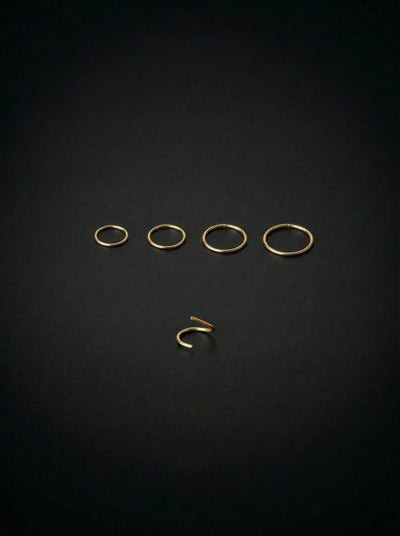
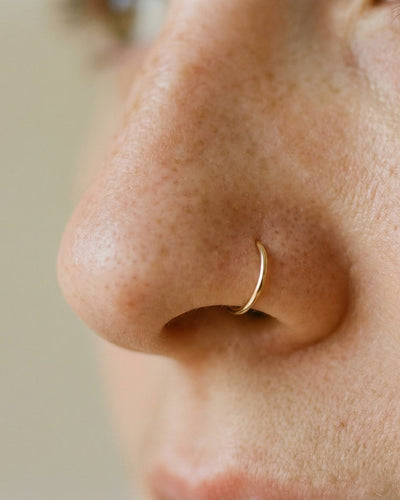
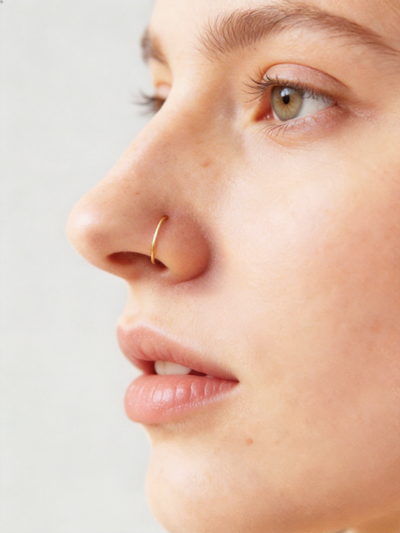
New 14ct Solid Gold Piercing Hoop


The Ultimate Nose Ring Guide: Types, Sizes & Styles

- Seamless hoops are the most popular nose ring style — no visible join for a clean look
- 8mm is the most popular diameter: visible, classic, and suits most nose shapes
- 20G is the standard nose ring gauge in the UK; 18G is slightly thicker
- 14K solid gold is the best material — moisture-resistant, nickel-free, lifetime durability
- Half sizes (6.5mm, 7.5mm, 8.5mm) help achieve the perfect fit for your specific nose
Nose ring types
Seamless hoop
A continuous circle of wire with an invisible join. The gold standard of nose rings. The ends meet perfectly so the ring appears as one unbroken circle. In 14K gold, this creates an elegant, timeless look. This is what we specialise in at Stepoy.
Segment ring
A hoop with a removable segment that clicks in and out. Easier to insert than a seamless hoop but the segment join may be slightly visible. Good for people who change jewellery frequently.
Clicker ring
A hinged ring that snaps shut. The easiest to insert and remove. Available in plain and decorative designs. The hinge mechanism adds slight bulk compared to a seamless hoop.
Captive bead ring
A hoop held closed by a small bead. The bead sits at the bottom of the ring against the nostril. A classic design but the bead adds visual weight. Less popular than seamless hoops for everyday wear.
Complete size guide
| Size | Look | Best for |
|---|---|---|
| 6mm | Very snug, nearly flush | Extremely subtle, small noses |
| 7mm | Snug, close-fitting | Subtle elegance, petite noses |
| 8mm Most popular | Classic nose ring | Most nose shapes, visible but elegant |
| 9mm | Relaxed fit | Average to larger noses, more movement |
| 10mm | Statement ring | Bold look, bohemian aesthetic |
| 11-12mm | Maximum impact | Dramatic, fashion-forward |

Gauge explained
20G (0.8mm): the most common nose ring gauge in the UK. Standard thickness for nostril piercings.
18G (1.0mm): slightly thicker. Some piercers prefer this for durability. Check your piercing gauge before ordering.
22G (0.6mm): the finest option. Very delicate look. Less common in the UK but popular in some traditions.
How to check: ask your piercer, or measure your current jewellery with a calliper. If unsure, 20G is the safe default for UK nostril piercings.
Metal comparison
| Metal | Verdict | Notes |
|---|---|---|
| 14K solid gold | Excellent | Moisture-resistant, nickel-free, lifetime wear. The best option. |
| Titanium | Excellent | Lightest, completely hypoallergenic. Cooler aesthetic than gold. |
| Surgical steel | Caution | Contains nickel. Risky for the moist nose environment. |
| Gold-plated | Avoid | Plating flakes inside the nose. Exposes reactive base metals. |
| Sterling silver | Avoid | Tarnishes rapidly in the moist nose environment. Can cause green/black staining. |
Choosing for your face
Nose shape matters. Smaller noses suit 6-7mm rings (proportional). Larger noses suit 8-10mm. An 8mm ring looks entirely different on a petite nose versus a broader nose.
Piercing placement matters. Higher placement on the nostril works with smaller rings. Lower placement needs larger rings to create the same arc.
Try before you buy. If possible, try a fake nose ring in different sizes to see what suits your face before ordering your real gold ring.
Care & maintenance
14K gold: virtually maintenance-free. Rinse occasionally with warm water. Does not tarnish or discolour.
Cleaning: warm water and gentle soap if needed. Avoid harsh chemicals. For seamless hoops, open and close carefully using gentle, even pressure to maintain the shape.
Storage: when not wearing, store in a small jewellery pouch or box. Avoid loose storage where rings can bend or scratch.