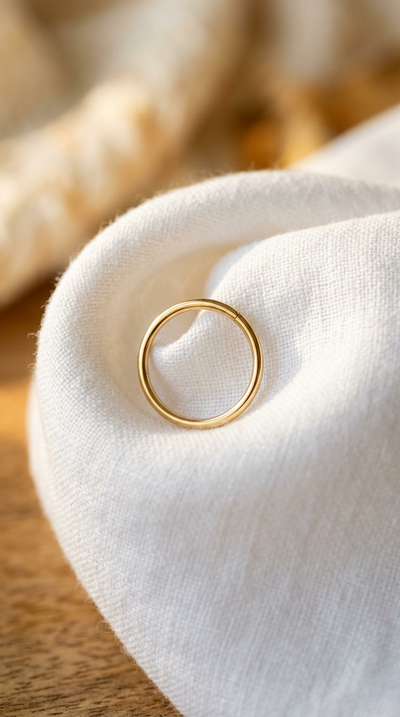
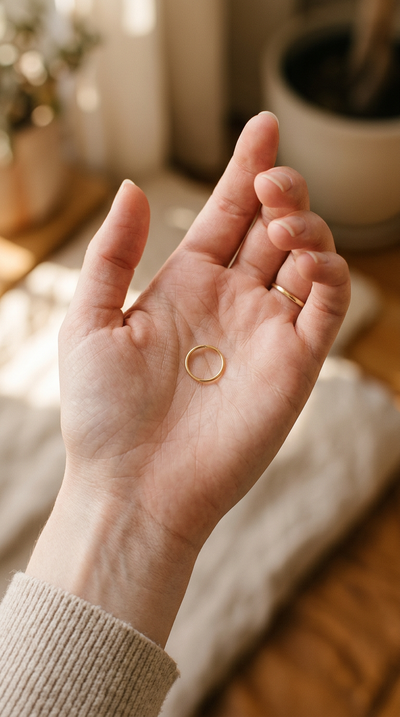
New 14ct solid gold hoop


Daith Piercing for Men: A Complete Style Guide
- The daith is the most understated ear piercing for men — framed deep inside the ear curve, it reads as intentional but subtle
- Men typically need 8mm daith hoops — average male ear anatomy suits this standard diameter
- A plain seamless ring or minimal clicker in 14K gold is the most popular men’s daith jewellery
- The daith is one of the easiest ear piercings to conceal for work — most people do not immediately notice it
- Earbuds and over-ear headphones are both compatible with a healed daith piercing
- Healing takes 9–12 months and sleeping pressure is the main challenge
Why men choose the daith
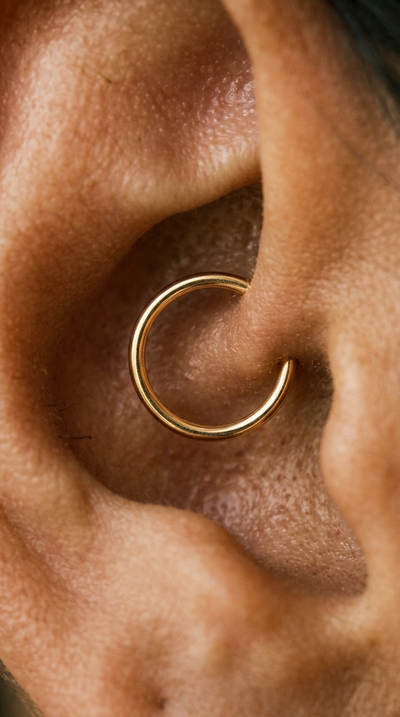
The daith has become one of the more thoughtful piercing choices for men, and the appeal is different from conch or helix piercings. Where a conch hoop wraps visibly around the ear and a helix hoop sits on the outer rim, the daith ring lives inside the ear’s inner curve. It is present, it catches light at certain angles, but it does not broadcast itself. This subtlety appeals to men who want a piercing that reads as deliberate without making a bold statement.
The daith is also one of the most photographically distinctive piercings. A 14K gold ring nested inside the daith fold creates a small, perfectly framed circle of gold visible when someone looks at your ear from the front or at an angle. It has the quality of a watch or a signet ring — understated craft rather than loud jewellery.
For men working in environments where visible piercings are discouraged, the daith is the most workplace-flexible ear piercing. The inner ear location means casual observers often do not notice it at all. It is visible if someone looks, but it does not catch the eye the way a hoop on the outer ear does.
Best styles for men
Plain seamless gold ring — the signature choice
The most popular daith jewellery for men is a plain seamless ring in 14K yellow gold. No gems, no decoration, no visible clasp — just a clean circle of gold framed by the inner ear curve. This style works for the same reason plain gold bands work for men’s rings and watches: restraint and quality speak for themselves.
The practical note: inserting a seamless ring into the daith is genuinely difficult at home. Most men with seamless daith rings have their piercer install them and leave them long-term. This is the “set and forget” approach — one appointment, then years of wear.
Plain hinged clicker — the practical version
A plain hinged clicker looks identical to a seamless ring from the front, but the hinged mechanism makes self-insertion and removal dramatically easier. For men who want to manage their own jewellery changes — cleaning, swapping between metals, or removing for medical imaging — a clicker is the sensible choice.
From any normal viewing distance, no one will see that the ring is hinged rather than seamless. The click mechanism sits at the top of the fold, hidden from view. The front-facing portion is indistinguishable from a seamless ring.
Curved barbell — the minimal option
A simple curved barbell with plain ball ends sits inside the daith fold as a small metal arc. This is the initial jewellery for most daith piercings and the most minimalist long-term option. From the front, only the two ball ends are visible as tiny metallic points in the ear.
A curved barbell in 14K gold with plain balls is the most discreet daith jewellery you can wear. For men who want a piercing but prefer almost-invisible jewellery, this is the answer.
White gold or black titanium
For men who prefer cooler metal tones, white gold offers the look of silver or platinum without oxidation risks. Black titanium (anodised) creates a more industrial, modern aesthetic that pairs well with darker wardrobes. Both are safe for the daith and both hold up well to daily wear.
Sizing for men
Daith sizing is determined more by the anatomy of the ear fold than by the overall size of the ear. That said, there are general patterns in male anatomy:
| Anatomy | Recommended diameter | Notes |
|---|---|---|
| Average male daith fold | 8mm MOST COMMON | The standard diameter for men. Fits most ear anatomies and is the default initial jewellery size. |
| Smaller/tighter fold | 7mm | For men with a more compact daith fold. Creates a snugger, more tucked-in look. |
| Wider/deeper fold | 8–10mm | For larger ears or more prominent daith ridges. 10mm works well with decorative clickers. |
Gauge: 16G is the standard for daith piercings regardless of gender. The thicker wire suits the dense cartilage fold and creates a ring with enough visual substance to read as intentional. 18G is available for a finer look but is less common and would need to match a piercing done at that gauge.
For detailed measuring, see our daith hoop size guide.
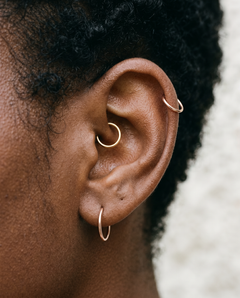
Daith in an ear stack
The daith pairs well with other ear piercings because it sits in a different visual zone — deep inside the ear rather than on the rim. This creates space for complementary piercings without visual crowding.
Daith + lobe stud
The simplest combination. A plain daith ring with a plain gold stud in the lobe creates two distinct accent points on one ear. The daith is the detail; the lobe is the anchor. Clean, balanced, and appropriate for nearly any setting.
Daith + helix hoop
Two rings on the same ear, in different zones. The helix hoop on the outer rim and the daith ring framed inside the inner curve create vertical visual rhythm. Match the gauge (both 16G or both 18G, not mixed) and the metal for the most cohesive look.
Daith + conch hoop
A bolder combination. The conch hoop wraps the outer ear rim while the daith ring sits framed in the inner curve. Two rings, two zones, both in 14K yellow gold creates a strong, curated look without requiring multiple piercings along the helix.
Daith alone
Many men who get a daith piercing keep it as their only ear piercing. The daith has enough visual interest to stand alone — the inner-curve framing is unusual enough to be its own statement. Solo daith piercings are increasingly popular among men who want a single, understated piercing rather than a curated stack.
Daith piercings at work
The daith is the most workplace-flexible ear piercing for men. Its location inside the ear means casual observers frequently do not notice it. Colleagues who have worked with someone for weeks may only spot the daith if the light catches the ring at a particular angle or they happen to look directly at the ear from close range.
In creative, tech and modern corporate environments: No issues. Visible piercings on men are broadly accepted, and the daith is less visible than most. It will not attract attention unless someone is actively looking at your ear.
In conservative environments (traditional finance, law, banking): The daith is the safest ear piercing choice for men in these fields. A plain 14K gold daith ring is barely noticeable from a normal viewing distance. If your workplace policy prohibits visible piercings, the daith is the closest you can get to that line without crossing it — though you should still check specific policies.
For client-facing roles: Most clients will not notice. In the rare case someone asks, a small plain gold ring in the ear is universally understood as restrained personal jewellery rather than a countercultural statement.
Daith and headphones for men
Men often have specific headphone concerns for daily work, gaming, and commuting. The daith is one of the more headphone-friendly ear piercings:
AirPods and earbuds: Generally compatible with a healed daith. The earbud sits in the ear canal, which is below and slightly behind the daith. Standard AirPods coexist comfortably with most daith rings. Silicone-tipped earbuds that push deeper into the canal may contact the bottom of the daith ring — if this causes discomfort, try a different tip size.
Over-ear headphones (gaming, studio, office): Generally fine. The daith is protected inside the ear, away from the direct pressure points of over-ear padding. Tight-clamping headphones may press the outer ear inward, indirectly affecting the daith, but this is usually mild.
Gaming headsets with microphones: The microphone arm often sits near the outer ear, not the inner ear. Most gaming headsets are fully compatible with a healed daith piercing. This makes the daith one of the best ear piercing choices for men who game regularly.
During healing: Avoid earbuds for the first 3–4 months. The insertion motion can bump the curved barbell. Over-ear headphones are fine as long as they do not press the ear hard inward against the pillow area.
Pain and healing for men
Pain and healing are determined by anatomy, not gender. But here are the practical points:
Pain: Rated 5–7 out of 10. The daith passes through thick cartilage, creating a distinct crunch and strong pressure sensation. It is more painful than a helix but less painful than a rook. The entire needle pass takes 1–2 seconds.
Healing: 9–12 months. The daith is one of the slowest ear piercings to heal due to the thick cartilage and limited blood supply. The main challenge during healing is sleeping — pressure on the pierced ear causes irritation bumps and extends the timeline.
The sleeping solution: Use a travel pillow with a hole, or sleep on the opposite side. This is the single most important habit for smooth daith healing, and men who commit to this habit consistently report faster, cleaner healing.
For full healing details, see our daith healing guide.
Materials for men
14K yellow gold: The classic choice. Warm, premium, universally recognisable as quality. A plain yellow gold daith ring reads as understated fine jewellery rather than body modification. Matches watches, rings, and cufflinks in the same metal.
14K white gold: Cooler tone, similar to platinum or silver. For men who prefer silver watches and stainless steel accessories, white gold creates visual consistency. No oxidation risk unlike actual silver.
Implant-grade titanium: Most affordable, lightweight, darker silver tone. Many men start with titanium during the long healing period and upgrade to 14K gold once the piercing is mature. Can be anodised black for a more industrial look.
The migraine myth
Many men considering a daith piercing have encountered claims that the daith reduces migraines. This claim is popular online but has no reliable scientific evidence supporting it. Some people report symptom reduction, but this appears to be consistent with the placebo effect rather than a demonstrable physiological mechanism.
We mention this not to discourage you from getting a daith piercing, but to set expectations correctly. Get a daith because you like how it looks. Do not get a daith because you expect it to cure migraines. If the aesthetic appeals to you, proceed. If you are hoping for migraine relief, consult a doctor about evidence-based treatments instead.
One ear or both?
One ear (most common for men): A single daith piercing on one ear is the standard approach. It creates visual asymmetry, which reads as more intentional than a matching pair. You also retain one piercing-free ear, which helps during the long healing period — you have a safe side to sleep on.
Both ears: Symmetrical daith piercings are uncommon but striking when done well. The challenge is purely practical: healing two thick-cartilage piercings simultaneously means you cannot sleep comfortably on either side for 9–12 months. Most piercers strongly recommend doing one ear first, healing fully, then doing the other.
Which side? Purely practical: pierce the ear opposite to your preferred sleeping side. If you sleep on your right, pierce the left. This lets you maintain normal sleep during the lengthy healing period.