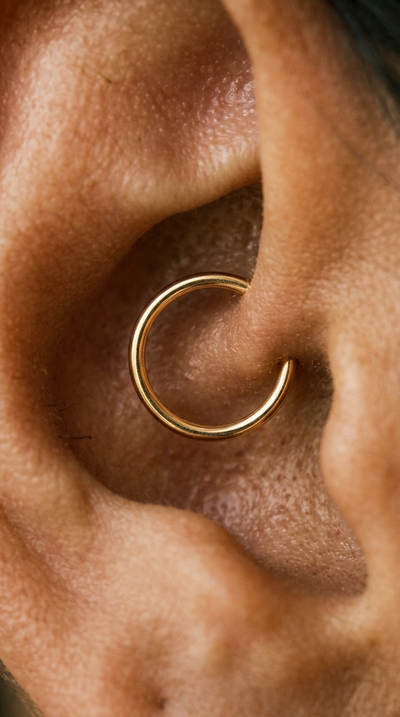
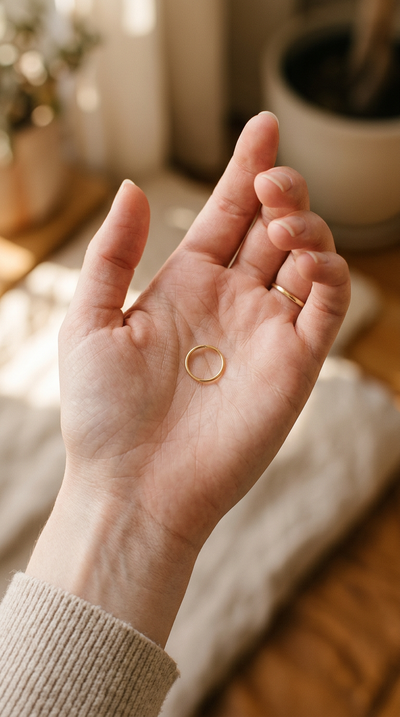
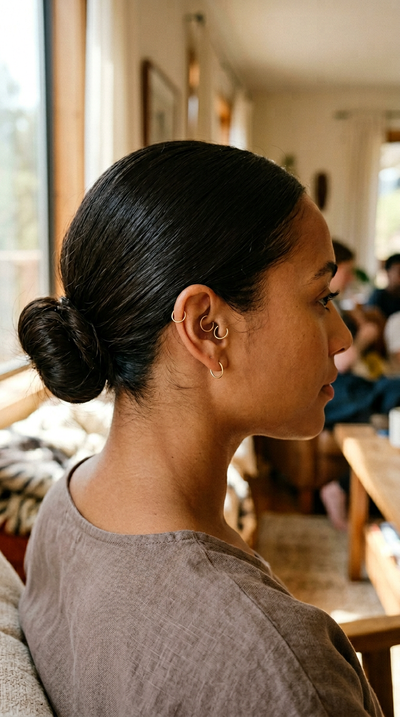
New 14ct Solid Gold Hoop


Daith Hoop Size Guide: 6mm, 7mm & 8mm
- The daith piercing passes through the innermost cartilage fold above the ear canal — a small, deep space with limited room
- 8mm is the most common daith hoop size — fits the majority of ears and is the standard initial jewellery diameter
- 6mm creates an extremely snug fit that only works for smaller ear folds — too tight for most people
- Standard daith gauge is 16G (1.2mm) — thicker than helix or nostril jewellery
- Clickers and segment rings are more popular than seamless rings for the daith because the deep fold makes opening and closing seamless rings very difficult
- The daith is almost always worn with a hoop — studs are uncommon because the anatomy suits circular jewellery
Daith anatomy and why sizing matters
The daith is pierced through the innermost cartilage ridge of the ear — the small, thick fold that sits directly above the ear canal opening. This ridge is called the crus of the helix, and it curves inward toward the centre of the ear. The piercing passes through this fold, and the ring sits inside the curved space between the fold and the concha bowl.
This anatomy creates two sizing challenges that are unique to the daith. First, the space is tight. The ring must fit inside a natural curve without pressing against the surrounding cartilage. A ring that is too large will protrude outward and catch on things. A ring that is too small will press into the fold and cause irritation.
Second, the fold thickness varies significantly from person to person. Some people have a thin, prominent daith ridge that accommodates smaller rings easily. Others have a thick, shallow fold that requires a larger diameter. There is more anatomical variation in the daith than in almost any other ear piercing location.
6mm vs 7mm vs 8mm
| Diameter | Fit | Look | Best for |
|---|---|---|---|
| 6mm | Very snug | Tucked tight into the fold, barely visible | Small daith folds, healed piercings only, minimal aesthetic |
| 7mm | Snug | Sits neatly in the fold with minimal gap | Average anatomy, those who want visible but compact |
| 8mm MOST COMMON | Comfortable | Classic daith look, ring visible from most angles | Standard anatomy, initial jewellery, most ear shapes |
| 10mm | Relaxed | Protrudes from the fold, bold statement | Larger ears, thicker folds, decorative clickers |
6mm — the compact fit
6mm is the smallest commonly available daith hoop. It tucks tightly into the daith fold, with the ring barely visible from the front. This creates an extremely discreet look — the piercing is present but almost hidden inside the ear’s natural curve.
However, 6mm only works if your daith fold is thin and the piercing is positioned at the narrowest point of the ridge. On most people, 6mm is too tight. It presses into the surrounding cartilage, causes discomfort, and may not close properly because the ring does not have enough room to complete its arc inside the fold.
Only choose 6mm if: you have already worn a 7mm or 8mm daith hoop successfully and want to downsize for a tighter look, and your piercer has confirmed the fold can accommodate it. Do not start with 6mm.
7mm — the middle ground
7mm sits neatly inside the daith fold with a small gap between the ring and the surrounding cartilage. It is visible from the front and side but does not protrude significantly from the ear. This size works well for people who find 8mm slightly too large or who have average-to-smaller daith anatomy.
7mm is also a popular downsize from the initial 8mm ring. Once the piercing is fully healed and any swelling has long resolved, some people prefer the tighter, more compact look of 7mm.
8mm — the standard
8mm is the most commonly used daith hoop diameter worldwide. It fits comfortably inside the daith fold on the majority of ear anatomies, leaves adequate room for the ring to sit without pressing on surrounding tissue, and is the standard diameter for initial daith jewellery.
If you are buying your first daith hoop or switching from a curved barbell to a ring, 8mm is the recommended starting point. It accommodates the slight swelling that may persist during late healing and works with the natural curvature of most daith folds.
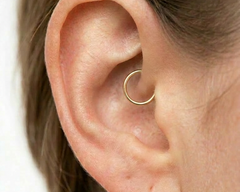
8mm also offers the best visibility. The ring is clearly visible from the front and side of the ear, which is the whole point for most people — the daith hoop framed inside the ear’s inner curve is one of the most distinctive and photogenic ear piercing looks.
10mm — the statement size
10mm is larger than most daith folds require. The ring protrudes outward from the fold, creating a bolder, more prominent look. This size is popular with decorative clickers and ornamental rings where the design needs space to be visible. For plain seamless hoops, 10mm may look oversized unless you have a larger ear or a wider daith fold.
How to measure
Measuring the daith at home is harder than measuring other piercings because the fold is deep, curved, and difficult to see or access with a ruler. Here are the practical options:
Best method: ask your piercer
The daith fold is one of the few piercing locations where we strongly recommend having your piercer measure rather than attempting it at home. They have the tools, the angle, and the experience to assess the fold depth and recommend the correct diameter. Most piercers will do this during a quick check-up or downsize appointment.
Alternative: measure your current ring
If you already have a daith ring that fits well, remove it carefully and measure the inner diameter — edge to edge across the inside. This is the most reliable DIY method because you know the size already works for your anatomy.
Rough guide by ear size
As a very general guide: if you have smaller ears with a compact daith fold, 6–7mm may work. If you have average ears, 8mm is the standard. If you have larger ears or a pronounced, wide daith fold, 8–10mm is likely. This is approximate — individual anatomy varies significantly, and the daith is one of the locations where a 1mm difference between sizes is immediately noticeable.
Daith gauge guide
| Gauge | Thickness | Notes |
|---|---|---|
| 18G (1.0mm) | Thinner option | Creates a finer ring inside the fold. Less common for daith. Only if your piercing was done at 18G. |
| 16G (1.2mm) STANDARD | Standard | The vast majority of daith piercings are done at 16G. Almost all daith jewellery is made in this gauge. |
| 14G (1.6mm) | Thicker option | Uncommon for daith. Only if specifically pierced at this gauge or stretched. |
The daith passes through a thick, dense cartilage fold, which is why 16G is the standard. The thicker wire provides structural stability inside the tight fold and holds the ring’s shape against the pressure of the surrounding cartilage. 18G works for healed daith piercings if you want a finer look, but confirm your piercing gauge before ordering.
Daith ring styles
The daith is unique among piercings in that it is almost always worn with a ring rather than a stud. The curved fold naturally suits circular jewellery, and the visible part of the ring sits framed inside the ear’s inner curve like a piece of jewellery in a setting.
Hinged clicker — most practical
The most popular daith jewellery style. The hinged mechanism clicks open and shut, making insertion and removal far easier than a seamless ring in this deep, awkward location. Clickers come in plain styles (identical to a seamless ring from the front) and ornamental designs with gems, filigree, hearts, and moons along the visible arc.
Seamless ring — most minimal
A plain continuous circle with no visible clasp. The cleanest, most minimal daith look — especially in 14K gold. The challenge: opening and closing a seamless ring inside the deep daith fold is significantly harder than on a helix or nostril. Many people need pliers or a piercer’s help.
Captive bead ring (CBR)
A ring with a removable bead that sits at the visible front of the daith. The bead can be a matching metal ball, a gemstone, or an opal. CBRs are secure once the bead is in place, but removing and replacing the bead inside the daith fold is fiddly.
Curved barbell
A curved bar with a ball on each end. This is the standard initial jewellery for daith piercings at many studios because it accommodates swelling and is easy for the piercer to fit. Once healed, most people switch to a hoop for the classic daith look.
Daith vs rook: sizing differences
The daith and rook are adjacent piercings that sometimes get confused. They are in different locations and use different sizing:
| Daith | Rook | |
|---|---|---|
| Location | Innermost fold above ear canal | Ridge between inner and outer ear |
| Typical hoop size | 6–8mm | 5–7mm |
| Standard gauge | 16G | 16G |
| Jewellery style | Hoops (clickers, seamless, CBR) | Curved barbells, small hoops |
| Visibility | Ring visible inside the ear curve | Barbell or hoop on the inner ridge |
If you have both a daith and a rook, sizing them separately is essential. The daith fold is a different width and depth from the rook ridge, so the diameters that fit each location are different. See our rook vs daith comparison for more detail.
Daith hoops and headphones
Earbuds (AirPods, etc.): The daith ring sits above and behind the ear canal entrance. Standard AirPods (hard shell) usually coexist with a daith ring, though you may feel the ring when inserting the bud. Silicone-tipped earbuds that push deeper into the canal can press against the bottom of the daith ring. If this causes discomfort, adjust the earbud angle or try a different tip size.
Over-ear headphones: Generally fine. The daith is deep inside the ear and protected from most external pressure. Over-ear cups sit around the outer ear, not inside it. The only issue arises if headphone padding compresses the ear inward, which can indirectly push the concha against the daith ring. This is usually mild.
During healing: Avoid earbuds in the pierced ear for the first 3–4 months. The earbud can bump the curved barbell or ring during insertion. Use earbuds in the opposite ear or switch to bone conduction headphones during healing.
Common mistakes
Ordering based on other piercing sizes. Your helix hoop may be 7mm. That does not mean your daith is 7mm. The daith fold is a completely different anatomical space. Always size the daith independently.
Choosing too small. A daith ring that is too small presses into the thick cartilage fold, causing constant irritation and bumps. The fold does not flex like the helix rim — it is rigid. A too-tight ring has nowhere to go except into the tissue. When in doubt, size up.
Attempting a seamless ring change at home. The daith is deep and the angle is awkward. Opening and closing a seamless ring inside the fold without tools or experience is extremely frustrating. If you want a seamless look, consider having your piercer install it, or use a hinged clicker which achieves the same visual result with much easier insertion.
Switching too early. Daith piercings take 9–12 months to fully heal. The thick cartilage and deep position slow healing compared to the helix or tragus. Switching jewellery before the piercing is mature risks irritation bumps and healing setbacks.