Key takeaways
- A daith bump is almost always an irritation bump (granulation tissue) — not an infection and not a keloid
- The daith is uniquely bump-prone because it sits in a deep, sheltered fold with limited airflow, thick cartilage, and difficult visibility for self-assessment
- The #1 cause: touching and fiddling with the jewellery. #2: wrong material. #3: earbuds pressing on the ring
- Daith bumps are harder to see than bumps on other piercings — you often feel them before you see them
- Treatment: stop touching, switch to safe metal, saline only — but expect slower resolution (3–6 weeks) than outer ear piercings
- 14K solid gold or implant-grade titanium eliminates material-related bumps
What a daith bump actually is
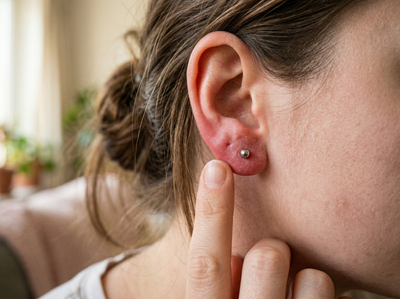
The bump beside your daith piercing is a granuloma — excess healing tissue that forms when the piercing channel is repeatedly irritated. It is your body’s healing response accumulating faster than it can resolve, because something keeps disrupting the process.
This is not an infection. Infections involve bacteria, thick coloured pus, spreading redness, escalating pain and potentially fever. A granuloma is an irritation response — the body reacting to pressure, friction, chemical irritants (like nickel), or movement of the jewellery inside the wound.
It is almost certainly not a keloid. True keloids are genetic, grow beyond the wound boundaries, and do not resolve on their own. The bump on your daith appeared after a specific trigger, sits at or near the piercing hole, and will flatten once the cause is removed.
Why the daith is especially vulnerable
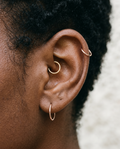
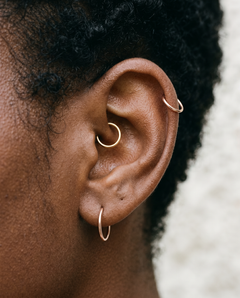
The daith develops bumps frequently — and those bumps tend to be more stubborn than bumps on other ear piercings. This is because of five factors unique to the daith’s anatomy and environment:
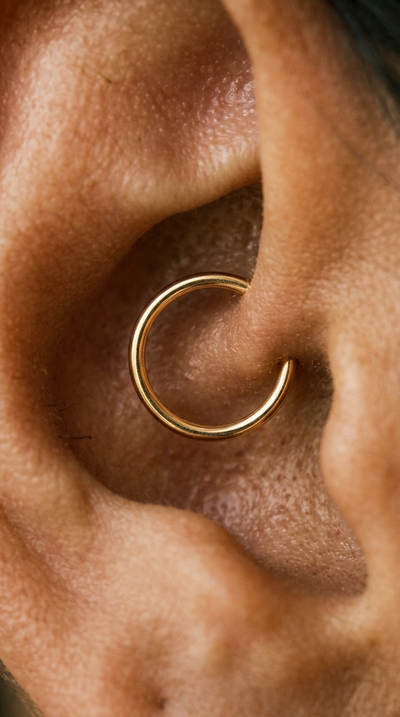
Deepest fold on the ear. The daith sits in the innermost cartilage fold, directly above the ear canal. It is the most sheltered, least exposed piercing location on the ear. While this protects it from some external snagging, it also means limited airflow, trapped moisture, and an environment where bacteria and irritants linger longer.
Thick, dense cartilage. The daith ridge is comparable in thickness to the conch. Thick cartilage heals slowly (6–12 months), which means a longer vulnerability window for bump triggers. Every additional month of healing is another month where the piercing can react to irritation.
Difficult to see. Unlike a helix bump (clearly visible on the outer rim) or a tragus bump (visible from the front), a daith bump is hidden inside the ear fold. You often feel a daith bump — as tenderness or a lump when you press the area — before you can see it. This makes early detection and monitoring harder.
Curved jewellery. The daith typically wears a curved barbell, captive bead ring, or seamless hoop that follows the curve of the fold. Curved jewellery has more contact points with the tissue than a straight stud, and any rotation creates friction along the entire curve. This multi-point contact is a persistent irritation source that straight-post piercings (like lobe or helix studs) do not face.
Earbud conflict. The daith sits directly in the path of in-ear earbuds. AirPods and similar earbuds rest at the ear canal entrance, exactly where the daith jewellery sits. Every earbud insertion pushes the ring, compressing it into the fold tissue.
The causes, ranked
#1 Most common
Touching & fiddling
The daith ring sits in a sheltered spot that hands naturally reach toward — adjusting earbuds, scratching an itch inside the ear, or simply feeling the ring. Every touch rotates the curved jewellery inside the wound channel and introduces bacteria.
#2 Very common
Wrong material
Nickel in surgical steel or base metal under gold plating. The daith’s sheltered, moist fold accelerates metal corrosion — nickel leaches faster here than on exposed piercings. Material bumps will not resolve until the metal is changed.
#3 Common
Earbuds during healing
AirPods and in-ear earbuds press directly on daith jewellery. Every insertion and removal pushes the ring into the wound. The daith is the piercing most incompatible with earbuds during healing.
#4 Common
Sleeping on it
Side sleeping compresses the daith ring into the inner ear fold. The deep position means the pressure is focused into a small area with no escape angle. A travel pillow is essential for daith piercings.
#5 Occasional
Moisture & product buildup
The sheltered fold traps shampoo residue, conditioner, sweat and moisture around the piercing. These products cause chemical irritation and create a moist environment where bacteria thrive. Rinse the daith area thoroughly in every shower.
#6 Occasional
Over-cleaning
The daith’s hidden position tempts people to clean aggressively with cotton buds, soaked pads, or harsh products pushed into the fold. This causes mechanical irritation and chemical damage to healing tissue. Saline spray only — no contact cleaning.
The visibility problem
With helix, tragus or conch bumps, you can see the bump clearly in a mirror and monitor changes day by day. Daith bumps are hidden inside the fold. You may need a phone camera held at an angle to photograph the piercing, or ask someone else to look. If you suspect a bump but cannot see it, visit your piercer — they have the tools and angle to assess the daith directly.
Bump vs keloid vs infection
| Irritation bump | Keloid | Infection |
|---|
| What | Excess granulation tissue | Genetic scar overgrowth | Bacterial invasion |
| Look | Small, soft, flesh/pink | Hard, shiny, grows beyond wound | Red, swollen, hot |
| Pain | Tender when pressed | Usually painless | Throbbing, escalating |
| Discharge | Clear/pale yellow | None | Thick green/white pus |
| Common? | Very — most daith bumps | Rare — genetic | Uncommon with aftercare |
| Fix | Remove cause — resolves | Dermatologist | Doctor (antibiotics) |
Daith bumps are hard to self-diagnose
Because the daith is hidden, you may not be able to distinguish between a small irritation bump and the beginnings of an infection by sight alone. If you feel a lump, tenderness and notice discharge that has changed colour or smell, see your piercer or GP for an in-person assessment. Do not attempt to diagnose a daith problem from photos or internet comparisons alone.
How to treat it
Stop touching entirely
The daith’s #1 cause is hands. No adjusting the ring, no checking the bump with fingers, no scratching near the piercing. The curved jewellery amplifies every touch — a small rotation moves the wire across multiple contact points inside the fold. Hands off completely.
Stop using earbuds
Switch to over-ear headphones or bone conduction headphones (Shokz, etc.) immediately. Do not insert anything into the ear canal on the pierced side until the bump has fully resolved and the piercing is completely healed. Earbuds are the daith’s nemesis.
Check your material
Surgical steel, gold-plated, sterling silver, unknown alloy → visit your piercer for a swap to implant-grade titanium (ASTM F-136) or 14K solid gold (nickel-free). The daith’s moist environment accelerates corrosion — cheap metal degrades faster here than on any other ear piercing.
Saline spray only
Sterile saline spray (0.9% sodium chloride). Tilt your head so the pierced ear faces up and spray directly into the fold, hitting both sides of the piercing. Do not insert cotton buds, gauze or cloth into the fold to clean — these leave fibres and cause mechanical irritation. Let the saline drip through and shower water rinse the area. Twice daily, no more.
Sleep on the other side
Travel pillow or donut pillow with the pierced ear in the hole. The daith’s deep position means sleeping pressure is concentrated and inescapable — unlike a helix which can sometimes be positioned to reduce contact.
Wait 3–6 weeks
Daith bumps resolve more slowly than helix or tragus bumps because of the thick cartilage and sheltered environment. Expect first visible change within 5–10 days. Full resolution in 3–6 weeks. Stubborn daith bumps can take 8–10 weeks. Do not add products or change approach — patience is the treatment.
Nickel-free · safe
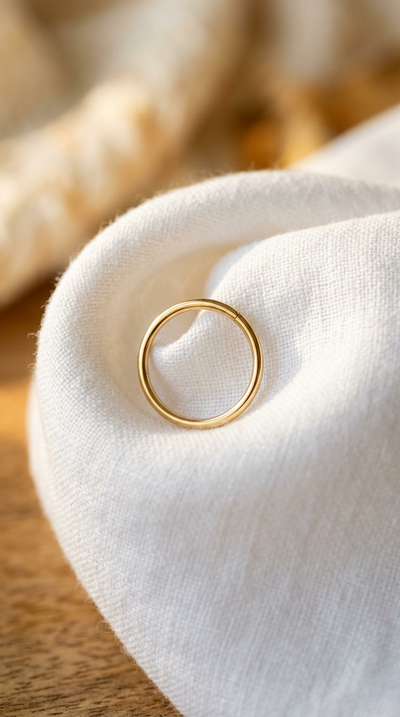
14K Gold Daith Ring
14K solid gold, nickel-free alloy. Eliminates material bumps. 16G & 18G, 8-10mm.
Shop bump-free rings ->Recovery timeline
Day 1–5
No visible change
The bump feels the same. Daith cartilage is thick and deep — the slowest-responding location on the ear. Internal healing has begun but is not detectable yet. Do not panic or add products.
Day 5–14
First signs
The bump may feel slightly softer when pressed gently. Tenderness begins to decrease. Because the daith is hard to see, you may need to photograph it to compare. Changes are subtle at this stage.
Week 2–4
Gradual reduction
The bump is noticeably smaller when you can see or feel it. Daily fluctuation is normal. The overall trend should be clearly downward. Continue all treatment measures without exception.
Week 4–6
Mostly resolved
Most daith bumps are flat or nearly flat. A slight textural change may persist for another few weeks inside the fold. Because the daith is hidden, this residual texture is invisible to anyone other than you.
Week 6–10
Stubborn bumps
If the bump persists, revisit causes. The daith’s hidden position makes it easy to miss ongoing triggers — a phone pressing against the ear, unconscious touching, earbuds used “just for a minute.” See your piercer for an in-person assessment with direct visibility into the fold.
Why material is critical for daith
The daith’s deep, sheltered fold creates a warm, moist micro-environment that accelerates metal corrosion. Cheap metal that might survive months on an exposed helix can begin degrading within weeks inside the daith fold. The moisture traps corrosion products (nickel ions, brass oxides) against the tissue rather than allowing them to disperse.
This is why material-related daith bumps are often the most persistent. The nickel source is not just causing inflammation — it is being amplified by the enclosed environment. Switching material produces the most dramatic improvement of any treatment step for daith piercings.
| Material | Nickel | Daith bump risk |
|---|
| 14K solid gold SAFEST | None (nickel-free alloy) | Near zero |
| Implant-grade titanium | None (ASTM F-136) | Near zero |
| “Surgical steel” | 10–14% | Very high — moist fold accelerates corrosion |
| Gold-plated | In base metal | Very high — plating degrades fastest in sheltered folds |
| Sterling silver | Trace + oxidises | High — tarnishes inside the fold, stains tissue |
For the full material comparison, see our gold-plated vs solid gold guide.
How to clean a daith properly
The daith’s hidden position makes cleaning different from other piercings. You cannot easily see or reach both sides of the piercing. Here is the correct technique:
Saline spray method: tilt your head so the pierced ear faces the ceiling. Hold the saline spray nozzle 2–3cm from the ear and spray into the fold, aiming at the piercing from above. The saline will pool in the fold around the jewellery. Let it sit for 10–15 seconds, then tilt your head to let it drain out. Do this morning and night.
Shower method: at the end of your shower, let warm water run directly into the pierced ear for 30–60 seconds. This rinses away loosened crusts, product residue and saline deposits. Gently pat the outer ear dry with a clean paper towel. Do not push anything into the fold to dry it.
What NOT to do: do not insert cotton buds into the fold. The fibres catch on the jewellery, leave residue inside the piercing channel, and the pushing motion moves the ring. Do not soak cotton pads in saline and press them into the fold. Do not use a cloth to wipe inside the fold. The only things that should enter the daith fold are saline spray and shower water.
What not to do
No tea tree oil. Chemical irritant. The daith’s enclosed fold traps the oil against the tissue, intensifying the chemical burn. Worse here than on any other piercing.
No cotton buds inside the fold. Fibres snag on the ring and get trapped in the wound channel. A leading cause of “I clean so carefully but the bump won’t go away.”
No popping or squeezing. The daith fold is tight — squeezing it compresses the entire fold around the ring, traumatising tissue on both sides of the piercing simultaneously.
No removing the jewellery. The daith’s thick cartilage can begin to close within hours. Reinserting a daith ring through a narrowing channel in a tight fold is significantly harder than reinserting a helix or tragus ring. Keep the jewellery in.
No earbuds until fully resolved. Not even “just for one song.” A single earbud insertion can restart a daith bump that was beginning to shrink.
How to prevent daith bumps
Hands off. The daith is the piercing where touching causes the most damage because the curved jewellery amplifies every movement across multiple contact points. Develop the habit of never reaching into the fold.
No earbuds for 6–12 months. Use over-ear headphones (which sit around the ear, not inside it) or bone conduction headphones. The daith and earbuds are fundamentally incompatible during healing.
Safe material from day one. Implant-grade titanium or 14K solid gold. The daith’s moist fold punishes cheap metal more severely than any other ear position.
Sleep management. Travel pillow, donut pillow, or opposite side. Every night, throughout the entire 6–12 month healing period.
Rinse hair products away. After shampoo and conditioner, tilt the pierced ear under running water for 10 seconds. The deep fold traps product residue that other piercings naturally shed.
Let your piercer check periodically. Because the daith is hard to self-assess, visit your piercer for a check at 6 weeks, 3 months and 6 months. They can spot issues forming before you feel them.
Infection signs — see a doctor
Thick green or white pus, spreading redness across the inner ear, throbbing pain that escalates, warmth, significant swelling, a bad smell from the fold, or fever. The daith’s enclosed position means infections can develop in a less visible location — if you suspect infection, do not wait to see if it improves. See your GP or a walk-in clinic. Do not remove the jewellery.
Frequently asked questions
Why does my daith bump take so long to heal?
Two reasons. First, the daith cartilage is thick and has limited blood supply, which means slower nutrient delivery to healing tissue. Second, the deep fold creates a sheltered, moist environment that slows tissue drying and maturation. Expect daith bumps to take 3–6 weeks to resolve — roughly 50% longer than helix or tragus bumps. This is normal for the location, not a sign of a serious problem.
Can I wear AirPods with a daith bump?
No. Earbuds press directly on daith jewellery and are almost certainly contributing to the bump. Switch to over-ear headphones or bone conduction headphones immediately. Do not reintroduce earbuds until the bump has been completely flat for at least 2 weeks and the piercing is fully healed. Even after healing, earbud compatibility with a daith piercing depends on your ear anatomy and jewellery size.
I cannot see my daith bump — how do I monitor it?
Use your phone camera. Hold the phone at an angle to photograph inside the ear fold, with the flash on. Take the same angle photo every 3–4 days to compare progression. Alternatively, ask a partner or friend to look at the piercing under good lighting. If you cannot assess the bump visually, visit your piercer — they have the tools and experience to examine the daith directly.
Should I use a cotton bud to clean around the bump?
No. Cotton bud fibres catch on the ring and deposit inside the piercing channel, causing irritation and potentially trapping bacteria. The daith fold is too tight for contact cleaning tools. Use sterile saline spray (no contact needed) and shower water only. Let the saline do the work — do not scrub, wipe or poke.
Is my daith bump a keloid?
Almost certainly not. Keloids are genetic, run in families, and grow beyond the wound boundaries. A daith irritation bump appeared after a trigger event, sits at the piercing hole, and responds to cause removal. Because the daith is hard to see, bumps can seem larger or more alarming than they are. Have your piercer assess in person if you are concerned. A dermatologist can give a definitive diagnosis if needed.
Will tea tree oil fix my daith bump?
No — and it will likely make it worse. The daith’s enclosed fold traps tea tree oil against the tissue, concentrating the chemical irritation. On exposed piercings like the helix, tea tree oil is bad. On the daith, it is significantly worse because there is nowhere for the oil to evaporate or disperse. Use sterile saline only.
My daith bump keeps coming back — what do I do?
A recurring bump means the cause has not been fully eliminated. For daith piercings, the most common hidden triggers are: unconscious touching (reaching toward the ear to adjust hair, glasses or earbuds), using earbuds “just briefly,” sleeping position shifting during the night, and product buildup in the fold. Track your habits carefully for a week. If you truly cannot find the cause, visit your piercer for an in-person assessment — they may identify a jewellery fit issue or a hidden irritation source.
←
Daith Piercing Pain: What to Expect
Pain rating, timeline, and comparison to other piercings
S
Stepoy
Piercing Jewellery Specialists
We craft handmade 14K solid gold piercing jewellery and publish in-depth guides to help you make informed decisions about your piercings.