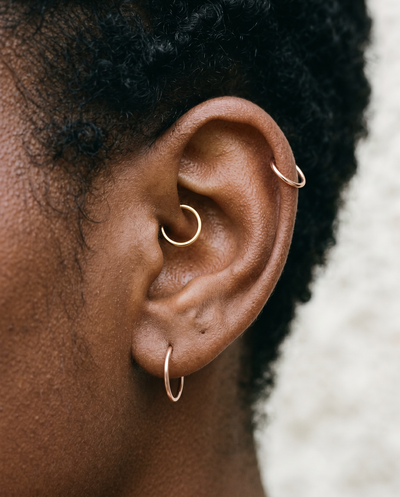
New 14ct Solid Gold Piercing Hoop
18G vs 20G Rook Ring: Gauge Comparison
- Almost every rook is pierced at 16G (1.2mm) — this is the standard and should remain your gauge during healing
- 18G (1.0mm) is the thinnest gauge most piercers consider safe for a healed rook in quality metal
- 20G (0.8mm) is rarely recommended for rook — the wire is too thin for thick cartilage and carries a real migration risk
- Going from 16G to 18G is a one-way trip — the channel contracts around the thinner gauge and going back to 16G later can be painful or impossible
- The visual difference between 16G and 18G is subtle. The structural difference is significant.
- If you want a daintier look at 16G, choose a seamless ring with a fine polish rather than dropping the gauge
What gauge actually means
Gauge is the thickness of the wire or post that passes through the piercing channel. It is measured in the American Wire Gauge system, where higher numbers mean thinner wire. This is counterintuitive, and it trips people up constantly. 16G is thicker than 18G, which is thicker than 20G.
| Gauge | Millimetres | Context |
|---|---|---|
| 14G | 1.6mm | Navel piercings, some industrial bars. Rarely used on rook. |
| 16G ROOK STANDARD | 1.2mm | Standard for rook, tragus, daith, conch. Almost every rook in the UK is pierced at 16G. |
| 18G | 1.0mm | Standard for helix and nostril. Used on healed rooks for a finer look. |
| 20G | 0.8mm | Fine-jewellery gauge. Common for nostril, sometimes helix. Risky for rook. |
| 22G | 0.6mm | Almost thread-thin. Nose studs only. Never appropriate for rook. |
The difference between 16G and 18G is 0.2mm. That sounds invisible, but in the context of a wire passing through thick cartilage, it matters. A thinner wire concentrates the same gravitational force over a smaller surface area, which increases pressure on the channel walls. In engineering this is called the "cheese wire effect" — and it is exactly what can happen inside a cartilage piercing if the gauge is too thin for the tissue.
16G vs 18G vs 20G — side by side
| 16G (1.2mm) | 18G (1.0mm) | 20G (0.8mm) | |
|---|---|---|---|
| Wire thickness | Standard — visible but clean | Noticeably finer, thread-like | Very fine, almost invisible wire |
| Structural strength | Strong. Holds shape in thick cartilage. | Adequate in 14K gold or titanium | Weak. Deforms under cartilage pressure. |
| Migration risk | Low | Low to moderate on healed rook | Moderate to high — wire can cut through |
| Look on the rook | Clean, deliberate ring or barbell | Delicate, fine-jewellery feel | Almost invisible wire — very dainty |
| Piercer opinion | Universal standard | Accepted on fully healed rooks | Most piercers advise against for rook |
| Best as | Curved barbell or any ring style | Seamless ring or clicker | Not recommended for rook |
| Our recommendation | DEFAULT | Acceptable if healed 12+ months | Avoid for rook |
16G — the rook standard
16G is the gauge almost every UK piercer uses for rook piercings, and for good reason. The rook passes through the thickest cartilage fold in the ear — dense, slow-healing tissue that needs structural support from the jewellery. A 16G post is 1.2mm thick, wide enough to distribute the weight of the ring or barbell evenly across the channel walls without concentrating pressure at any point.
At 16G, curved barbells hold their shape under the compression of the rook fold. Seamless rings maintain a clean circle without warping. Clickers snap shut with a solid click. The gauge is strong enough to sit permanently in thick cartilage without migrating, even under daily headphone use and occasional sleeping pressure.
If you never intend to go thinner, 16G is the gauge to stay at for life. It is safe, stable, and available in every rook jewellery style. The wire is not thick enough to look bulky on the inner ear — at 1.2mm, it reads as a clean line, not a heavy ring.
18G — the fine-jewellery option
18G (1.0mm) is one step thinner than the rook standard. It is the default gauge for helix piercings and nostril piercings, and many jewellery brands sell their most popular seamless gold hoops in 18G. For a fully healed rook, 18G creates a noticeably more delicate ring — the wire is thinner, the hoop looks lighter, and the overall effect is closer to fine jewellery than body piercing.
When 18G works on a rook
18G is a reasonable choice if all of the following are true:
• The rook has been fully healed for at least 12 months (not 12 months total — 12 months of zero symptoms).
• The jewellery is 14K solid gold or implant-grade titanium. These metals are strong enough at 18G to maintain shape. Gold-plated, surgical steel or silver are too soft or too brittle at this gauge.
• You are switching to a seamless ring or clicker, not a curved barbell. A barbell at 18G has small balls that concentrate force, which increases migration risk. Rings distribute weight more evenly.
• You understand that the channel will contract to 18G and going back to 16G later may not be easy.
The visual difference
In photographs, the difference between 16G and 18G on a rook is subtle. In person, at close distance, the 18G ring looks finer and sits slightly flatter against the fold. At arm’s length, most people cannot tell. The difference is most visible in 14K gold, where the thinner wire catches light differently and creates a more delicate, thread-like appearance.
20G — why we do not recommend it for rook
20G (0.8mm) is a beautiful gauge on nostrils and healed helixes, where the tissue is thin and the ring has minimal load. On a rook, the tissue is thick, the ring hangs vertically with gravity pulling on it, and the channel is deep enough that even minor migration has consequences.
At 0.8mm, the wire is thin enough that the weight of the ring itself — even a tiny 5mm seamless hoop — concentrates force on a very small surface area inside the channel. Over months, this can cause the ring to slowly cut into the cartilage, a process called migration. The piercing gradually moves towards the surface of the skin, and the channel thins until the ring sits visibly closer to the surface than it should.
Migration at 20G on a rook typically takes 6–18 months to become noticeable. By the time you see it, the channel is permanently thinned and the only fix is removing the jewellery, letting the piercing close, and re-piercing at 16G — which means another 9–12 months of healing.
The exception
A very small number of people with shallow rook folds and light, tiny hoops (5mm seamless in high-quality 14K gold) can wear 20G on a rook long-term without migration. But this is the exception, not the rule, and there is no way to predict it in advance. If a piercer with extensive rook experience assesses your anatomy and says 20G is safe for you specifically, that professional opinion overrides general guidance. But you should hear it from a piercer who has seen your rook, not from a product listing.
What happens to your channel when you go thinner
This is the part most people do not consider before switching gauges. A piercing channel is living tissue that conforms to whatever is inside it. When you move from 16G to 18G, the channel contracts around the thinner wire over 4–8 weeks. After that contraction, re-inserting a 16G piece means stretching the channel back open — which can be painful, may cause a bump, and sometimes is simply not possible without a taper.
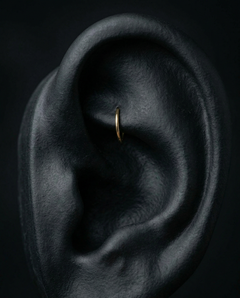
Why rook gauge rules are stricter than helix
If you already wear an 18G or 20G hoop on your helix and it works perfectly, you might assume the same gauge works on a rook. It does not, and here is why the rook is different:
Tissue thickness. A helix piercing passes through 1–2mm of thin cartilage rim. A rook passes through a 4–6mm cartilage fold. Thicker tissue means more surface area for the wire to exert pressure on, but also more weight and more movement resistance.
Gravity and orientation. A helix ring hangs on the outer rim and gravity pulls it outward, which is mostly supported by the rim itself. A rook ring hangs vertically from a fold inside the ear, and gravity pulls the ring straight downward through the channel. The downward pull on a rook is directly in the migration direction.
Movement. The helix rim barely moves. The rook fold shifts subtly every time you open your jaw, yawn, chew or talk. Each movement cycles the wire back and forth through the channel, and thinner wire does more damage per cycle.
This is why 20G works fine on a helix for years but can migrate on a rook within months. The anatomy is fundamentally different, and gauge rules do not translate across piercings.
How to check your current gauge
Before ordering a new ring, confirm what gauge your rook was pierced at. The simplest methods:
Ask your piercer. If you were pierced at a reputable studio, they will have a record. Most UK piercers use 16G for rook by default and will confirm quickly.
Measure the post. Remove your curved barbell and hold it next to a millimetre ruler, measuring the thickness of the post (not the ball). 1.2mm = 16G, 1.0mm = 18G, 0.8mm = 20G. The difference between 16G and 18G is visible to the naked eye on a ruler.
Use a gauge card. Many piercing supply shops sell thin plastic cards with holes at each gauge size. Slide the post through each hole — the one that fits snugly without force is your gauge.
Gauge and material interact
Not all metals are equally strong at the same gauge. Dropping to 18G magnifies the importance of material quality, because thinner wire has less structural margin for error.
| Material | At 16G | At 18G | At 20G |
|---|---|---|---|
| 14K solid gold | Excellent — strong and biocompatible | Good — holds shape, safe for rook | Marginal — soft, risk of deforming |
| Implant-grade titanium | Excellent — strongest option | Good — very strong even at 18G | Adequate structurally, but migration risk remains |
| Surgical steel | Acceptable structure, nickel concern | Adequate structure, higher nickel risk at thinner gauge | Not recommended — too rigid, no give |
| Gold-plated / filled | Not recommended — plating wears | Avoid — base metal exposed faster at thinner gauge | Avoid |
| Sterling silver | Not recommended — tarnishes in channel | Avoid | Avoid |
If you are going to 18G on a rook, 14K solid gold and implant-grade titanium are the only materials we recommend. At this gauge, you need metal that is simultaneously strong enough to hold its shape, biocompatible enough not to irritate, and smooth enough not to create friction in the narrower channel.
The decision framework
Here is the practical question: should you go from 16G to 18G on your rook? Use this framework:
If all four answers pass, 18G is a safe choice for your rook. If any answer fails, stay at 16G. The dainty look you are after can usually be achieved with a finely polished 16G seamless ring in 14K gold — which carries zero structural risk.