


True rook
If anatomy allows
The original. A true rook can wear a fitted hoop once fully healed, giving you a small ring that hugs the rook ridge. Requires a pronounced rook anatomy.
Read the full rook guideIf you love the look of a rook but your anatomy says otherwise, a faux rook is often suggested instead — though usually as a stud, not a hoop. Here's the honest UK guide.
A faux rook is usually described as a cartilage piercing placed near the rook area, often through the flatter cartilage above or beside the rook ridge. It's designed to create a rook-like look from the front, usually with a flat-back stud, and tends to be treated as a stud placement rather than a hoop placement.
A faux rook is usually described as a cartilage piercing placed near the rook area, often through the flatter cartilage above or beside the rook ridge. It's designed to look like a rook from the front, and is typically worn with a small flat-back stud.
The faux rook has grown in popularity as a more anatomy-flexible alternative to a true rook. Piercers often suggest it when a client loves the rook aesthetic but doesn't have the ridge anatomy to support a traditional rook. Exactly where the piercing sits can vary slightly between piercers — some place it higher on the flat above the ridge, some closer beside it — but the visual intention is consistent: the visible end sits roughly where the top of a rook would appear.
In day-to-day terms, a faux rook behaves much more like a flat piercing in a specific location than a true rook. That has real implications for jewellery, healing and what you can wear later on.
If you press your finger gently into the inner ridge above your ear canal, you'll feel a small ledge of cartilage curving upward — that's the rook. The flatter cartilage around and just above that ledge is where a faux rook is typically placed. Your piercer will mark the exact entry and exit points based on your anatomy and any nearby piercings.
Some jewellery brands use the phrase "faux rook" to describe clip-on or cuff earrings that mimic a rook look without any piercing. This guide is about the actual cartilage piercing, not those styling-only pieces.
The two piercings sit close together on the ear, but they behave very differently. The true rook is a more anatomy-dependent piercing through a fold of cartilage. The faux rook is a more flexible piercing through the flatter cartilage near that fold.
| True rook | Faux rook | |
|---|---|---|
| Placement | Vertical, through the rook ridge | Horizontal, through flatter cartilage near the ridge |
| Anatomy needed | A pronounced rook ridge | More anatomy-flexible, still needs assessment |
| Starter jewellery | Curved barbell | Flat-back labret stud |
| Hoop potential | Possible once healed | Not normally |
| Healing window | 6–12 months (sometimes longer) | 6–12 months or longer |
| Pain (subjective) | Higher — thick cartilage | Often easier than a true rook |
| Best suited for | Someone with the anatomy who wants a ring later | Someone who wants the look with a stud |
In most cases, no. Because a faux rook does not pass through the rook ridge, it is generally not considered a natural ring placement — reputable piercers tend to treat it as a stud piercing rather than a hoop one.
The reason is anatomical. A true rook passes through a defined fold of cartilage, so a small hoop can curl around that ridge and sit comfortably. A faux rook passes through the flat near that ridge, so a hoop would have to wrap around the upper ear cartilage to close — which is rarely practical, often uncomfortable, and can put pressure on the healing channel.
For that reason, STEPOY does not recommend trying to retrofit a seamless hoop into a faux rook, even once fully healed. If a gold hoop is the look you want, there are better options — covered further down this page.
Jewellery suitability always depends on your individual anatomy, your healing status and your piercer's professional judgement. This guide is educational, not medical advice — always speak to a qualified piercer before changing or sizing jewellery.
For a fresh faux rook, your piercer will almost always fit an internally-threaded flat-back labret in implant-grade titanium or a comparable body-safe alloy, typically at 16G with a length chosen to accommodate swelling. This is not the time to change into decorative jewellery yourself. If gold is used for an initial or early-stage piercing, it should be professionally fitted and made from a suitable body-safe material (such as solid 14K nickel-free gold), not a plated or hollow piece.
After your piercer confirms the channel is healed (usually six to twelve months in, sometimes longer), you can experiment with decorative flat-back stud tops — small clusters, single stones, or simple flat ends. Some people add a chain that links the faux rook to a nearby helix or flat piercing for a curated look.
If you've been collecting inspiration, the table below shows where studs vs hoops are typically appropriate. It's a useful planner before you visit a piercer.
| Piercing | Starter | Long-term | Hoop suitability |
|---|---|---|---|
| Faux rook | Flat-back labret | Flat-back stud, chains | Not normally |
| True rook | Curved barbell | Curved barbell or hoop | Possible once healed |
| Helix | Labret or barbell | Stud or hoop | Yes, once healed |
| Conch | Labret | Stud or large hoop | Yes, once healed |
| Daith | Curved barbell or small ring | Hoop is standard | Yes |
| Lobe | Stud | Stud or hoop | Yes |
Pain is highly subjective and varies a lot with anatomy and technique, but many people who've had both find the faux rook noticeably easier than a true rook because the needle passes through thinner cartilage. Most describe it as a sharp pressure that's over quickly — broadly comparable to a helix or daith.
Like other inner-ear cartilage piercings, a faux rook needs patience. Cartilage has limited blood flow, so the channel rebuilds slowly even when the outside looks calm. Many faux rook piercings take around 6–12 months — or sometimes longer — to fully settle.
Swelling, warmth and clear lymph discharge are normal. Stick strictly to saline rinses and resist any temptation to touch.
Swelling subsides; small crusts form around the stud. Avoid sleeping on the side and skip over-ear headphones.
The exterior often looks healed, but the internal channel is still fragile. Don't change jewellery yet — leave that to your piercer.
This is the window in which many piercings finish settling, though some take longer. Once your piercer confirms healing, you can start considering refined jewellery — including healed-piercing 14K gold pieces.
The most common irritants in the first few months are side-sleeping, over-ear headphones, mask straps and glasses arms catching the stud. A travel pillow with a hole, switching to earbuds and being patient with your hair routine all help.
Only once your piercer confirms the piercing is fully healed. Early changes are a leading cause of irritation, migration and angry-looking bumps. Save heavier or more decorative jewellery — including solid gold — for the end stage.
Faux rook piercings are widely available in the UK. Look for studios that follow APP-aligned standards, use implant-grade jewellery (titanium or comparable body-safe alloy), and take time to assess your individual anatomy. Healing expectations in the UK match international guidance — typically the 6–12 month window described above. As a rough cost guide, expect somewhere in the region of £30–£60 at a reputable studio including basic jewellery, with quality solid gold options adding to that.
This is the part many readers actually came for. If you've been pinning images of slim 14K gold hoops near the rook area, here's the honest version: a faux rook is a stud piercing, but several nearby placements are wonderful with hoops once healed.
The right choice depends on your anatomy and what your piercer thinks will suit you — but these are the four placements to discuss.
The original. A true rook can wear a fitted hoop once fully healed, giving you a small ring that hugs the rook ridge. Requires a pronounced rook anatomy.
Read the full rook guideThe outer-rim hoop most people picture when they think "cartilage hoop". Suits most anatomies and looks beautiful in a stack of slim gold rings.
Explore helix hoopsA larger hoop that hugs the inner ear bowl — striking but minimal. Wonderful as a single piece once fully healed.
Explore conch hoopsA hoop that sits in the inner curve of the ear. A natural home for a small, precisely-sized gold ring.
Explore daith hoops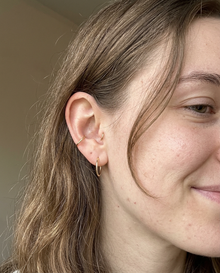
If you're trying to pick between these placements, three questions tend to do most of the work.
If it's "a small stud where the top of a rook would be", a faux rook is the natural answer. If it's "a slim gold ring", you should be looking at a true rook (if anatomy allows), or a helix, conch or daith.
A reputable piercer will assess your ear before recommending a placement. Many ears don't suit a true rook, and most people only find this out at the studio. A good piercer will redirect you to a faux rook, conch or alternative without trying to force the original idea.
Initial jewellery is about healing, not styling. The fitted titanium piece in the studio isn't your final look — it's the piece that gets you to the point where you can wear refined 14K gold.
STEPOY's 14K solid gold seamless hoops are designed for healed helix, conch, daith and rook piercings — not for faux rook placements and not for fresh piercings. Always confirm sizing and placement with your piercer before switching from your studio jewellery.
A faux rook is usually described as a cartilage piercing placed near the rook area, often through the flatter cartilage above or beside the rook ridge. It's designed to create a rook-like look from the front using a flat-back stud, and typically takes around 6–12 months or longer to fully settle.
No. A true rook passes vertically through the rook ridge and is highly anatomy-dependent, typically fitted with a curved barbell. A faux rook passes through the flatter cartilage near the rook area, is more anatomy-flexible, and is fitted with a flat-back stud.
Generally no. Because a faux rook does not pass through the rook ridge, it is not considered a natural ring placement, and reputable piercers treat it as a stud piercing. If a hoop is what you want, consider a true rook, helix, conch or daith piercing instead.
A flat-back labret stud, fitted by a professional piercer in implant-grade titanium or comparable body-safe material at the appropriate gauge and length. Once fully healed, decorative flat-back tops in quality solid gold are an option, but hoops are not.
Most piercers quote around six to twelve months, in line with other inner-ear cartilage piercings, though some take longer to fully settle. The outside often looks calm long before the internal channel is fully healed, so any jewellery changes should wait for your piercer's go-ahead.
Pain is highly subjective, but many people find a faux rook noticeably easier than a true rook because the needle passes through thinner cartilage. It's often described as mild-to-moderate — broadly comparable to a helix or daith — but the experience varies with your anatomy and your piercer's technique.
Yes. Most reputable UK piercing studios offer the faux rook. Look for piercers who follow APP-aligned standards, use implant-grade jewellery, and take time to assess your anatomy. Healing expectations in the UK match international guidance: usually six to twelve months or longer.
If your anatomy suits a true rook, that can wear a small hoop once fully healed. Otherwise, hoop-friendly cartilage placements include the helix, conch and daith. Discuss the options with a professional piercer and plan your final jewellery for once the piercing is healed.
Editorial note · This guide is intended as educational reading for people planning their piercings. STEPOY designs jewellery for healed piercings and does not provide medical advice. Always consult a qualified piercer for placement, sizing and aftercare decisions.