


Face-wide jewellery styling
How to Match a Nose Hoop with an Ear Stack
The nose hoop and ear stack do not need to be identical. They need a clear relationship when the whole face is viewed together.

Step one
Decide where the focal point lives
Trying to make every hoop equally noticeable is what usually makes a combination feel busy. Give the face one visual lead and let the other area support it.
Nose leads
Choose a distinctive nose hoop, then use a restrained ear stack: plain lines, fewer hoops or one quiet metal colour.
Ear leads
Keep the nostril hoop plain and close-fitting while one ear motif, layered lobe or cartilage placement carries the character.
Balanced pair
Use similar visual weight on both sides without duplicating every detail. A shared gold colour or curved line is usually enough.
Three useful relationships
Match, echo or contrast
These are different styling strategies. Pick one deliberately instead of accumulating pieces and hoping they agree.
Repeat the clearest feature
Use the same gold colour, similar hoop thickness or the same motif family. Best when you want a polished, coordinated result.
Repeat only one clue
A plain nose hoop can echo the curve of ear hoops while the ear stack adds the motif. This is the most flexible everyday method.
Make the difference intentional
Pair a minimal nose line with a playful ear motif, or mix metal colours while repeating one tone across the face.
What can repeat
Use one or two links—not four
Coordination comes from selective repetition. Repeating every feature can look more like a set than a personal stack.
Gold colour
Yellow, white or rose gold is the quickest visual link across the face.
Hoop line
Similar roundness or wire delicacy can connect unlike designs.
Visual weight
Balance how much space and contrast each area occupies—not just item count.
Motif mood
Celestial, romantic, graphic or playful pieces can relate without matching exactly.
Four repeatable formulas
Choose the structure before the products
Each formula controls where the detail sits, so individual designs can change without rebuilding the whole look.
Choose a clean, close line with no competing charm.
Vary diameter or placement instead of adding a motif. Quiet and architectural.
Acts as the visual full stop and works with most ear changes.
Place the motif among plain hoops where its outline has room to read.
Let the small design become the face-level focal point.
Repeat the metal and curved line, but keep the ear quieter.
Choose a compact design whose outline reads clearly.
Use a related mood rather than an identical symbol, separating motifs with plain hoops.
The safest starting point: formula B—a plain nose hoop with one ear motif—keeps the nostril versatile while giving the ear stack a clear story.
Placement across the face
Same-side concentration or cross-face balance?
Concentrate detail on one side
If the visible ear stack sits on the same side as the nostril hoop, keep one of the two quieter. This creates an intentional jewellery side and a cleaner opposite side.
Useful for: side parts, asymmetrical hair and one strongly photographed profile.
Spread detail across opposite sides
If the nose hoop and most decorated ear sit on opposite sides, they can visually counterweight one another. Check the result from the front, not only in a side mirror.
Useful for: hair worn back, front-facing portraits and asymmetrical piercing layouts.

A better mirror check
Use the three-photo test
Your usual mirror angle hides how the jewellery reads to other people. Take three ordinary photographs in the same light and at the same distance.
Front
Does the face have one focal point? Check whether both sides carry similar visual weight.
Turned
Can the nose hoop and ear stack be seen together without either area looking crowded?
Profile
Does each hoop sit well in its own piercing? Look for excess gap, pressure or an awkward motif direction.
Fit before coordination
Do not copy the nose size into the ear
Matching jewellery does not mean matching dimensions. Nostril and ear anatomy require separate gauge and inner-diameter decisions.
| Decision | Nose hoop | Ear stack | What to do |
|---|---|---|---|
| Gauge | Must suit the healed nostril channel. | Can vary between lobe and cartilage piercings. | Confirm each piercing separately; do not assume one wire thickness fits all. |
| Inner diameter | Controls nostril clearance and how closely the hoop follows the nose. | Controls drop, spacing and room around the ear edge. | Use anatomy and placement first, then coordinate the visible line. |
| Motif direction | May rotate with the nostril channel and viewing angle. | May face differently in lobe, helix or tragus placements. | Treat a perfectly front-facing motif as possible, not guaranteed. |
| Changing jewellery | Only change when healed and appropriate for the piercing. | Healing times and suitability differ by placement. | Ask a professional piercer if there is pain, swelling or uncertainty. |
The rest of the frame
Account for glasses, hair and other facial jewellery
Glasses
Bold frames already add a strong line near the nose and ear. Use fewer motifs or repeat the frame’s metal tone rather than its exact shape.
Hair
A tucked or shaved side exposes the ear stack; a loose side may hide it. Style for the version of your hair you wear most often.
Other piercings
Septum jewellery, studs and facial chains add visual weight. Count them as part of the composition before adding another motif hoop.
Five real-life starting points
Build for how you actually dress
What usually goes wrong
Four common styling mistakes
Remove one motif or replace it with a plain hoop.
Coordinate visible weight while fitting each anatomy independently.
Use the three-photo test before deciding the balance works.
A tiny design follows the piercing channel and may not face forward at every angle.
Build the relationship
Five useful starting pieces
Begin with a plain anchor, then decide whether the personality belongs at the nose or in the ear stack. Cards automatically load the selected product’s image, current title, price and URL.
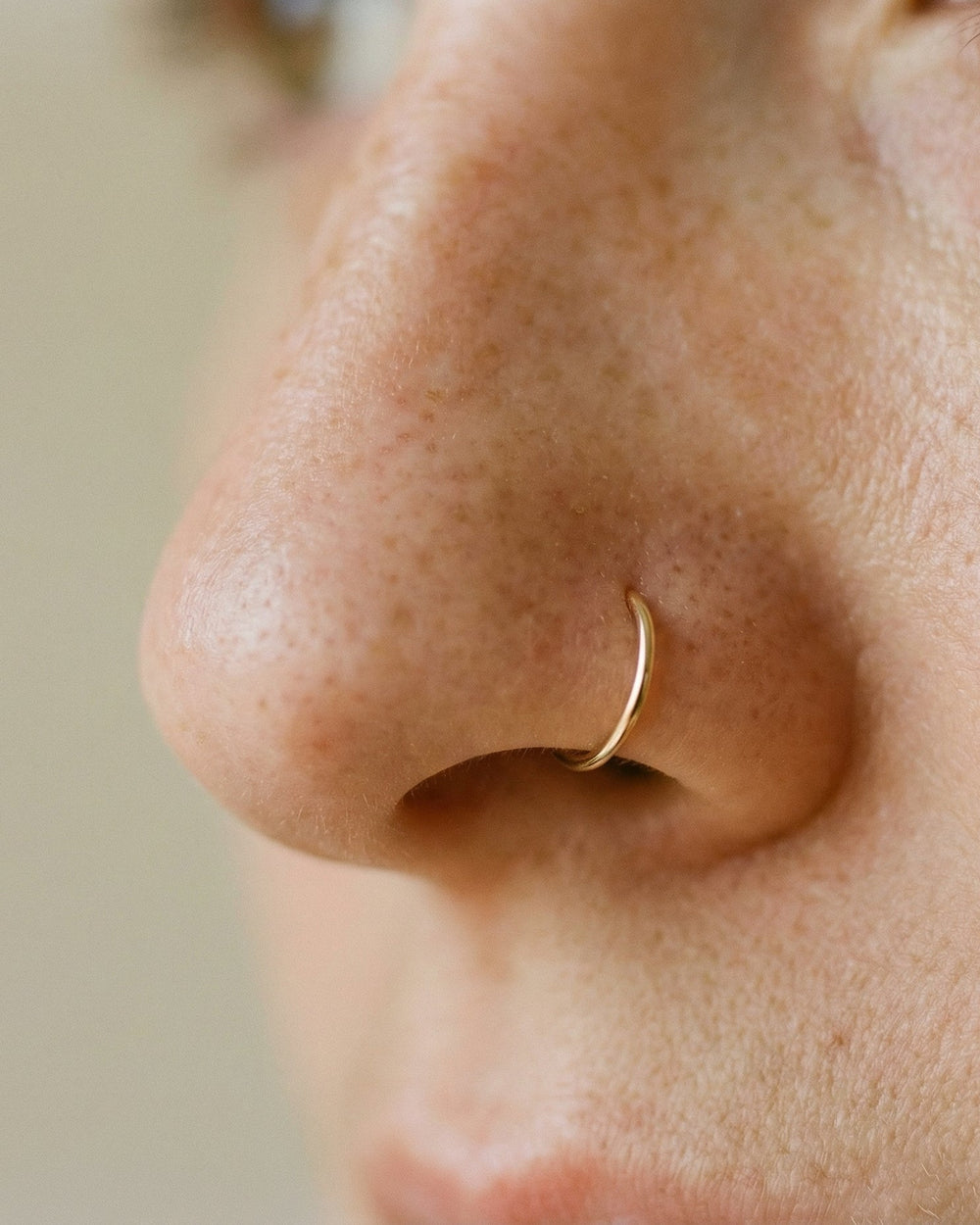
Plain nose anchor · Formulas A and B
Nostril Ring
£38.00
A clean starting line when the ear stack carries the motif or most of the visual detail.
View the Plain Nose Ring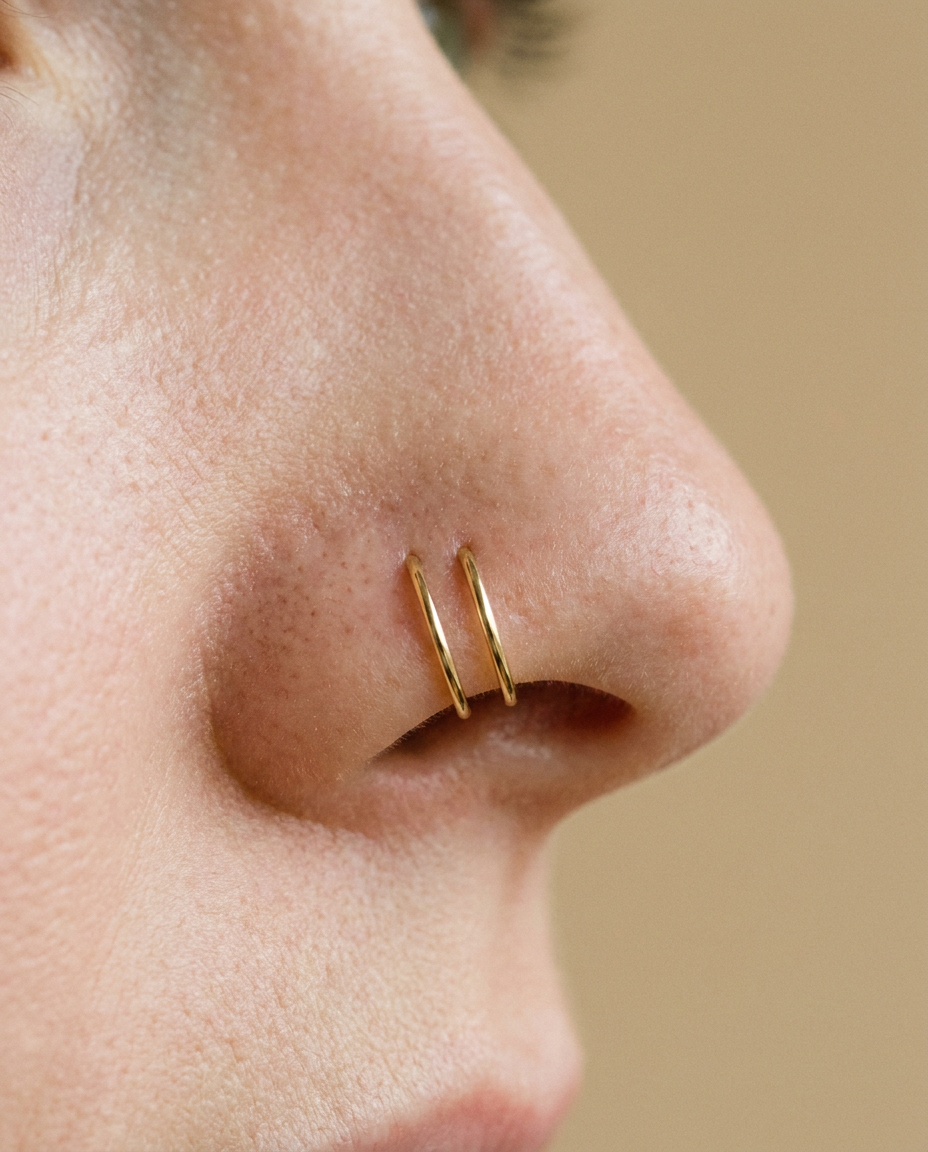
Stronger nose line · Balanced pair
Double Nose Ring
£48.00
Adds more visual weight at the nostril without introducing a pictorial motif.
View the Double Nose Ring
Plain ear anchor · Formulas A and C
EarLobe Hoop
£65.00
A quiet foundation or separator that lets a nose motif or one ear motif remain the focal point.
View the Plain Earlobe HoopRomantic ear motif · Formulas B and D
Heart Hoop
A compact, familiar symbol for adding a softer focal point to an otherwise plain stack.
View the Heart HoopCelestial ear motif · Formulas B and D
Star Hoop
A crisp graphic accent that works best when the surrounding nose and ear lines stay quieter.
View the Star HoopBefore you choose
The face-wide styling checklist
- I know whether the nose, ear or overall balance is the focal point.
- I am using match, echo or contrast deliberately.
- Only one or two features repeat across the face.
- Each piercing has been sized for its own anatomy.
- I checked the jewellery from front, 45 degrees and profile.
- I included glasses, hairstyle and other facial jewellery in the decision.
Questions, answered
Nose hoop and ear stack FAQ
Does my nose hoop need to match my earrings?
No. A shared gold colour, hoop line, visual weight or motif mood can create a relationship without making the pieces identical.
Can I wear a motif nose hoop with motif earrings?
Yes, but give the motifs different roles. Keep one dominant, separate ear motifs with plain hoops and avoid making every design equally prominent.
Should the decorated ear be on the same side as my nose hoop?
Either can work. The same side concentrates detail; the opposite side creates cross-face balance. Check both from the front and at 45 degrees.
Can I mix gold colours between my nose and ear jewellery?
Yes. Make the mixture repeat intentionally—for example, include the nose-hoop colour at least once in the ear stack—rather than leaving one isolated metal tone.
Should my nose hoop and ear hoop have the same diameter?
Not necessarily. Each diameter should fit its own piercing and anatomy. Coordinate visible delicacy or weight, not the number printed on the size.
How many motifs should be in one ear stack?
One is the easiest focal point. If you use more, choose related moods and place plain hoops between them so each outline has room to read.
How do glasses affect a nose hoop and ear stack?
Frames add another line near both areas. Strong frames often work best with finer hoops, fewer motifs or a repeated metal tone.
Can a tiny motif face sideways?
Yes. Its orientation follows the piercing channel and anatomy, so it may sit front-facing, angled or sideways. A particular direction cannot be guaranteed.
Coordinate the face—not every hoop
One clear relationship is enough
Choose the focal point, repeat one useful clue and size each healed piercing independently.